## Code Snippet: Theorem Definitions
### Overview
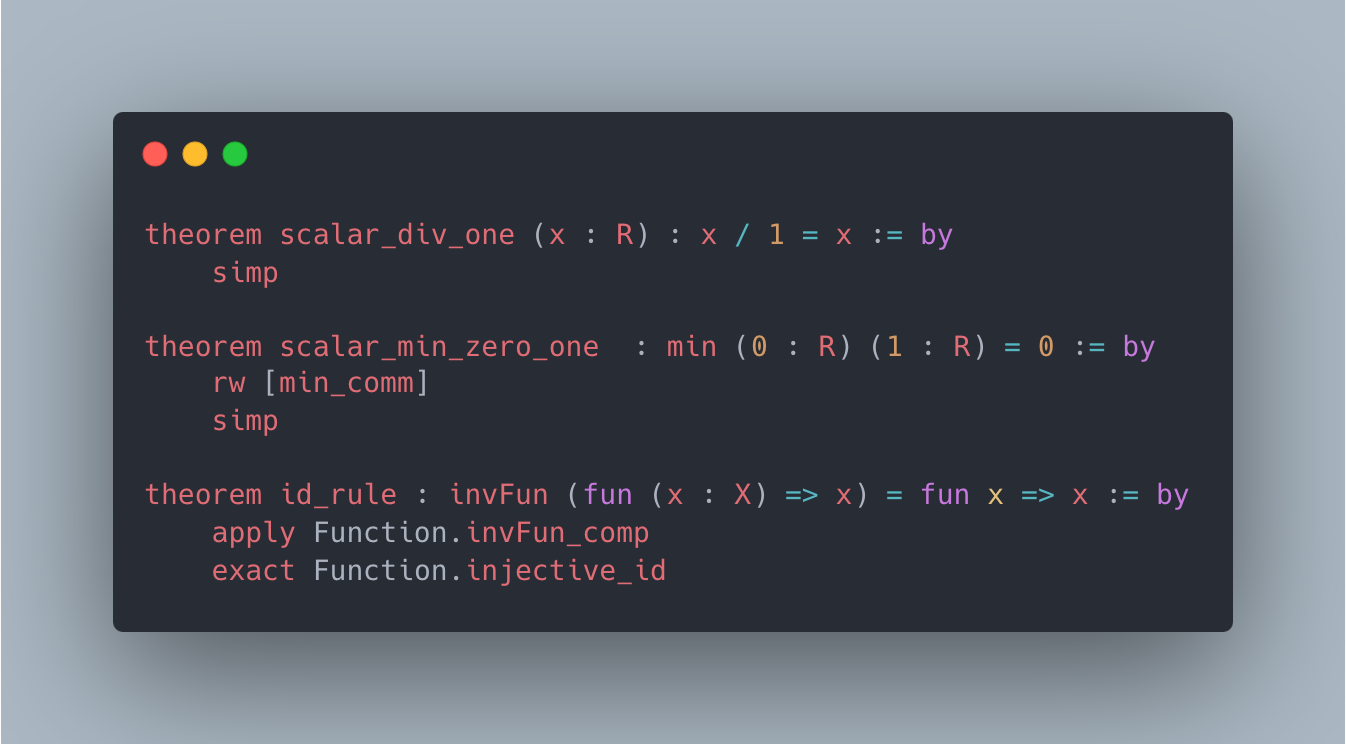
The image displays a code snippet, likely from a formal verification system or proof assistant, defining and proving mathematical theorems. The code defines three theorems: `scalar_div_one`, `scalar_min_zero_one`, and `id_rule`. Each theorem definition includes the theorem's statement and a proof strategy.
### Components/Axes
The image contains the following elements:
- **Window Decoration:** Red, yellow, and green circles in the top-left corner, resembling window controls.
- **Code Block:** A block of text containing theorem definitions and proof steps.
### Detailed Analysis or ### Content Details
The code block contains the following theorem definitions:
1. **`theorem scalar_div_one (x : R) : x / 1 = x := by`**
* This theorem states that for any real number `x` (denoted by `x : R`), dividing `x` by 1 results in `x`.
* The proof strategy is `simp`, which likely refers to simplification.
2. **`theorem scalar_min_zero_one : min (0 : R) (1 : R) = 0 := by`**
* This theorem states that the minimum of 0 and 1 (both real numbers) is 0.
* The proof strategy involves rewriting using `min_comm` (likely commutativity of the minimum function) and then simplifying.
* `rw [min_comm]`
* `simp`
3. **`theorem id_rule : invFun (fun (x : X) => x) = fun x => x := by`**
* This theorem defines the inverse function of the identity function. It states that the inverse function of a function that maps `x` to `x` is the function that maps `x` to `x`.
* The proof strategy involves applying `Function.invFun_comp` and then using `Function.injective_id`.
* `apply Function.invFun_comp`
* `exact Function.injective_id`
### Key Observations
- The code uses a formal syntax for defining theorems and proofs.
- The theorems cover basic mathematical properties related to division, minimum, and inverse functions.
- The proof strategies are concise, relying on simplification and pre-defined lemmas.
### Interpretation
The code snippet demonstrates the use of a formal system to define and prove mathematical theorems. The theorems themselves are fundamental properties, and their proofs illustrate the system's capabilities for automated reasoning and simplification. The use of tactics like `simp`, `rw`, `apply`, and `exact` suggests an interactive proof environment where the user guides the system towards a complete proof. The code is likely part of a larger formalization effort, aiming to create a machine-verifiable library of mathematical knowledge.