\n
## Composite Diagram: Input/Output Transformation Process
### Overview
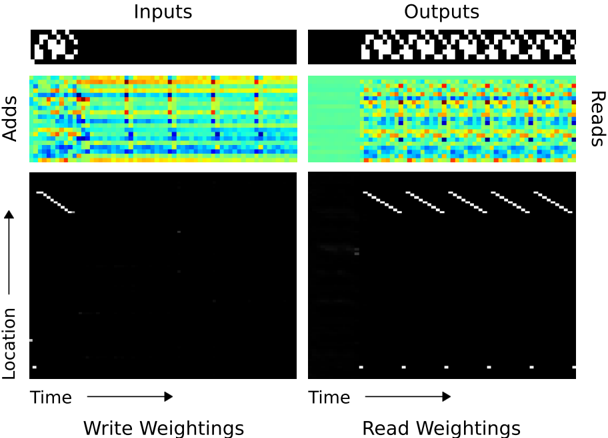
The image is a technical composite diagram divided into two primary columns labeled "Inputs" and "Outputs," each containing three vertically stacked visualizations. It appears to illustrate a data transformation or computational process, likely within a neural network or signal processing context, showing how an initial input pattern is expanded or processed into a more complex output pattern through intermediate stages represented by heatmaps and scatter plots.
### Components/Axes
**Global Structure:**
- Two main columns: Left column titled **"Inputs"**, Right column titled **"Outputs"**.
- Each column contains three rows of visualizations.
**Row 1 (Top): Binary Pattern Displays**
- **Inputs (Left):** A rectangular black field containing a small, localized cluster of white pixels in the upper-left quadrant. The pattern resembles a sparse, irregular shape.
- **Outputs (Right):** A rectangular black field containing a longer, horizontally extended pattern of white pixels. This pattern is more complex and distributed across the upper portion of the field.
**Row 2 (Middle): Heatmaps**
- **Left Heatmap (under Inputs):**
- **Y-axis Label:** **"Adds"** (positioned vertically on the left side).
- **X-axis:** Unlabeled, but implied to represent a spatial or feature dimension.
- **Content:** A dense, colorful grid. Colors range from dark blue (low values) through cyan and green to yellow (high values). The pattern shows horizontal bands of higher intensity (yellow/green) interspersed with lower intensity (blue) regions. There are distinct vertical lines of higher intensity.
- **Right Heatmap (under Outputs):**
- **Y-axis Label:** **"Reads"** (positioned vertically on the right side).
- **X-axis:** Unlabeled, but implied to correspond to the same dimension as the left heatmap.
- **Content:** A similar dense, colorful grid with the same blue-to-yellow color scale. The pattern is more uniform and "noisier" than the left heatmap, with a prominent solid green vertical band on the far left edge. The distribution of high-intensity (yellow) points appears more scattered.
**Row 3 (Bottom): Scatter Plots**
- **Left Scatter Plot (under Inputs):**
- **Title:** **"Write Weightings"** (centered below the plot).
- **Y-axis Label:** **"Location"** (positioned vertically on the left).
- **X-axis Label:** **"Time"** (positioned horizontally below the axis).
- **Content:** A black field with white dots. The dots form a clear, tight diagonal line sloping upward from left to right in the upper-left quadrant. A few isolated white dots are visible near the bottom-left corner.
- **Right Scatter Plot (under Outputs):**
- **Title:** **"Read Weightings"** (centered below the plot).
- **Y-axis Label:** **"Location"** (positioned vertically on the left, shared with the left plot).
- **X-axis Label:** **"Time"** (positioned horizontally below the axis).
- **Content:** A black field with white dots. The dots form multiple, parallel diagonal lines sloping upward from left to right, spanning a wider range of the plot. There are approximately 5-6 distinct diagonal lines. A few isolated dots are also present near the bottom axis.
### Detailed Analysis
**Binary Patterns (Row 1):**
- **Input Pattern:** A compact, localized activation. Approximate dimensions: ~15% of the width, ~30% of the height of its container, located in the top-left.
- **Output Pattern:** An expanded, sequential activation. It spans approximately 70% of the width of its container, suggesting the input has been replicated or convolved across a temporal or spatial dimension.
**Heatmaps (Row 2):**
- **"Adds" Heatmap (Input Side):** Shows structured, banded activity. The vertical lines of high intensity suggest specific features or channels are being activated repeatedly. The horizontal bands indicate consistent activity levels across certain rows.
- **"Reads" Heatmap (Output Side):** Shows more diffuse, granular activity. The solid green band on the left edge is a notable anomaly, indicating a region of constant, medium-level value. The scattered yellow points suggest a more distributed pattern of high-value activations compared to the input side.
**Scatter Plots (Row 3):**
- **"Write Weightings" (Input Side):** The single, sharp diagonal line indicates a strong, linear correlation between "Time" and "Location" for the write operation. This suggests a sequential, ordered writing process where each subsequent time step writes to the next location. The slope is approximately 1 (45 degrees).
- **"Read Weightings" (Output Side):** The multiple parallel diagonal lines indicate that the read operation accesses multiple locations in a similar sequential, time-ordered manner, but starting from different initial locations or for different parallel processes. The lines are evenly spaced, suggesting a regular, tiled access pattern.
### Key Observations
1. **Transformation Complexity:** The system transforms a simple, localized input into a complex, distributed output. This is evident in the expansion from a single binary cluster to a long pattern, and from a single diagonal line to multiple parallel lines.
2. **Structured vs. Diffuse Activity:** The input-side processes ("Adds", "Write Weightings") show highly structured, clean patterns (bands, single line). The output-side processes ("Reads", "Read Weightings") show more complex, distributed, or noisy patterns (scattered points, multiple lines).
3. **Temporal-Spatial Mapping:** The scatter plots explicitly map "Time" to "Location," confirming the process involves a spatiotemporal transformation. The output's multiple read lines imply parallel or multi-channel processing.
4. **Anomaly:** The solid green vertical band on the far left of the "Reads" heatmap is a distinct feature not present in the "Adds" heatmap, possibly indicating a bias, initialization, or boundary condition in the read phase.
### Interpretation
This diagram likely visualizes the internal mechanics of a **memory-augmented neural network** or a **convolutional process with temporal unfolding**.
- **What it demonstrates:** It shows how a network writes a compressed input representation ("Write Weightings" to memory locations) and then reads from that memory in a more expansive, parallel fashion ("Read Weightings") to generate a complex output. The "Adds" and "Reads" heatmaps may represent the accumulation of values (e.g., in a memory matrix) and the subsequent retrieval patterns.
- **Relationship between elements:** The top row shows the *what* (data), the middle row shows the *how* (aggregated operations), and the bottom row shows the *when and where* (the precise spatiotemporal access patterns). The input's single write diagonal directly enables the output's multiple read diagonals, illustrating a one-to-many readout scheme.
- **Underlying principle:** The core concept is **structured sparsity and parallel access**. The system writes information in a sparse, ordered manner and reads it back in a parallel, tiled manner to construct a larger output. This is a common pattern in sequence modeling, attention mechanisms, or convolutional algorithms where a local kernel is applied across an entire input. The "noisier" output heatmaps suggest the read process integrates or transforms the stored information, introducing complexity.