\n
## State Transition Diagram: RTBS Process Model
### Overview
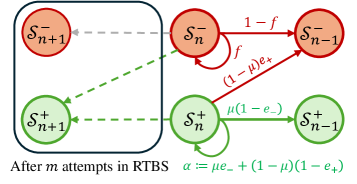
The image displays a state transition diagram modeling a process labeled "RTBS" (likely an acronym for a specific algorithm or system). The diagram illustrates transitions between positive (`+`) and negative (`-`) states across three sequential time steps or stages: `n+1`, `n`, and `n-1`. The flow moves generally from left (most recent/future state `n+1`) to right (past state `n-1`). The model incorporates probabilistic transitions and error terms, culminating in a defined parameter `α`.
### Components/Axes
The diagram is composed of nodes (states) and directed edges (transitions). There are no traditional chart axes.
**Nodes (States):**
* **Left Group (within a rounded rectangle):**
* `S_{n+1}^-` (Red circle, top-left)
* `S_{n+1}^+` (Green circle, bottom-left)
* **Middle Group:**
* `S_n^-` (Red circle, top-center)
* `S_n^+` (Green circle, bottom-center)
* **Right Group:**
* `S_{n-1}^-` (Red circle, top-right)
* `S_{n-1}^+` (Green circle, bottom-right)
**Edges (Transitions) and Labels:**
* **From `S_{n+1}^-`:**
* Solid red arrow to `S_n^-`, labeled `f`.
* Solid red arrow to `S_{n-1}^-`, labeled `1-f`.
* Dashed green arrow to `S_n^+` (no explicit label).
* **From `S_{n+1}^+`:**
* Dashed green arrow to `S_n^+` (no explicit label).
* Dashed green arrow to `S_n^-` (no explicit label).
* **From `S_n^-`:**
* Red self-loop arrow, labeled `μ(e_+)`.
* Solid red arrow to `S_{n-1}^-`, labeled `f`.
* Solid red arrow to `S_{n-1}^+`, labeled `(1-μ)e_+`.
* **From `S_n^+`:**
* Green self-loop arrow, labeled `μ(e_+)`.
* Solid green arrow to `S_{n-1}^+`, labeled `μ(e_+)`.
* Solid green arrow to `S_{n-1}^-`, labeled `(1-μ)e_+`.
**Legend/Footer Text:**
* Text at bottom-left: `After m attempts in RTBS`
* Equation at bottom-center/right: `α = μ e_- + (1-μ)(1-e_+)`
### Detailed Analysis
The diagram defines a Markov-like process where the system can be in a positive (`+`) or negative (`-`) state at each step. The transitions are governed by parameters `f`, `μ`, `e_+`, and `e_-`.
1. **Temporal Flow:** The primary flow is from stage `n+1` to `n` to `n-1`. The dashed arrows from `n+1` to `n` suggest a direct but possibly conditional or different-type transition compared to the solid arrows.
2. **Transition Logic from `S_n^-` (Negative State at step n):**
* It can remain in a negative state at the next step (`n-1`) with probability `f`.
* It can transition to a positive state at step `n-1` with probability `(1-μ)e_+`.
* It has a self-loop (staying in `S_n^-`?) with weight `μ(e_+)`. The notation is ambiguous; it may represent an internal process or a transition back to itself within the same time step.
3. **Transition Logic from `S_n^+` (Positive State at step n):**
* It can remain in a positive state at step `n-1` with probability `μ(e_+)`.
* It can transition to a negative state at step `n-1` with probability `(1-μ)e_+`.
* It also has a self-loop with weight `μ(e_+)`.
4. **Parameter `α`:** Defined as `α = μ e_- + (1-μ)(1-e_+)`. This is a weighted sum combining a term related to the negative state (`e_-`) and the complement of a term related to the positive state (`e_+`), with `μ` acting as a mixing weight.
### Key Observations
* **Symmetry and Asymmetry:** The transition structure from `S_n^-` and `S_n^+` to the `n-1` stage is symmetric in form but uses the same parameters (`f`, `μ`, `e_+`) for both source states. The asymmetry lies in the outcome: from a negative source, `f` leads to negative; from a positive source, `μ(e_+)` leads to positive.
* **Dashed vs. Solid Arrows:** Dashed arrows only appear from the `n+1` stage to the `n` stage, indicating these transitions might be of a different nature (e.g., initialization, observation, or a separate process layer) compared to the solid-arrow transitions between `n` and `n-1`.
* **Color Consistency:** Red is consistently used for negative (`-`) states and their outgoing solid transitions. Green is used for positive (`+`) states and their outgoing solid transitions. The dashed arrows from `S_{n+1}^+` are green, and from `S_{n+1}^-` is green, which is an interesting cross-color transition.
* **Parameter Reuse:** The term `μ(e_+)` appears as a self-loop on both `S_n^-` and `S_n^+`, and as the transition from `S_n^+` to `S_{n-1}^+`. The term `(1-μ)e_+` appears as the cross-state transition from both `S_n^-` to `S_{n-1}^+` and from `S_n^+` to `S_{n-1}^-`.
### Interpretation
This diagram models a sequential decision-making or error-propagation process, likely in the context of reliability, learning, or signal detection (RTBS could stand for something like "Repeated Trial Bayesian System" or "Response Threshold Based System").
* **What it represents:** The system's state (`+` or `-`) evolves over discrete attempts or time steps (`m` attempts). At each step, the state can persist, flip, or self-reinforce based on probabilistic rules involving a base rate (`f`), a modulation parameter (`μ`), and state-dependent error or sensitivity terms (`e_+`, `e_-`).
* **Relationships:** The parameter `α` is the key output or derived metric of the process after `m` attempts. It is not a simple average but a specific combination of the error terms, suggesting it might represent an overall system bias, confidence, or adjusted error rate. The process from `n+1` to `n` (dashed arrows) may represent the input or observation phase, while the process from `n` to `n-1` (solid arrows) represents the state update or memory consolidation phase.
* **Notable Implications:** The model suggests that maintaining a positive state (`S^+`) is governed by the same parameters (`μ`, `e_+`) that also govern escaping a negative state (`S^-`). This implies a system where the mechanisms for success and failure are intertwined. The definition of `α` indicates that system performance (`α`) depends on both the likelihood of errors in the negative state (`e_-`) and the likelihood of *not* making a correct response in the positive state (`1-e_+`), weighted by `μ`. This is characteristic of models in psychophysics, machine learning (e.g., multi-armed bandits), or quality control.