## Neural Network Architecture Diagram: Two-Layer Feedforward Networks with Parameter Scaling
### Overview
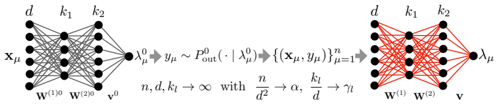
The image depicts two interconnected neural network architectures with mathematical annotations. The left side shows a standard feedforward network with input `x_μ`, hidden layers, and output `y_μ`, while the right side shows a modified network with output `λ_μ`. Equations describe parameter relationships and asymptotic behavior.
### Components/Axes
1. **Left Network (Black Lines)**
- Input: `x_μ` (dimension `d`)
- Hidden Layers:
- First layer weights: `W^(1)_0` (dimension `d × k₁`)
- Second layer weights: `W^(2)_0` (dimension `k₁ × k₂`)
- Output: `y_μ` (dimension `k₂`)
- Probability: `P^0_out(·|λ^0_μ)` (conditional distribution)
- Equation: `y_μ ~ P^0_out(·|λ^0_μ)`
2. **Right Network (Red Lines)**
- Input: `x_μ` (same as left network)
- Hidden Layers:
- First layer weights: `W^(1)` (dimension `d × k₁`)
- Second layer weights: `W^(2)` (dimension `k₁ × k₂`)
- Output: `λ_μ` (dimension `k₂`)
- Equation: `λ_μ` derived from `y_μ` through transformation
3. **Parameter Relationships**
- Asymptotic scaling: `n, d, k_l → ∞` with:
- `n/d² → α` (signal-to-noise ratio)
- `k_l/d → γ_l` (width-to-depth ratio)
### Detailed Analysis
- **Left Network Flow**:
`x_μ` → `W^(1)_0` → `W^(2)_0` → `λ^0_μ` → `y_μ`
- Input dimension: `d`
- Hidden layer dimensions: `k₁` (first layer), `k₂` (second layer)
- Output dimension: `k₂`
- **Right Network Flow**:
`x_μ` → `W^(1)` → `W^(2)` → `λ_μ`
- Maintains same dimensionality as left network
- Output `λ_μ` represents transformed version of `y_μ`
- **Key Equations**:
1. `y_μ ~ P^0_out(·|λ^0_μ)`: Output distribution conditioned on latent variable
2. Asymptotic scaling laws:
- `n/d² → α`: Sample complexity scaling
- `k_l/d → γ_l`: Network width scaling
### Key Observations
1. **Architectural Symmetry**: Both networks share identical dimensionality structure (`d → k₁ → k₂`)
2. **Weight Differentiation**:
- Left network uses subscripted weights (`W^(1)_0`, `W^(2)_0`)
- Right network uses standard weights (`W^(1)`, `W^(2)`)
3. **Latent Variable Transformation**:
- `λ^0_μ` serves as intermediate representation
- `λ_μ` appears to be a modified version of `λ^0_μ`
4. **Scaling Regimes**:
- `α` controls signal strength relative to noise
- `γ_l` governs network expressivity
### Interpretation
This diagram illustrates a theoretical analysis of neural network behavior under specific scaling regimes. The left network represents a baseline architecture with fixed initialization (`_0` subscripts), while the right network shows a modified version with potentially learned weights. The equations suggest:
1. **Capacity Analysis**: The `n/d² → α` relationship indicates how sample size scales with input dimension to maintain signal quality.
2. **Expressivity Tradeoff**: The `k_l/d → γ_l` ratio shows how network width grows relative to input size.
3. **Latent Space Dynamics**: The transformation from `λ^0_μ` to `λ_μ` implies a non-linear processing step that could represent:
- Regularization
- Feature extraction
- Loss function optimization
The red/black color coding emphasizes the architectural relationship between the two networks, suggesting the right network is a variant or optimized version of the left. The asymptotic analysis implies this is a theoretical study of network behavior in high-dimensional limits, relevant for understanding generalization bounds and capacity tradeoffs in deep learning.