## Flowchart: Multi-Stage AI Model Development Pipeline
### Overview
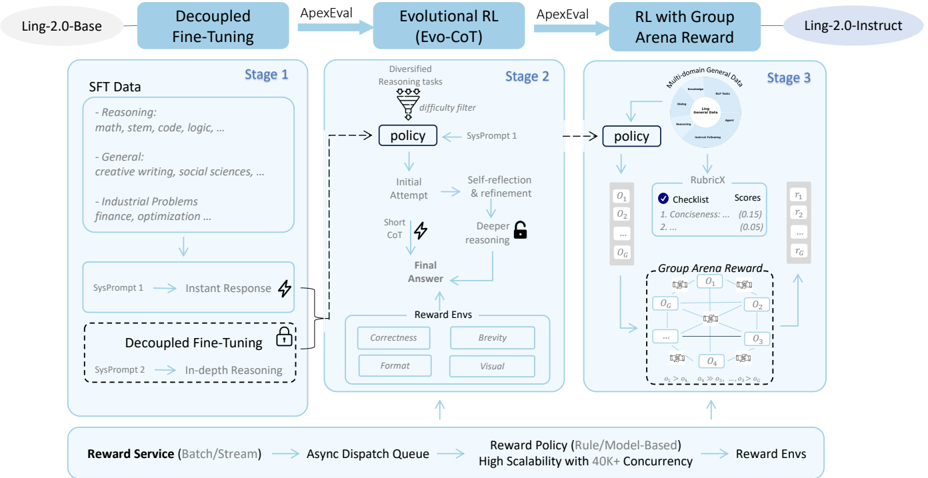
The diagram illustrates a three-stage pipeline for developing an AI model, starting from base model fine-tuning to group arena reward optimization. It combines technical components (SFT data, reward services) with reinforcement learning frameworks (Evo-CoT, Group Arena Reward) to produce a final instruction-tuned model.
### Components/Axes
**Stage 1: Decoupled Fine-Tuning**
- Input: SFT Data (Reasoning, General, Industrial Problems)
- Process:
- SysPrompt 1 → Instant Response
- SysPrompt 2 → In-depth Reasoning
- Output: Decoupled Fine-Tuning
**Stage 2: Evolutional RL (Evo-CoT)**
- Input: Policy from Stage 1
- Process:
- Diversified Reasoning tasks → Initial Attempt → Self-reflection → Deeper reasoning
- Reward Envs (Correctness, Brevity, Format, Visual)
- Output: Policy with refined reasoning
**Stage 3: RL with Group Arena Reward**
- Input: Policy from Stage 2
- Process:
- RubriX evaluation with Checklist (Conciseness, ...)
- Group Arena Reward calculation
- Output: Final policy with group-based optimization
### System Components
- Reward Service (Batch/Stream)
- Async Dispatch Queue
- High Scalability (40K+ Concurrency)
- Reward Policy (Rule/Model-Based)
### Detailed Analysis
**Stage 1 Components**
- SFT Data categories:
- Reasoning: math, stem, code, logic
- General: creative writing, social sciences
- Industrial: finance, optimization
- Decoupled Fine-Tuning shows two response modes:
- SysPrompt 1: Instant Response
- SysPrompt 2: In-depth Reasoning
**Stage 2 Components**
- Evo-CoT process:
- Initial Attempt → Self-reflection → Deeper reasoning
- Reward dimensions: Correctness, Brevity, Format, Visual
- Policy refinement shown through iterative attempts
**Stage 3 Components**
- RubriX evaluation with:
- Checklist items (Conciseness: 0.15, ...)
- Group Arena Reward calculation
- Visual representation of reward distribution across outputs
### Key Observations
1. Progressive complexity: Starts with basic fine-tuning → adds self-reflection → ends with group-based optimization
2. Reward system evolution: From individual metrics (Stage 2) to group-based evaluation (Stage 3)
3. Scalability emphasis: Explicit mention of 40K+ concurrency in reward service
4. Technical integration: Combines SFT data with RL frameworks
### Interpretation
This pipeline demonstrates a sophisticated approach to AI model development that:
1. Begins with specialized fine-tuning on diverse data categories
2. Implements evolutionary reinforcement learning with self-reflection mechanisms
3. Culminates in group-based reward optimization using RubriX evaluation
4. Maintains high scalability throughout the process
The architecture suggests a focus on creating models that can handle complex reasoning tasks while maintaining efficiency and adaptability. The group arena reward system implies a competitive or collaborative training environment that could enhance model robustness through peer evaluation.