## Chart/Diagram Type: Multi-Panel Performance Analysis
### Overview
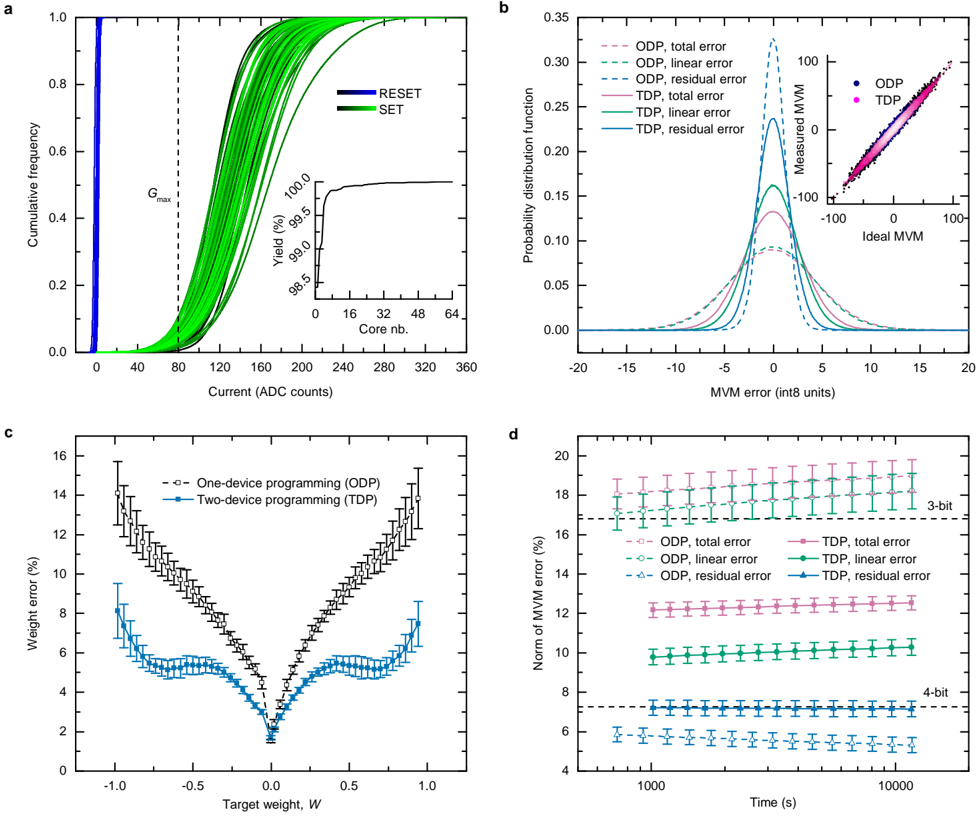
The image presents a multi-panel figure analyzing the performance of one-device programming (ODP) and two-device programming (TDP) techniques. The panels cover cumulative frequency distributions, error distributions, weight errors, and the norm of MVM (Matrix-Vector Multiplication) errors over time.
### Components/Axes
**Panel a:**
* **Type:** Cumulative frequency distribution plot with an inset plot.
* **X-axis:** Current (ADC counts), ranging from 0 to 360.
* **Y-axis:** Cumulative frequency, ranging from 0 to 1.0.
* **Curves:**
* Multiple green curves representing "SET" operations.
* A single blue curve representing "RESET" operations.
* **Vertical dashed line:** Labeled "Gmax" at approximately x=80.
* **Inset Plot:**
* **X-axis:** Core nb., ranging from 0 to 64.
* **Y-axis:** Yield (%), ranging from 98.5 to 100.0.
* A black curve showing yield as a function of core number.
**Panel b:**
* **Type:** Probability distribution function plot with an inset scatter plot.
* **X-axis:** MVM error (int8 units), ranging from -20 to 20.
* **Y-axis:** Probability distribution function, ranging from 0 to 0.35.
* **Curves:**
* Dashed light purple: ODP, total error
* Dashed light green: ODP, linear error
* Dashed light blue: ODP, residual error
* Solid purple: TDP, total error
* Solid green: TDP, linear error
* Solid blue: TDP, residual error
* **Inset Scatter Plot:**
* **X-axis:** Ideal MVM, ranging from -100 to 100.
* **Y-axis:** Measured MVM, ranging from -100 to 100.
* Blue dots: ODP
* Purple dots: TDP
**Panel c:**
* **Type:** Weight error plot.
* **X-axis:** Target weight, W, ranging from -1.0 to 1.0.
* **Y-axis:** Weight error (%), ranging from 0 to 16.
* **Curves:**
* Dashed black with error bars: One-device programming (ODP)
* Solid blue with error bars: Two-device programming (TDP)
**Panel d:**
* **Type:** Norm of MVM error plot.
* **X-axis:** Time (s), ranging from 1000 to 10000 (logarithmic scale).
* **Y-axis:** Norm of MVM error (%), ranging from 4 to 20.
* **Horizontal dashed lines:** Indicating 3-bit and 4-bit levels.
* 3-bit line at approximately 17%
* 4-bit line at approximately 7.5%
* **Curves:**
* Dashed light purple with error bars: ODP, total error
* Dashed light green with error bars: ODP, linear error
* Dashed light blue with error bars: ODP, residual error
* Solid purple with error bars: TDP, total error
* Solid green with error bars: TDP, linear error
* Solid blue with error bars: TDP, residual error
### Detailed Analysis
**Panel a:**
* The "RESET" curve (blue) shows a sharp transition around 40 ADC counts, indicating a consistent reset behavior.
* The "SET" curves (green) show a distribution of switching currents, with the majority of devices switching between 80 and 240 ADC counts.
* The inset plot shows that the yield increases rapidly with the number of cores, reaching nearly 100% after approximately 32 cores.
**Panel b:**
* The probability distribution of MVM errors is centered around zero for all error types and both programming methods.
* The ODP (One-Device Programming) method exhibits larger total and linear errors compared to TDP (Two-Device Programming).
* The residual errors are smaller than the linear and total errors for both methods.
* The inset scatter plot shows a strong linear correlation between ideal and measured MVM values for both ODP and TDP, with TDP exhibiting less scatter.
**Panel c:**
* The weight error is minimized near a target weight of 0 for both ODP and TDP.
* TDP consistently exhibits lower weight errors compared to ODP across the entire range of target weights.
* The weight error increases as the absolute value of the target weight moves away from 0.
**Panel d:**
* The norm of MVM error remains relatively constant over time for all error types and both programming methods.
* TDP consistently exhibits lower total and linear errors compared to ODP.
* The residual errors are smaller than the linear and total errors for both methods.
* The TDP residual error is consistently below the 4-bit level.
* The TDP total error is consistently below the 3-bit level.
### Key Observations
* TDP (Two-Device Programming) generally outperforms ODP (One-Device Programming) in terms of error metrics.
* The MVM errors are centered around zero, indicating a lack of systematic bias.
* The weight error is minimized when the target weight is close to zero.
* The performance of both programming methods is relatively stable over time.
### Interpretation
The data suggests that using a two-device programming (TDP) approach leads to more accurate and reliable analog memory elements compared to a one-device programming (ODP) approach. This is evident in the lower weight errors, smaller MVM errors, and tighter distribution of errors around zero for TDP. The stability of the error metrics over time indicates that both methods are relatively robust, but TDP offers superior performance, especially in applications requiring high precision, as demonstrated by the TDP residual error consistently being below the 4-bit level. The inset plots in panels a and b provide additional context, showing the yield of the devices and the correlation between ideal and measured MVM values, respectively.