## System Diagram: Model Context Protocol
### Overview
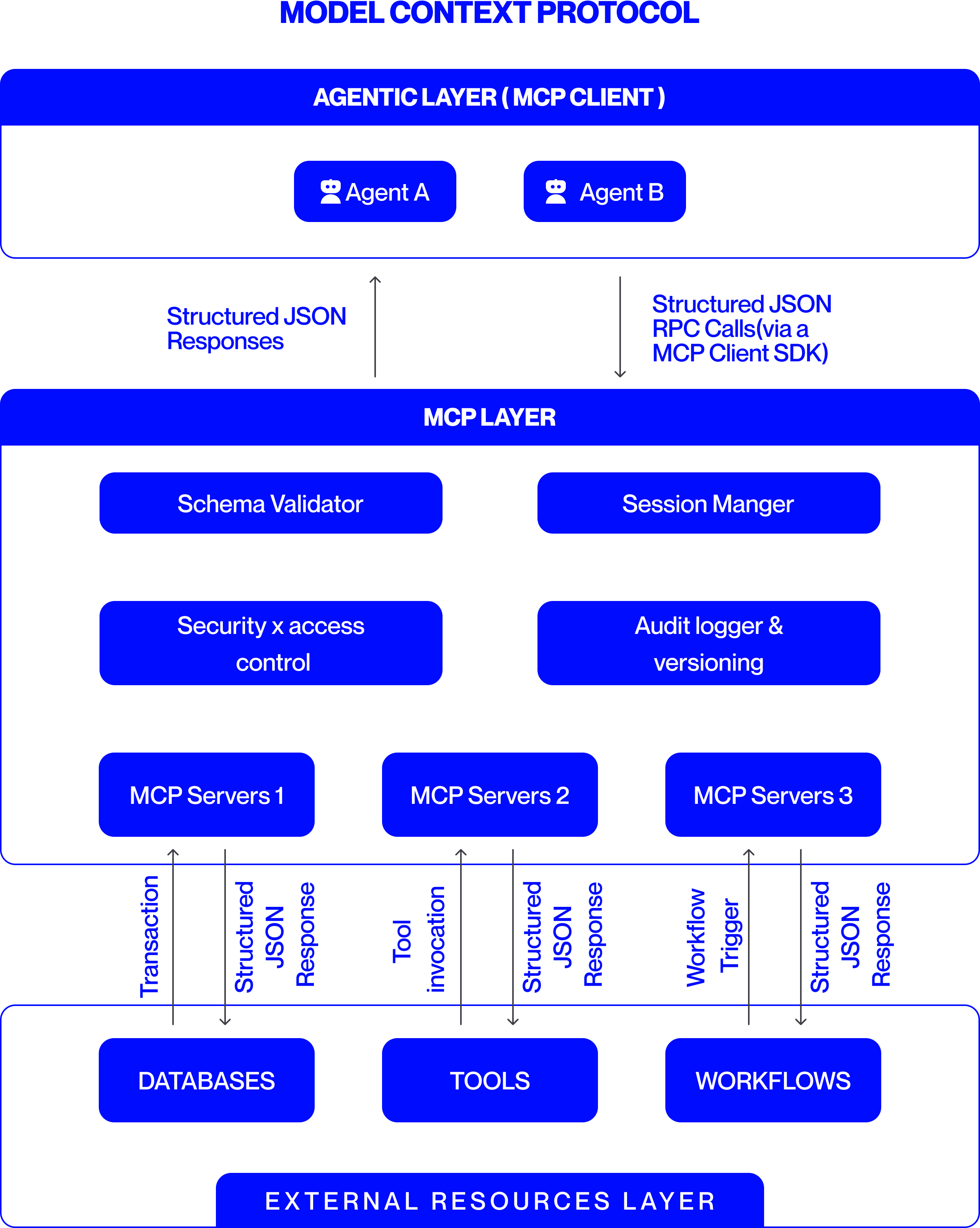
The image is a system diagram illustrating the Model Context Protocol (MCP) architecture. It depicts the flow of data and interactions between different layers, including the Agentic Layer, MCP Layer, Databases, Tools, Workflows, and External Resources Layer.
### Components/Axes
* **Title:** MODEL CONTEXT PROTOCOL
* **Layers (from top to bottom):**
* AGENTIC LAYER (MCP CLIENT)
* MCP LAYER
* DATABASES, TOOLS, WORKFLOWS
* EXTERNAL RESOURCES LAYER
* **Components within AGENTIC LAYER:**
* Agent A (with a robot icon)
* Agent B (with a robot icon)
* **Components within MCP LAYER:**
* Schema Validator
* Session Manager
* Security x access control
* Audit logger & versioning
* MCP Servers 1
* MCP Servers 2
* MCP Servers 3
* **Components within DATABASES, TOOLS, WORKFLOWS:**
* DATABASES
* TOOLS
* WORKFLOWS
* **Arrows:** Indicate the direction of data flow and interactions between layers and components.
* "Structured JSON Responses" (from MCP LAYER to AGENTIC LAYER)
* "Structured JSON RPC Calls (via a MCP Client SDK)" (from AGENTIC LAYER to MCP LAYER)
* "Transaction" (from MCP Servers 1 to DATABASES)
* "Structured JSON Response" (from MCP Servers 1 to DATABASES)
* "Tool Invocation" (from MCP Servers 2 to TOOLS)
* "Structured JSON Response" (from MCP Servers 2 to TOOLS)
* "Workflow Trigger" (from MCP Servers 3 to WORKFLOWS)
* "Structured JSON Response" (from MCP Servers 3 to WORKFLOWS)
### Detailed Analysis or ### Content Details
* **AGENTIC LAYER (MCP CLIENT):**
* Contains two agents, Agent A and Agent B.
* Sends "Structured JSON RPC Calls (via a MCP Client SDK)" to the MCP LAYER.
* Receives "Structured JSON Responses" from the MCP LAYER.
* **MCP LAYER:**
* Contains components for schema validation, session management, security and access control, and audit logging and versioning.
* Contains three MCP Servers: MCP Servers 1, MCP Servers 2, and MCP Servers 3.
* MCP Servers interact with DATABASES, TOOLS, and WORKFLOWS respectively.
* **DATABASES, TOOLS, WORKFLOWS:**
* Represent the backend systems that the MCP interacts with.
* DATABASES receive "Transaction" and "Structured JSON Response" from MCP Servers 1.
* TOOLS receive "Tool Invocation" and "Structured JSON Response" from MCP Servers 2.
* WORKFLOWS receive "Workflow Trigger" and "Structured JSON Response" from MCP Servers 3.
* **EXTERNAL RESOURCES LAYER:**
* Represents the external resources that the entire system relies on.
### Key Observations
* The diagram illustrates a layered architecture with clear separation of concerns.
* The MCP LAYER acts as an intermediary between the agents and the backend systems.
* The flow of data is primarily through Structured JSON messages.
* Each MCP Server is responsible for interacting with a specific type of backend system (Databases, Tools, or Workflows).
### Interpretation
The diagram provides a high-level overview of the Model Context Protocol architecture. It demonstrates how agents interact with backend systems through a centralized MCP layer. The MCP layer provides essential services such as schema validation, session management, security, and auditing. The use of Structured JSON for communication enables interoperability between different components. The architecture promotes modularity and scalability by separating the agent logic from the backend system interactions.