\n
## Diagram: Model Context Protocol
### Overview
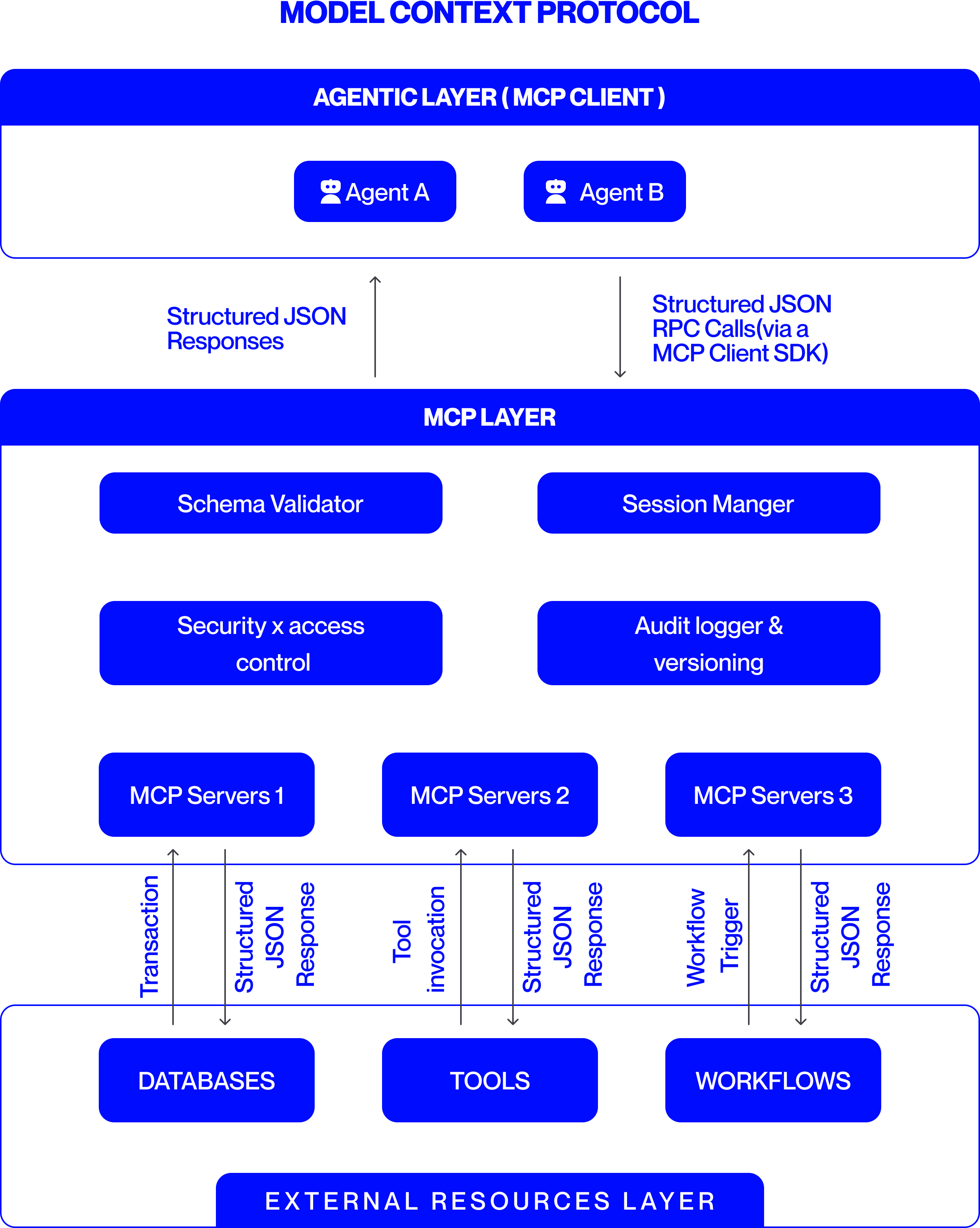
The image is a diagram illustrating the "Model Context Protocol" (MCP). It depicts a layered architecture with four main layers: Agentic Layer (MCP Client), MCP Layer, MCP Servers, and External Resources Layer. The diagram shows the flow of information and interactions between these layers. It's a high-level architectural overview, focusing on components and data exchange rather than specific numerical data.
### Components/Axes
The diagram is structured into layers, each represented by a colored block. The layers are:
* **Agentic Layer (MCP Client):** Located at the top, colored light orange. Contains "Agent A" and "Agent B" represented by person icons.
* **MCP Layer:** Located below the Agentic Layer, colored dark blue. Contains four components: "Schema Validator", "Session Manager", "Security x access control", and "Audit logger & versioning".
* **MCP Servers Layer:** Located below the MCP Layer, colored purple. Contains three servers: "MCP Servers 1", "MCP Servers 2", and "MCP Servers 3".
* **External Resources Layer:** Located at the bottom, colored yellow. Contains three components: "Databases", "Tools", and "Workflows".
Arrows indicate the direction of data flow. Text labels on the arrows describe the type of data being exchanged, such as "Structured JSON Responses", "Structured JSON RPC Calls (via a MCP Client SDK)", "Transaction", "Tool invocation", and "Workflow Trigger".
### Detailed Analysis or Content Details
The diagram illustrates the following interactions:
1. **Agentic Layer to MCP Layer:**
* Agent A sends "Structured JSON Responses" to the MCP Layer.
* Agent B sends "Structured JSON RPC Calls (via a MCP Client SDK)" to the MCP Layer.
2. **MCP Layer to MCP Servers Layer:**
* MCP Servers 1 receives a "Transaction" and sends a "Structured JSON Response" to the External Resources Layer (Databases).
* MCP Servers 2 receives a "Tool invocation" and sends a "Structured JSON Response" to the External Resources Layer (Tools).
* MCP Servers 3 receives a "Workflow Trigger" and sends a "Structured JSON Response" to the External Resources Layer (Workflows).
3. **MCP Servers Layer to External Resources Layer:**
* MCP Servers 1 interacts with "Databases".
* MCP Servers 2 interacts with "Tools".
* MCP Servers 3 interacts with "Workflows".
The diagram does not contain any numerical data or specific values. It focuses on the logical flow and components of the system.
### Key Observations
* The architecture is layered, suggesting a separation of concerns.
* The MCP Layer acts as a central point of control and validation.
* The External Resources Layer provides access to underlying data and functionality.
* The Agents interact with the system through the MCP Layer.
* The use of "Structured JSON" indicates a standardized data format for communication.
### Interpretation
The diagram represents a robust and well-defined protocol for managing interactions between agents and external resources. The layered architecture promotes modularity and scalability. The MCP Layer's components (Schema Validator, Session Manager, Security, Audit Logger) suggest a strong emphasis on data integrity, security, and traceability. The use of JSON as the data format implies interoperability and ease of integration with various systems.
The diagram highlights a system designed for complex interactions, likely involving multiple agents and a variety of external resources. The protocol aims to provide a secure, reliable, and auditable framework for these interactions. The separation of concerns into distinct layers allows for independent development and maintenance of each component. The diagram doesn't reveal the specific purpose of the agents or the nature of the external resources, but it clearly outlines the infrastructure that supports their interaction. The diagram is a conceptual overview, and further details would be needed to understand the specific implementation and functionality of each component.