## Diagram: Model Context Protocol (MCP) Architecture
### Overview
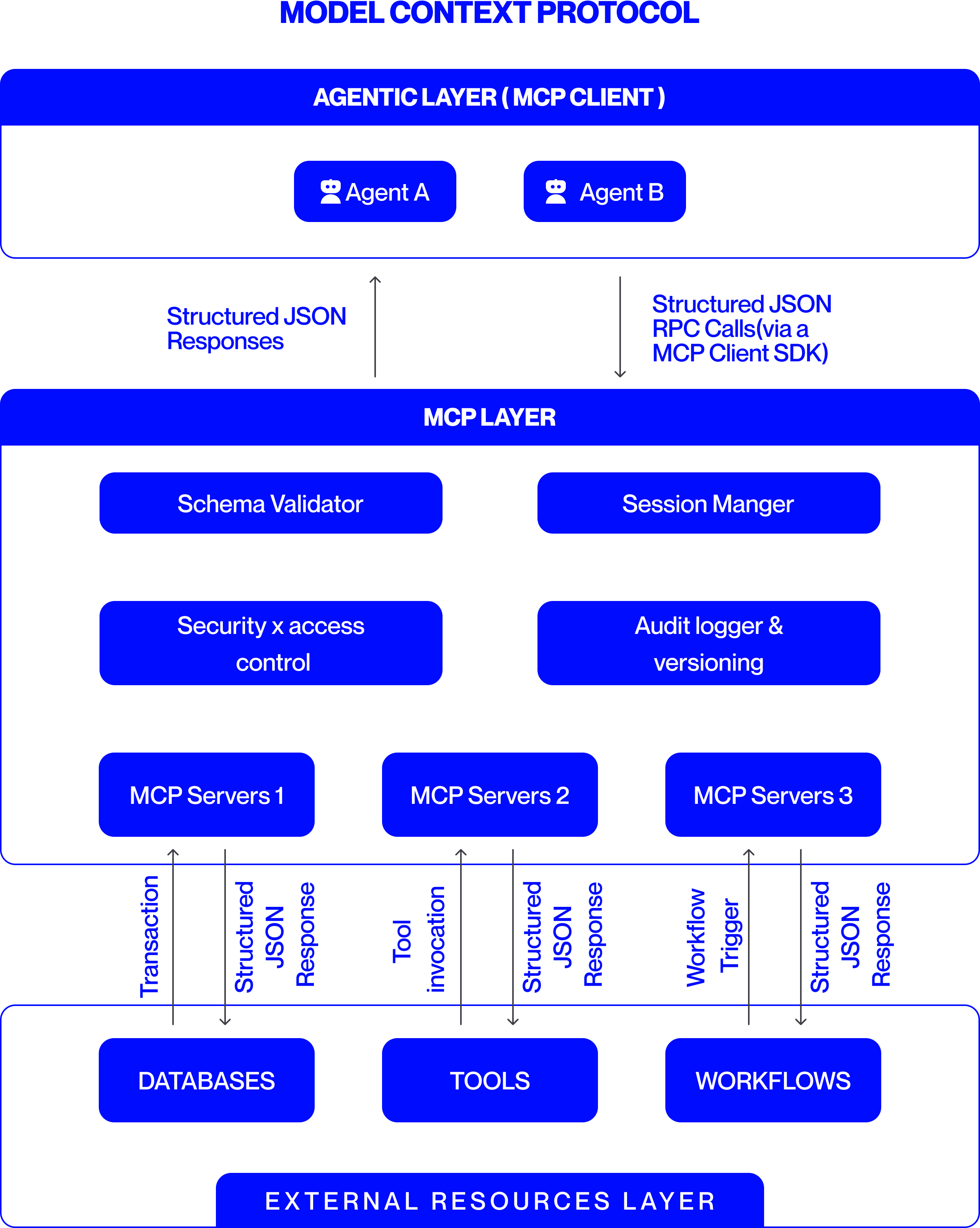
This image is a technical architecture diagram illustrating the structure and data flow of the "Model Context Protocol" (MCP). It depicts a layered system designed to connect AI agents (clients) with external resources (databases, tools, workflows) through a standardized middleware layer. The diagram uses a blue and white color scheme with rounded rectangular boxes for components and arrows to indicate communication flows.
### Components/Flow
The diagram is organized into three primary horizontal layers, stacked vertically.
**1. Header (Top)**
* **Title:** "MODEL CONTEXT PROTOCOL" (centered, bold, blue text).
**2. Main Diagram - Layered Architecture**
The core content is divided into three distinct layers:
* **Layer 1: AGENTIC LAYER (MCP CLIENT)**
* **Position:** Topmost layer, enclosed in a light gray box with a blue header bar.
* **Components:** Two agent icons labeled "Agent A" and "Agent B".
* **Outgoing Flow (Downward Arrow):** Labeled "Structured JSON RPC Calls (via a MCP Client SDK)". This indicates requests sent from agents to the MCP Layer.
* **Incoming Flow (Upward Arrow):** Labeled "Structured JSON Responses". This indicates data returned to the agents.
* **Layer 2: MCP LAYER**
* **Position:** Middle layer, enclosed in a light gray box with a blue header bar.
* **Internal Components (Blue Boxes):**
* "Schema Validator"
* "Session Manger" (Note: Likely a typo for "Manager")
* "Security x access control"
* "Audit logger & versioning"
* "MCP Servers 1"
* "MCP Servers 2"
* "MCP Servers 3"
* **Function:** This layer acts as the protocol's core, handling validation, session management, security, auditing, and hosting multiple server instances.
* **Layer 3: EXTERNAL RESOURCES LAYER**
* **Position:** Bottom layer, enclosed in a light gray box with a blue header bar at the very bottom.
* **Components (Blue Boxes):**
* "DATABASES"
* "TOOLS"
* "WORKFLOWS"
**3. Inter-Layer Communication Flows**
Arrows connect the MCP Servers in the middle layer to the External Resources in the bottom layer, with specific labels for each interaction type:
* **Between "MCP Servers 1" and "DATABASES":**
* Upward Arrow: "Transaction"
* Downward Arrow: "Structured JSON Response"
* **Between "MCP Servers 2" and "TOOLS":**
* Upward Arrow: "Tool invocation"
* Downward Arrow: "Structured JSON Response"
* **Between "MCP Servers 3" and "WORKFLOWS":**
* Upward Arrow: "Workflow Trigger"
* Downward Arrow: "Structured JSON Response"
### Detailed Analysis
The diagram explicitly defines the communication protocol and data structure at each interface:
* **Agent to MCP Layer:** Communication uses "Structured JSON RPC Calls" and receives "Structured JSON Responses".
* **MCP Layer to External Resources:** Each MCP Server instance is specialized for a resource type (Database, Tool, Workflow). The upward calls are specific actions ("Transaction", "Tool invocation", "Workflow Trigger"), while all downward responses are uniformly "Structured JSON Response".
* **Component Hierarchy:** The MCP Layer contains both cross-cutting services (Validator, Session Manager, Security, Logger) and the server instances that interface directly with external resources.
### Key Observations
1. **Standardized Data Format:** The repeated use of "Structured JSON" for all communication flows emphasizes a key design principle of the protocol: using a consistent, machine-readable data format.
2. **Specialization:** The MCP Servers are not generic; they are depicted as specialized endpoints for different external resource categories (Databases, Tools, Workflows).
3. **Security and Audit Focus:** The inclusion of dedicated "Security x access control" and "Audit logger & versioning" components within the MCP Layer highlights these as critical, built-in features of the protocol.
4. **Potential Typo:** The component "Session Manger" is likely intended to be "Session Manager".
### Interpretation
This diagram presents the Model Context Protocol as a structured middleware solution for AI agent interoperability. It solves the problem of connecting diverse AI agents (Agent A, Agent B) to a heterogeneous set of external systems (data, tools, processes) by:
* **Abstracting Complexity:** Agents make simple RPC calls via an SDK, unaware of the underlying resource specifics.
* **Enforcing Standards:** The MCP Layer mandates a JSON-based communication schema, validated by the "Schema Validator".
* **Centralizing Governance:** Critical functions like security, access control, auditing, and session management are centralized within the MCP Layer, providing a single point for policy enforcement and monitoring.
* **Enabling Scalability:** The presence of multiple "MCP Servers" suggests the architecture can scale horizontally to handle load or separate concerns.
The flow is strictly hierarchical and mediated: Agents never communicate directly with Databases, Tools, or Workflows. All interaction is brokered, validated, and logged by the MCP Layer, positioning it as a crucial control plane for secure and manageable AI agent operations.