## Diagram: Model Context Protocol Architecture
### Overview
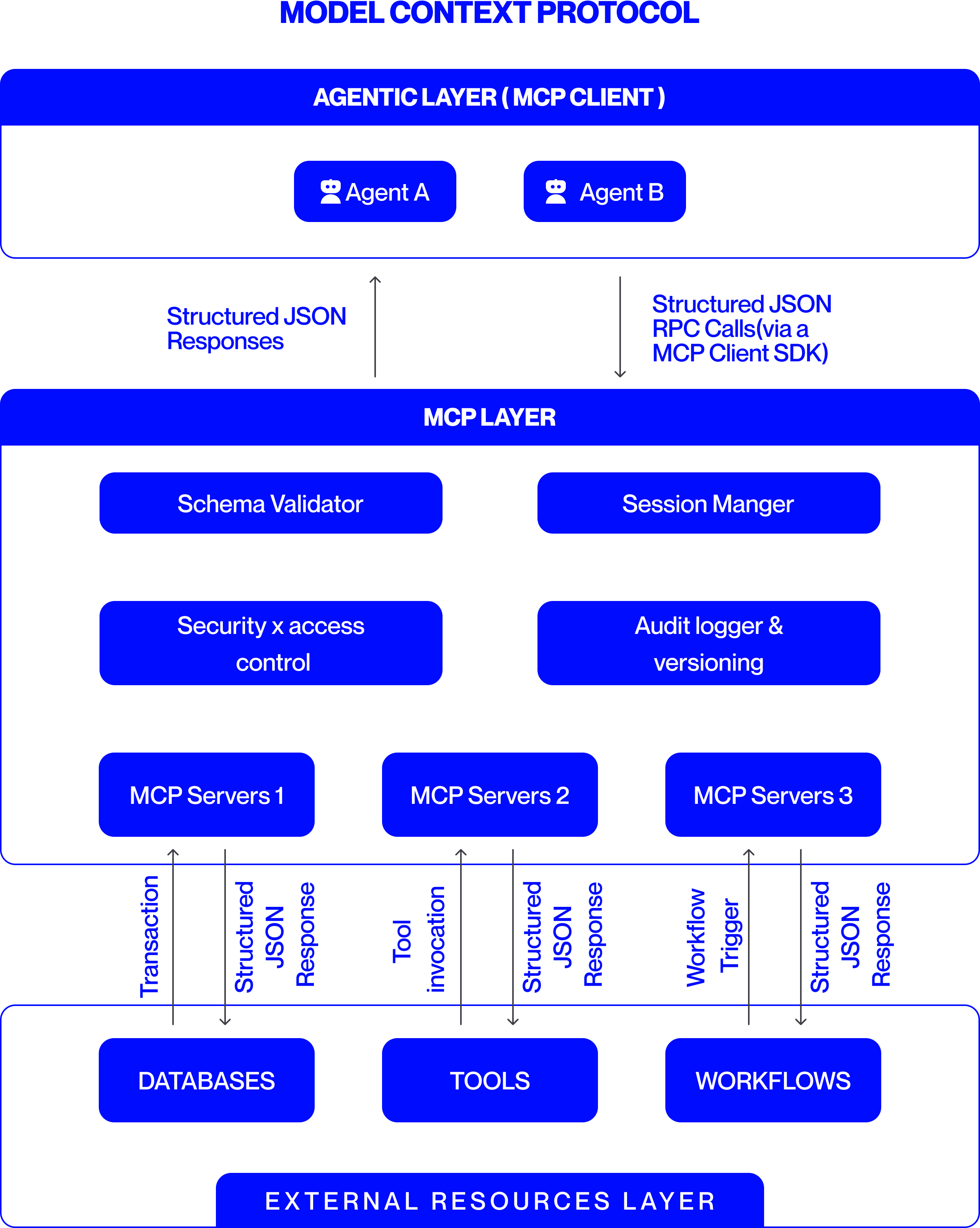
The diagram illustrates a three-layer architecture for the Model Context Protocol (MCP), showing interactions between agents, middleware components, and external resources. It emphasizes structured data flow, security controls, and system integration.
### Components/Axes
**1. Agentic Layer (MCP Client)**
- **Agents**: Agent A and Agent B (represented with robot icons)
- **Communication**:
- Structured JSON Responses (bidirectional arrows)
- RPC Calls via MCP Client SDK (unidirectional arrow from Agent B)
**2. MCP Layer**
- **Core Components**:
- Schema Validator
- Session Manager
- Security & access control
- Audit logger & versioning
- **MCP Servers**:
- MCP Servers 1, 2, and 3 (horizontal grouping)
- **External Interfaces**:
- Databases (bottom-left)
- Tools (center-bottom)
- Workflows (bottom-right)
**3. External Resources Layer**
- **Resource Types**:
- Databases
- Tools
- Workflows
- **Connections**:
- Transactional links to databases
- Tool invocations
- Workflow triggers
### Detailed Analysis
**Agent-to-Server Flow**:
1. Agent A sends Structured JSON Responses to MCP Layer
2. Agent B makes RPC Calls through MCP Client SDK to MCP Layer
3. All server interactions follow structured JSON formatting
**MCP Layer Processing**:
- Schema Validator ensures data integrity
- Session Manager handles connection lifecycle
- Security controls enforce access policies
- Audit logger tracks system changes
- Versioning maintains compatibility
**Server-Resource Interactions**:
- **MCP Server 1**:
- Transactional database access
- Structured JSON responses
- **MCP Server 2**:
- Tool invocations
- Structured JSON responses
- **MCP Server 3**:
- Workflow triggers
- Structured JSON responses
### Key Observations
1. **Structured Communication**: All interactions use standardized JSON format
2. **Security Integration**: Access control and audit logging are central components
3. **Modular Design**: Three distinct server types handle different resource types
4. **Bidirectional Flow**: Agents receive structured responses from servers
5. **Version Control**: Explicit versioning component suggests backward compatibility
### Interpretation
This architecture demonstrates a security-conscious, modular approach to agent-server communication. The layered design separates:
- **Agent Logic** (top layer) from
- **Middleware Processing** (middle layer) and
- **Resource Access** (bottom layer)
The emphasis on structured JSON responses suggests a focus on interoperability and data validation. The presence of audit logging and versioning indicates enterprise-grade requirements for accountability and system evolution. The three-server specialization implies optimized handling of different resource types (databases, tools, workflows) through dedicated processing paths.