## Diagram: Binary Tree Representation of an Expression
### Overview
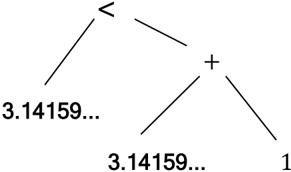
The image depicts a binary tree representing a mathematical expression. The tree structure shows the relationship between operators and operands.
### Components/Axes
* **Nodes:** The nodes represent operators and operands.
* **Edges:** The edges represent the relationship between parent and child nodes.
* **Operators:** The operators are "<" (less than) and "+"(addition).
* **Operands:** The operands are "3.14159..." (representing pi) and "1".
### Detailed Analysis
* **Root Node:** The root node is "<" (less than).
* **Left Child of Root:** The left child of the root node is "3.14159...".
* **Right Child of Root:** The right child of the root node is "+"(addition).
* **Left Child of "+" Node:** The left child of the "+" node is "3.14159...".
* **Right Child of "+" Node:** The right child of the "+" node is "1".
### Key Observations
The tree represents the expression "3.14159... < (3.14159... + 1)".
### Interpretation
The diagram illustrates how a mathematical expression can be represented as a binary tree. The root node represents the main operation, and the child nodes represent the operands or sub-expressions. This representation is commonly used in computer science for parsing and evaluating expressions. The expression being evaluated is whether pi is less than pi + 1.