## Text Snippets: Questions and Statements about Hybrid Offspring
### Overview
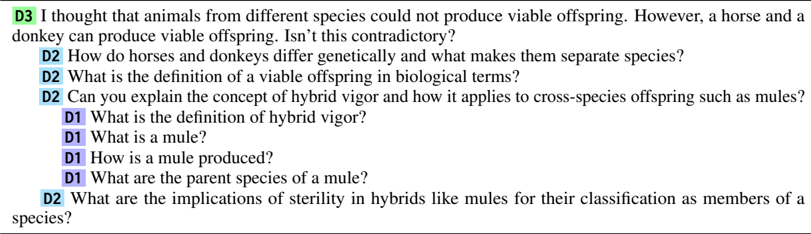
The image presents a series of questions and a statement related to the biological concept of viable offspring from different species, specifically focusing on horses, donkeys, and mules. The questions are categorized into three levels, D1, D2, and D3, indicated by colored labels.
### Components/Axes
* **Labels:** The questions and statements are labeled with "D1" (light purple), "D2" (light blue), and "D3" (light green). These labels likely indicate different levels of difficulty or depth of inquiry.
* **Text Content:** The image contains several questions and one statement.
### Detailed Analysis or ### Content Details
Here's a breakdown of the text content, categorized by its label:
* **D3 (light green):** "I thought that animals from different species could not produce viable offspring. However, a horse and a donkey can produce viable offspring. Isn't this contradictory?"
* **D2 (light blue):**
* "How do horses and donkeys differ genetically and what makes them separate species?"
* "What is the definition of a viable offspring in biological terms?"
* "Can you explain the concept of hybrid vigor and how it applies to cross-species offspring such as mules?"
* "What are the implications of sterility in hybrids like mules for their classification as members of a species?"
* **D1 (light purple):**
* "What is the definition of hybrid vigor?"
* "What is a mule?"
* "How is a mule produced?"
* "What are the parent species of a mule?"
### Key Observations
* The questions range from basic definitions (D1) to more complex genetic and classification implications (D2).
* The statement (D3) introduces a perceived contradiction that prompts further inquiry.
* The focus is on the biological concepts of viable offspring, hybrid vigor, and species classification, using the example of horses, donkeys, and mules.
### Interpretation
The image appears to be a set of prompts or questions designed to explore the complexities of species, hybridization, and reproductive viability. The progression from D1 to D3 suggests a learning path, starting with fundamental definitions and culminating in a deeper understanding of the apparent contradiction in the case of horse-donkey hybrids (mules). The questions highlight the importance of understanding genetic differences, hybrid vigor, and the implications of sterility in defining species boundaries.