## Text Document: Biological Questions on Hybrid Species
### Overview
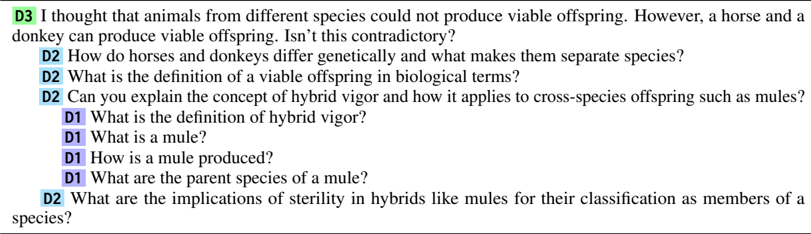
The image displays a screenshot of a text document containing a series of numbered questions related to biology, genetics, and species classification. The questions are prefixed with colored labels (D3, D2, D1) and are presented in a hierarchical or grouped list format. The content focuses on the apparent contradiction of viable offspring between different species (horse and donkey), the definition of species, hybrid vigor, and the specific case of mules.
### Components/Axes
The document consists solely of text elements organized as follows:
* **Labels:** Each question is preceded by a colored label.
* **D3:** Green background, white text.
* **D2:** Blue background, white text.
* **D1:** Purple background, white text.
* **Questions:** A list of 10 questions in English, indented to varying degrees, suggesting a potential grouping or sequence.
### Detailed Analysis / Content Details
The complete textual content, transcribed precisely with its label, is as follows:
1. **[D3]** I thought that animals from different species could not produce viable offspring. However, a horse and a donkey can produce viable offspring. Isn't this contradictory?
2. **[D2]** How do horses and donkeys differ genetically and what makes them separate species?
3. **[D2]** What is the definition of a viable offspring in biological terms?
4. **[D2]** Can you explain the concept of hybrid vigor and how it applies to cross-species offspring such as mules?
5. **[D1]** What is the definition of hybrid vigor?
6. **[D1]** What is a mule?
7. **[D1]** How is a mule produced?
8. **[D1]** What are the parent species of a mule?
9. **[D2]** What are the implications of sterility in hybrids like mules for their classification as members of a species?
### Key Observations
* **Hierarchical Structure:** The labels (D3, D2, D1) may indicate a difficulty level, a question type, or a sequence in a learning module. D3 poses the core contradiction, D2 asks explanatory and definitional questions, and D1 asks foundational, factual questions.
* **Thematic Grouping:** The questions logically progress from a specific observation (horse/donkey offspring) to general biological concepts (species definition, hybrid vigor) and back to a specific case study (the mule).
* **Visual Layout:** The text is left-aligned. The indentation of the D1 questions under the fourth D2 question suggests they are sub-questions or related clarifications for the topic of "hybrid vigor" and "mules."
### Interpretation
This text represents a structured inquiry or a set of discussion prompts designed to explore a classic biological paradox. The sequence of questions guides a learner from recognizing an apparent contradiction in the definition of species, through the necessary genetic and biological concepts to resolve it, and finally to the specific implications of hybrid sterility.
The document's purpose is likely educational or investigative. It methodically deconstructs a complex topic by:
1. **Identifying a Paradox (D3):** Challenging a simplified understanding of species.
2. **Seeking Definitions & Mechanisms (D2):** Asking for the precise rules (genetic differences, viability, hybrid vigor) that govern the paradox.
3. **Establishing Foundational Facts (D1):** Ensuring basic terminology (mule, hybrid vigor) is understood before proceeding.
4. **Exploring Implications (Final D2):** Considering how observed phenomena (sterile hybrids) fit into or challenge theoretical frameworks (species classification).
The underlying investigation is about the boundaries and definitions of biological species, using the mule as a central, tangible example to test theoretical concepts. The questions imply that the "biological species concept" (which often emphasizes reproductive isolation) requires nuanced understanding when applied to real-world hybrids.