## Screenshot: Text Conversation on Hybrid Vigor and Mules
### Overview
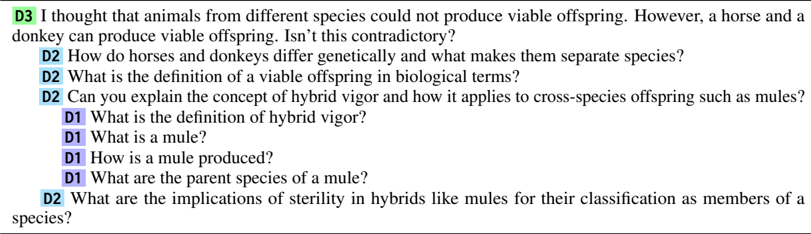
The image is a screenshot of a text-based conversation discussing biological concepts related to hybrid vigor, mules, and cross-species offspring. The dialogue involves three participants labeled **D1**, **D2**, and **D3**, with questions and answers structured hierarchically.
### Components/Axes
- **Labels**:
- **D1**: Answers to questions (purple text).
- **D2**: Intermediate questions (blue text).
- **D3**: Initial question and summary (green text).
- **Structure**:
- Hierarchical numbering (e.g., D3 → D2 → D1) indicates a nested Q&A flow.
- No numerical data, charts, or diagrams present.
### Content Details
1. **D3 (Green)**:
- *"I thought that animals from different species could not produce viable offspring. However, a horse and a donkey can produce viable offspring. Isn’t this contradictory?"*
2. **D2 (Blue)**:
- *"How do horses and donkeys differ genetically and what makes them separate species?"*
- *"What is the definition of a viable offspring in biological terms?"*
- *"Can you explain the concept of hybrid vigor and how it applies to cross-species offspring such as mules?"*
3. **D1 (Purple)**:
- *"What is the definition of hybrid vigor?"*
- *"What is a mule?"*
- *"How is a mule produced?"*
- *"What are the parent species of a mule?"*
4. **D2 (Blue)**:
- *"What are the implications of sterility in hybrids like mules for their classification as members of a species?"*
### Key Observations
- The conversation progresses from a foundational question about species compatibility (D3) to detailed inquiries about genetic differences, definitions, and hybrid biology (D2).
- D1 provides definitions and explanations, focusing on hybrid vigor, mules, and their parent species.
- The final question (D2) ties sterility in hybrids to taxonomic classification, implying a deeper exploration of evolutionary biology.
### Interpretation
The dialogue reflects a structured inquiry into the biological paradox of hybrid viability. While D3 highlights the contradiction between the general rule of species incompatibility and the existence of mules, D2 and D1 unpack the mechanisms (e.g., hybrid vigor) and taxonomic implications (e.g., sterility) that resolve this contradiction. The discussion underscores the complexity of species classification, where hybrids like mules challenge traditional definitions despite their sterility. This aligns with evolutionary biology principles, where hybrid vigor (heterosis) can occur even in sterile hybrids, but their inability to reproduce reinforces their status as distinct from parent species.
**Note**: The image contains no numerical data, charts, or diagrams. All information is textual and structured as a Q&A exchange.