\n
## Diagram: Comparison of Retrieval-Augmented Generation (RAG), ReAct/Search-01, and Re²Search
### Overview
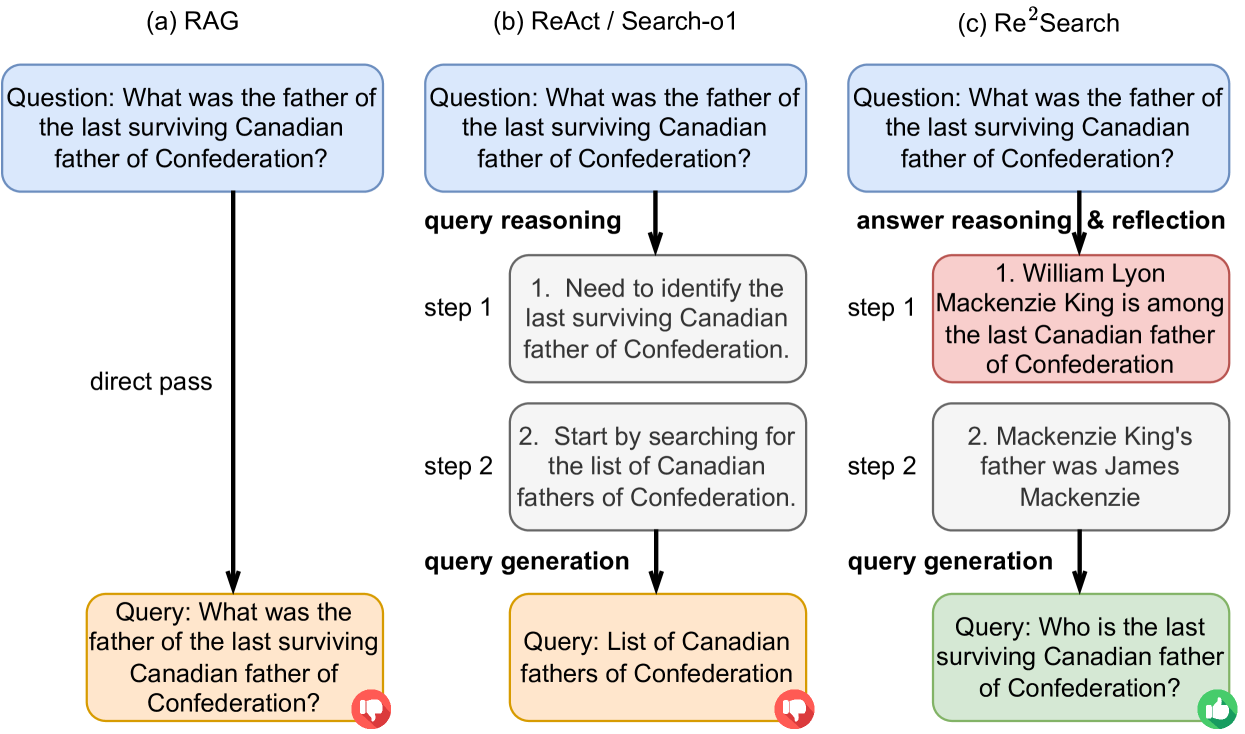
This diagram illustrates and compares three different approaches to answering a question: Retrieval-Augmented Generation (RAG), ReAct/Search-01, and Re²Search. Each approach is presented as a flow diagram, showing the question asked, the steps taken to answer it, and the final query generated. The diagram highlights the differences in reasoning and query generation strategies employed by each method.
### Components/Axes
The diagram is divided into three columns, labeled (a) RAG, (b) ReAct / Search-01, and (c) Re²Search. Each column represents a different approach. Within each column, the diagram shows:
* **Question:** The initial question posed to the system.
* **Steps:** Numbered steps outlining the reasoning or action taken.
* **Query Generation:** The final query sent to an external source (presumably a search engine or knowledge base).
* **Arrows:** Indicate the flow of information and the sequence of steps.
* **Shapes:** Different shapes are used to represent different elements:
* Rounded rectangles: Questions and direct passes.
* Rectangles with rounded corners: Reasoning steps.
* Parallelograms: Query generation.
* Speech bubbles: Indicate a query being sent.
* **Icons:** Thumbs up/down icons are used to indicate the success or failure of a query.
### Detailed Analysis or Content Details
**(a) RAG**
* **Question:** "What was the father of the last surviving Canadian father of Confederation?"
* **Direct Pass:** The question is passed directly to the query generation stage.
* **Query:** "What was the father of the last surviving Canadian father of Confederation?"
* **Icon:** Question mark icon.
**(b) ReAct / Search-01**
* **Question:** "What was the father of the last surviving Canadian father of Confederation?"
* **Step 1:** "Need to identify the last surviving Canadian father of Confederation."
* **Step 2:** "Start searching for the list of Canadian fathers of Confederation."
* **Query Generation:** "List of Canadian fathers of Confederation"
* **Icon:** Thumbs up icon.
**(c) Re²Search**
* **Question:** "What was the father of the last surviving Canadian father of Confederation?"
* **Step 1:** "William Lyon Mackenzie King is among the last Canadian father of Confederation."
* **Step 2:** "Mackenzie King's father was James Mackenzie"
* **Query Generation:** "Who is the last surviving Canadian father of Confederation?"
* **Icon:** Thumbs up icon.
### Key Observations
* RAG directly passes the question as a query without any intermediate reasoning steps.
* ReAct/Search-01 breaks down the question into smaller steps, first identifying the need to find the last surviving father of Confederation, then generating a query to find a list of fathers.
* Re²Search incorporates answer reasoning and reflection, first identifying a potential candidate (William Lyon Mackenzie King) and then generating a query to confirm the information.
* ReAct/Search-01 and Re²Search both use thumbs up icons, suggesting successful query generation, while RAG uses a question mark, implying uncertainty or a need for further processing.
### Interpretation
The diagram demonstrates a progression in complexity and sophistication in question-answering approaches. RAG represents a simple retrieval-based method, while ReAct/Search-01 and Re²Search introduce reasoning steps to refine the query and improve accuracy. Re²Search further enhances this by incorporating answer reasoning and reflection, potentially leading to more reliable results. The use of icons suggests a feedback mechanism for evaluating query success. The diagram highlights the benefits of breaking down complex questions into smaller, manageable steps and leveraging external knowledge sources to enhance the reasoning process. The differences in approach suggest trade-offs between simplicity, computational cost, and accuracy. The diagram is a visual representation of the evolution of question-answering systems, showcasing the increasing importance of reasoning and reflection in achieving more intelligent and reliable results.