## Causal Diagram: Identifying Variables for Causal Effect Size
### Overview
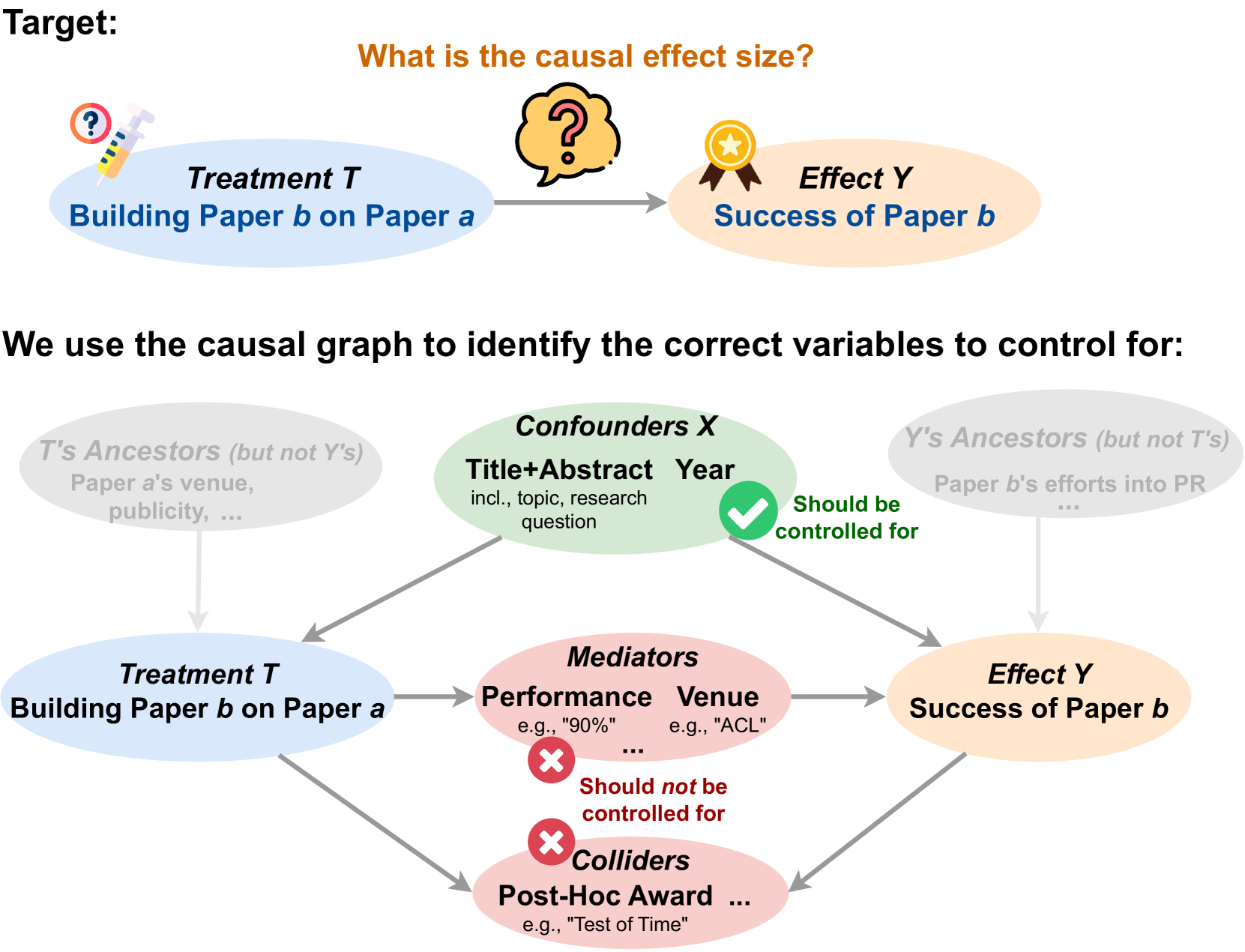
The image presents a causal diagram used to identify variables that should or should not be controlled for when estimating the causal effect size of a treatment (building paper b on paper a) on an effect (success of paper b). The diagram distinguishes between confounders, mediators, and colliders, indicating which variables should be controlled for and which should not.
### Components/Axes
* **Title:** "What is the causal effect size?"
* **Target:** Located at the top-left of the image.
* **Treatment T:** "Building Paper b on Paper a" (represented in a blue oval).
* **Effect Y:** "Success of Paper b" (represented in an orange oval).
* **Confounders X:** "Title+Abstract Year" (represented in a green oval). Includes topic and research question.
* **Mediators:** "Performance Venue" (represented in a pink oval). Examples given are "90%" and "ACL".
* **Colliders:** "Post-Hoc Award" (represented in a pink oval). Example given is "Test of Time".
* **T's Ancestors (but not Y's):** "Paper a's venue, publicity, ..." (represented in a gray oval).
* **Y's Ancestors (but not T's):** "Paper b's efforts into PR ..." (represented in a gray oval).
* **Checkmark:** A green checkmark is associated with "Confounders X" and the text "Should be controlled for".
* **Cross Marks:** Red cross marks are associated with "Mediators" and "Colliders" along with the text "Should not be controlled for".
* **Arrows:** Gray arrows indicate causal relationships between the variables.
### Detailed Analysis or ### Content Details
* **Treatment T:** Building Paper b on Paper a.
* **Effect Y:** Success of Paper b.
* **Confounders X:** Title+Abstract Year (including topic, research question). Should be controlled for.
* **Mediators:** Performance Venue (e.g., "90%", "ACL"). Should not be controlled for.
* **Colliders:** Post-Hoc Award (e.g., "Test of Time"). Should not be controlled for.
* **T's Ancestors (but not Y's):** Paper a's venue, publicity.
* **Y's Ancestors (but not T's):** Paper b's efforts into PR.
### Key Observations
* Confounders should be controlled for when estimating the causal effect.
* Mediators and Colliders should not be controlled for.
* The diagram illustrates the relationships between treatment, effect, and other variables that can influence the causal relationship.
### Interpretation
The causal diagram provides a framework for understanding and addressing confounding variables in research. By identifying confounders, mediators, and colliders, researchers can make informed decisions about which variables to control for in their analyses, leading to more accurate estimates of causal effects. The diagram highlights the importance of considering the underlying causal structure when designing and interpreting research studies.