## Causal Diagram: Effect of Building Paper b on Paper a's Success
### Overview
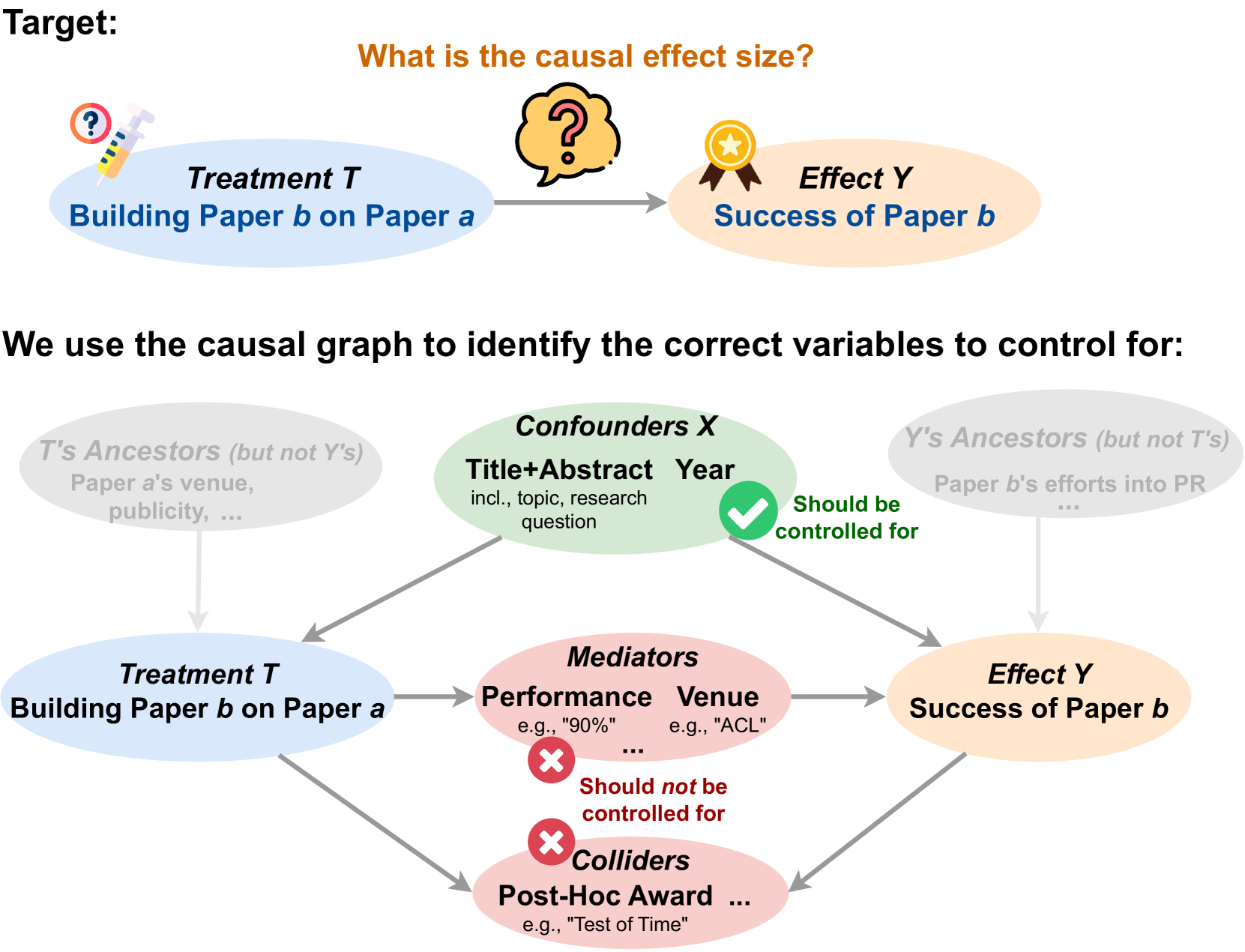
The diagram illustrates a causal framework to analyze the relationship between "Building Paper b on Paper a" (Treatment T) and "Success of Paper b" (Effect Y). It identifies variables to control for in causal inference, distinguishing confounders, mediators, and colliders.
### Components/Axes
1. **Main Elements**:
- **Treatment T**: "Building Paper b on Paper a" (light blue oval).
- **Effect Y**: "Success of Paper b" (peach oval).
- **Confounders X**: "Title+Abstract" (incl. topic, research question) and "Year" (green oval with checkmark).
- **Mediators**: "Performance" (e.g., "90%") and "Venue" (e.g., "ACL") (pink ovals with X marks).
- **Colliders**: "Post-Hoc Award" (e.g., "Test of Time") (pink oval with X mark).
2. **Arrows**:
- **Direct Influence**: Treatment T → Effect Y (dashed arrow).
- **Mediation Path**: Treatment T → Mediators → Effect Y (solid arrows).
- **Confounder Influence**: Confounders X → Effect Y (dashed arrows).
- **Ancestral Links**:
- T’s Ancestors (e.g., "Paper a’s venue, publicity") → Treatment T (gray dashed arrows).
- Y’s Ancestors (e.g., "Paper b’s efforts into PR") → Effect Y (gray dashed arrows).
3. **Annotations**:
- **Checkmark**: Confounders X should be controlled for.
- **X Marks**: Mediators and Colliders should not be controlled for.
### Detailed Analysis
- **Confounders X** (green oval):
- Includes "Title+Abstract" (topic, research question) and "Year."
- Explicitly marked with a checkmark, indicating these variables must be controlled to isolate the causal effect of Treatment T on Effect Y.
- **Mediators** (pink ovals):
- "Performance" (e.g., "90%") and "Venue" (e.g., "ACL").
- Arrows show they mediate the relationship between Treatment T and Effect Y.
- X marks indicate they should **not** be controlled for, as doing so would block the causal pathway.
- **Colliders** (pink oval):
- "Post-Hoc Award" (e.g., "Test of Time").
- Colliders are variables influenced by both Treatment T and Effect Y. Controlling for them would introduce bias, hence the X mark.
- **Ancestral Links**:
- T’s Ancestors (e.g., "Paper a’s venue, publicity") and Y’s Ancestors (e.g., "Paper b’s efforts into PR") are excluded from direct control, as they are upstream/downstream factors not directly tied to the causal mechanism.
### Key Observations
1. **Control Variables**: Only Confounders X (Title+Abstract, Year) should be controlled for to avoid confounding bias.
2. **Mediators**: Performance and Venue are critical mediators; controlling them would obscure the true causal effect.
3. **Colliders**: Post-Hoc Awards are colliders; controlling them would distort the causal relationship.
4. **Ancestral Factors**: Excluded from control to focus on direct and mediated effects.
### Interpretation
This diagram emphasizes the importance of distinguishing between confounders, mediators, and colliders in causal analysis. By controlling only for Confounders X (Title+Abstract, Year), researchers can isolate the direct and indirect effects of building Paper b on Paper a’s success. Mediators (Performance, Venue) and Colliders (Post-Hoc Awards) are excluded from control to preserve the integrity of the causal pathway. The diagram aligns with principles of causal inference, highlighting how improper variable selection can lead to biased conclusions. For example, controlling for mediators would underestimate the true effect of Treatment T, while controlling for colliders would introduce spurious associations.