## Diagram: Spatial Reasoning Test
### Overview
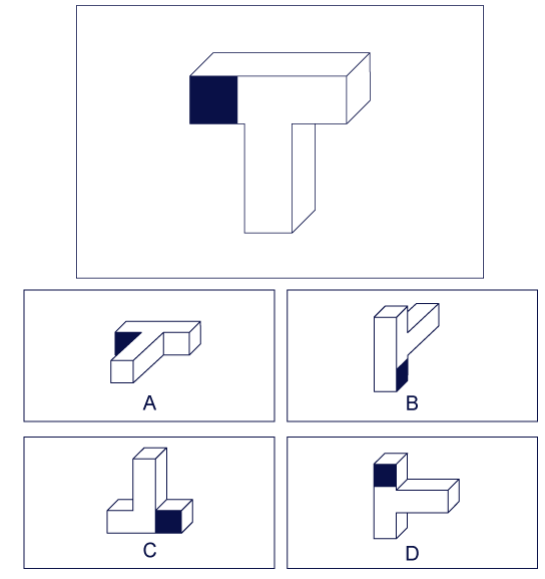
The image is a spatial reasoning assessment item. It displays a reference 3D object at the top and four potential variations (labeled A, B, C, and D) at the bottom. The task requires the viewer to identify which of the four options represents the reference object after a rotation in 3D space.
### Components
* **Reference Object (Top):** A 3D "T" block, oriented upright.
* **Options (Bottom):** Four distinct panels, labeled "A", "B", "C", and "D", each containing a rotated version of the "T" block.
* **Visual Style:** The diagrams are rendered as simple 3D wireframes with a single shaded face (dark blue) on each object.
### Detailed Analysis
**Reference Object (Top Center)**
* **Structure:** A horizontal rectangular prism (crossbar) sits atop a vertical rectangular prism (stem).
* **Shading:** The top-left corner of the horizontal crossbar is shaded dark blue.
**Option A (Bottom Left)**
* **Orientation:** The "T" is rotated.
* **Shading Position:** The shaded face is located on the "inner" corner where the horizontal crossbar meets the vertical stem.
**Option B (Bottom Right)**
* **Orientation:** The "T" is rotated.
* **Shading Position:** The shaded face is located at the bottom of the vertical stem.
**Option C (Bottom Left, below A)**
* **Orientation:** The "T" is rotated.
* **Shading Position:** The shaded face is located at the bottom-right corner of the horizontal crossbar.
**Option D (Bottom Right, below B)**
* **Orientation:** The "T" is rotated 90 degrees clockwise.
* **Shading Position:** The horizontal crossbar is now positioned on the right side of the stem. The shaded face is located at the top of this crossbar.
### Key Observations
* **Object Constancy:** The geometry of the "T" shape remains constant across all five instances; only the orientation and the position of the shaded face change.
* **Shading Consistency:** The shaded face is always a single square unit of the 3D object.
* **Visual Logic:** The test relies on the viewer's ability to perform mental rotation. For example, if the reference object is rotated 90 degrees clockwise, the top-left corner of the crossbar would move to the top-right corner of the crossbar (which is now vertical).
### Interpretation
This image is a standard psychometric test item designed to evaluate **spatial visualization ability**.
* **The Challenge:** The viewer must mentally manipulate the 3D object to determine which of the four options (A, B, C, or D) is a valid rotation of the reference object.
* **Peircean/Analytical Perspective:** The diagram functions as a signifier of spatial logic. The "T" shape acts as the *representamen*, and the shaded corner acts as a *marker* or *index* to track the object's orientation. By tracking the position of the shaded marker relative to the stem and crossbar, one can deduce the correct rotation.
* **Conclusion:** Based on mental rotation, Option D is the correct transformation of the reference object. When the reference object is rotated 90 degrees clockwise, the crossbar moves to the right, and the shaded top-left corner of the crossbar moves to the top of the now-vertical crossbar, matching the configuration in Option D.