\n
## Diagram: 3D Block Rotation/Matching
### Overview
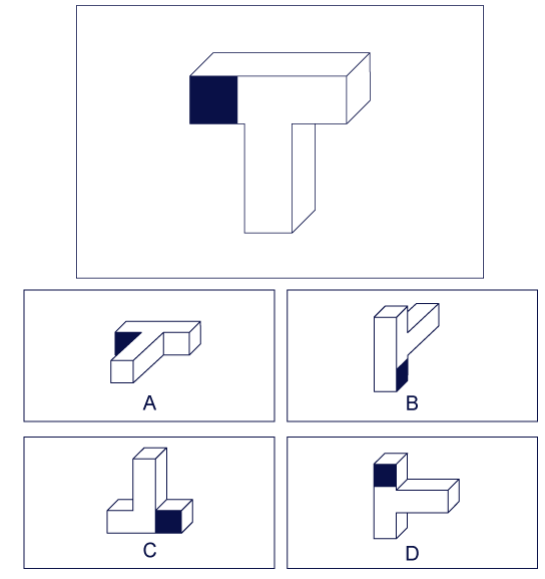
The image presents a spatial reasoning puzzle. A 3D block in a specific orientation is shown at the top. Below it are four alternative 3D blocks (labeled A, B, C, and D). The task appears to be identifying which of the four blocks represents a rotation of the original block. The blocks are rendered in a simple line drawing style with a single dark block within each.
### Components/Axes
There are no axes or scales present. The diagram consists of five distinct 3D block representations. Each block is a variation of a basic rectangular prism shape. The blocks are arranged in a 2x3 grid. The top row contains the original block, and the bottom two rows contain the four alternatives. Each alternative is labeled with a letter: A, B, C, and D.
### Detailed Analysis or Content Details
The original block is shaped like the letter "T". It has a vertical stem and a horizontal crossbar. A dark block is positioned on the upper right side of the crossbar.
* **Block A:** This block is a rectangular prism with a dark block on the upper left side.
* **Block B:** This block is a more complex shape, angled, with a dark block on the upper right side.
* **Block C:** This block is shaped like the letter "T", similar to the original, with a dark block on the upper right side of the crossbar.
* **Block D:** This block is a rectangular prism with a dark block on the upper right side.
### Key Observations
Block C is the only block that matches the original block's shape and the position of the dark block. The other blocks have different shapes or the dark block is in a different location.
### Interpretation
The diagram is designed to test spatial reasoning skills. The puzzle requires the viewer to mentally rotate the original block and compare it to the alternatives. The correct answer is Block C, as it is a direct rotation of the original block, maintaining both the shape and the position of the dark block. The other options are either different shapes or have the dark block in an incorrect position, indicating they are not rotations of the original. This type of puzzle is commonly used in aptitude tests and cognitive assessments.