## Diagram: Manual Curation Workflow for Annotated Dataset
### Overview
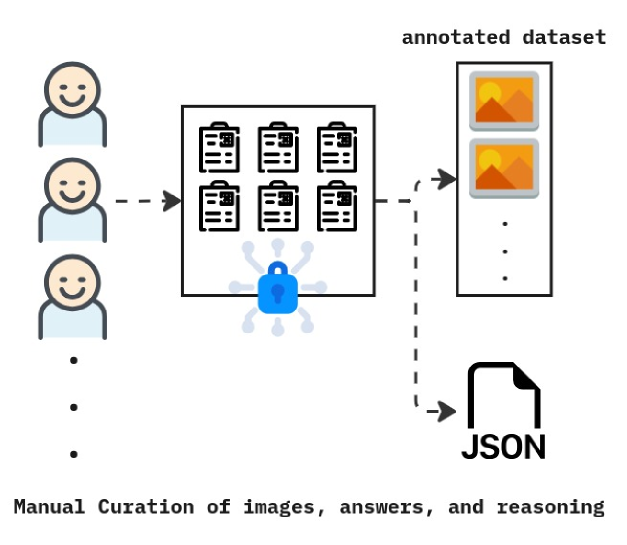
The diagram illustrates a multi-step process for curating an annotated dataset, involving human input, data processing, and output generation. It uses visual metaphors (lock icon, document icons) to represent security, documentation, and structured data.
### Components/Axes
1. **Input Elements**:
- Three smiling human figures (left side) with dashed arrows pointing to a central box.
- Central box labeled with six document icons (representing raw data or initial inputs).
- Blue lock icon at the bottom of the central box (symbolizing security/access control).
2. **Output Elements**:
- Annotated dataset (right side) containing:
- Two image thumbnails (orange/yellow gradient backgrounds).
- JSON file icon (bottom right).
- Dashed arrows connecting the central box to the annotated dataset and JSON file.
3. **Textual Labels**:
- "annotated dataset" (top right).
- "JSON" (bottom right).
- "Manual Curation of images, answers, and reasoning" (bottom center).
### Detailed Analysis
- **Flow Direction**: Left-to-right progression from human input → central processing → structured output.
- **Key Relationships**:
- Human figures → Central box (manual curation).
- Central box → Annotated dataset (data transformation).
- Central box → JSON file (structured data export).
- **Visual Metaphors**:
- Lock icon: Implies secure handling of sensitive data.
- Document icons: Represent unstructured/raw data.
- Dashed arrows: Suggest iterative or non-linear refinement steps.
### Key Observations
1. The process emphasizes human-in-the-loop curation ("Manual Curation" text).
2. Security is explicitly highlighted via the lock icon, suggesting sensitive data handling.
3. Outputs are dual-format: visual (images) and machine-readable (JSON).
4. No numerical data or quantitative metrics are present in the diagram.
### Interpretation
This diagram represents a **data annotation pipeline** where human experts manually curate and validate raw data (images/documents) before producing a structured, annotated dataset and exportable JSON file. The lock icon implies compliance with data privacy standards (e.g., GDPR), while the dual output formats suggest the dataset is intended for both human review and algorithmic use. The absence of quantitative metrics indicates this is a conceptual workflow rather than a performance measurement tool.