## Grouped Bar Chart: Refusal Ratio by Training Set and Testing Set
### Overview
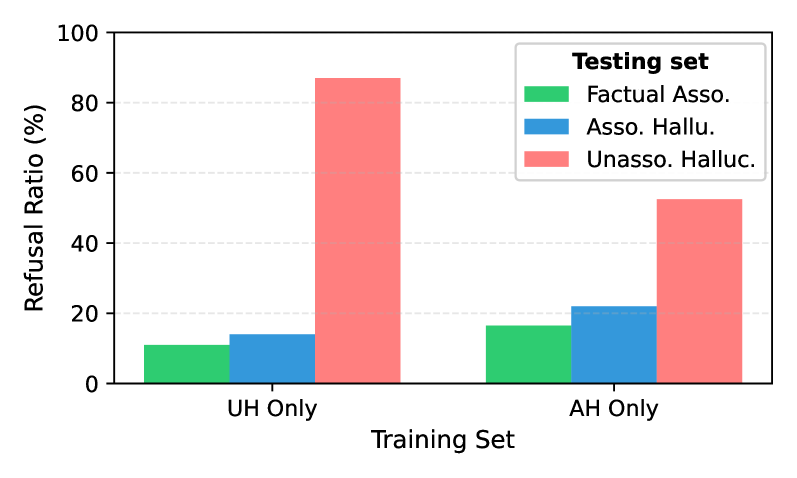
The image is a grouped bar chart comparing the "Refusal Ratio (%)" of a system (likely an AI model) when tested on three different types of data, after being trained on one of two specific training sets. The chart visually demonstrates how the training data composition affects the model's tendency to refuse responses during testing.
### Components/Axes
* **Chart Type:** Grouped Bar Chart.
* **Y-Axis:** Labeled **"Refusal Ratio (%)"**. The scale runs from 0 to 100 in increments of 20 (0, 20, 40, 60, 80, 100).
* **X-Axis:** Labeled **"Training Set"**. It contains two categorical groups:
1. **"UH Only"** (left group)
2. **"AH Only"** (right group)
* **Legend:** Located in the **top-right corner** of the chart area, titled **"Testing set"**. It defines three data series by color:
* **Green square:** "Factual Asso." (Factual Association)
* **Blue square:** "Asso. Hallu." (Associated Hallucination)
* **Red square:** "Unasso. Halluc." (Unassociated Hallucination)
### Detailed Analysis
The chart presents data for two training conditions, each tested on three data types. Values are approximate visual estimates.
**1. Training Set: "UH Only"**
* **Factual Asso. (Green Bar):** The bar height indicates a refusal ratio of approximately **10%**.
* **Asso. Hallu. (Blue Bar):** The bar height indicates a refusal ratio of approximately **15%**.
* **Unasso. Halluc. (Red Bar):** This is the tallest bar in the group, indicating a very high refusal ratio of approximately **85%**.
**2. Training Set: "AH Only"**
* **Factual Asso. (Green Bar):** The bar height indicates a refusal ratio of approximately **18%**.
* **Asso. Hallu. (Blue Bar):** The bar height indicates a refusal ratio of approximately **22%**.
* **Unasso. Halluc. (Red Bar):** The bar height indicates a refusal ratio of approximately **52%**.
**Trend Verification:**
* For the **"UH Only"** training set, the refusal ratio shows a steep, positive trend from "Factual Asso." to "Asso. Hallu." to "Unasso. Halluc.".
* For the **"AH Only"** training set, the refusal ratio also shows a positive trend across the same sequence, but the slope is less steep, and the absolute values are more moderate.
### Key Observations
1. **Dominant Effect of "Unasso. Halluc.":** Across both training sets, the "Unasso. Halluc." testing set (red bars) consistently elicits the highest refusal ratio.
2. **Training Set Impact:** The "UH Only" training set leads to a dramatically higher refusal ratio for "Unasso. Halluc." (~85%) compared to the "AH Only" training set (~52%).
3. **Factual Baseline:** The refusal ratio for "Factual Asso." is the lowest in both groups, serving as a baseline. It is slightly higher in the "AH Only" condition (~18%) than in the "UH Only" condition (~10%).
4. **Associated Hallucination Response:** The refusal ratio for "Asso. Hallu." is intermediate in both groups, sitting between the values for factual data and unassociated hallucinations.
### Interpretation
This chart likely illustrates the results of an experiment on AI model safety or alignment, specifically measuring a model's propensity to "refuse" to answer certain prompts. The data suggests a strong correlation between the type of data a model is trained on and its subsequent refusal behavior.
* **"UH Only" Training:** Models trained exclusively on data related to **Unassociated Hallucinations** become extremely sensitive to that specific type of prompt during testing, refusing them at a very high rate (85%). However, this specialization comes at a cost: their refusal rate for factual associations is the lowest, suggesting they may be less cautious or discerning with factual information.
* **"AH Only" Training:** Models trained on **Associated Hallucinations** show a more balanced, though still elevated, refusal profile. They are less hyper-sensitive to unassociated hallucinations than the UH-only model but maintain a higher baseline refusal rate across all categories, including factual associations. This could indicate a more generalized, but potentially over-cautious, safety behavior.
* **Underlying Pattern:** The consistent ordering of refusal rates (Factual < Associated Hallucination < Unassociated Hallucination) across both training regimes indicates a fundamental hierarchy in how the model categorizes and responds to these prompt types. Unassociated hallucinations are treated as the most "dangerous" or requiring the strongest refusal response. The training set primarily modulates the *intensity* of this response, especially for the most extreme category.