# Technical Document Extraction: Refusal Ratio Analysis
## 1. Image Overview
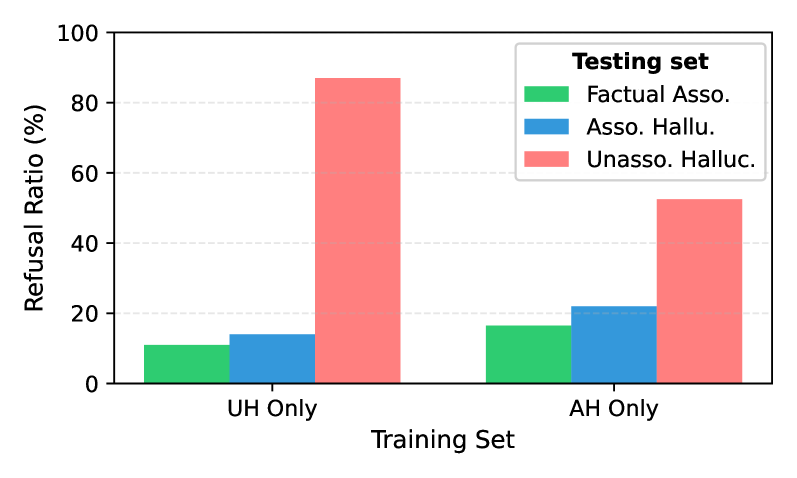
This image is a grouped bar chart illustrating the "Refusal Ratio (%)" of a system (likely a Large Language Model) across different training and testing conditions. It compares how training on specific types of data (UH vs. AH) affects the system's tendency to refuse prompts categorized by factual association and hallucination types.
## 2. Component Isolation
### A. Header/Axes
* **Y-Axis Label:** Refusal Ratio (%)
* **Y-Axis Scale:** 0 to 100, with major markers every 20 units (0, 20, 40, 60, 80, 100).
* **X-Axis Label:** Training Set
* **X-Axis Categories:** "UH Only" and "AH Only"
* **Gridlines:** Horizontal dashed light-gray lines at 20, 40, 60, and 80 on the Y-axis.
### B. Legend
The legend defines three categories for the **Testing set**:
* **Green:** Factual Asso.
* **Blue:** Asso. Hallu.
* **Red/Salmon:** Unasso. Halluc.
## 3. Data Extraction and Trend Analysis
### Trend Verification
1. **Unasso. Halluc. (Red):** This series shows the highest refusal ratios in both training scenarios but drops significantly when moving from "UH Only" training to "AH Only" training.
2. **Asso. Hallu. (Blue):** This series shows a moderate increase in refusal ratio when moving from "UH Only" to "AH Only" training.
3. **Factual Asso. (Green):** This series shows the lowest refusal ratios overall, with a slight increase when moving from "UH Only" to "AH Only" training.
### Data Table (Reconstructed)
Values are estimated based on the Y-axis scale and gridlines.
| Training Set (X-Axis) | Factual Asso. (Green) | Asso. Hallu. (Blue) | Unasso. Halluc. (Red) |
| :--- | :--- | :--- | :--- |
| **UH Only** | ~11% | ~14% | ~87% |
| **AH Only** | ~16% | ~22% | ~53% |
## 4. Detailed Observations
* **Dominant Category:** The "Unasso. Halluc." (Unassociated Hallucination) testing set consistently triggers the highest refusal ratio regardless of the training set.
* **Impact of Training:**
* Training on **"UH Only"** (Unassociated Hallucination) results in an extremely high refusal rate for unassociated hallucinations (~87%) but very low refusal for factual associations (~11%).
* Training on **"AH Only"** (Associated Hallucination) leads to a more balanced, though still skewed, refusal profile. It reduces the refusal of unassociated hallucinations to ~53% while slightly increasing the refusal of factual associations and associated hallucinations.
* **Cross-Reference Check:** The red bar in the "UH Only" group nearly reaches the 90% mark, while the red bar in the "AH Only" group sits just above the 50% midline between the 40 and 60 gridlines, confirming the data points align with the visual representation.