## Neural Network Switching Types
### Overview
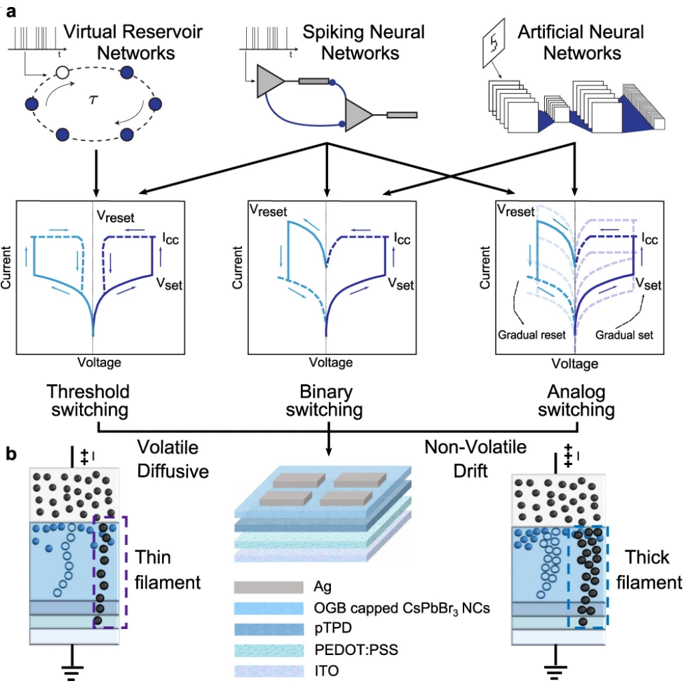
The image illustrates three types of neural networks (Virtual Reservoir, Spiking Neural, and Artificial Neural Networks) and their corresponding switching behaviors (Threshold, Binary, and Analog). It also depicts the physical mechanisms behind volatile and non-volatile switching, showing thin and thick filament formation.
### Components/Axes
**Part a: Neural Networks and Switching Characteristics**
* **Top Row:** Three types of neural networks are shown:
* Virtual Reservoir Networks: A circular network with nodes and connections.
* Spiking Neural Networks: A network with amplifier-like components.
* Artificial Neural Networks: A layered network structure.
* **Bottom Row:** Current-Voltage (I-V) characteristics for each network type:
* **Axes:** Each I-V plot has "Voltage" on the x-axis and "Current" on the y-axis.
* **Key Points:** Each plot indicates Vreset, Icc, and Vset.
* **Threshold Switching:** The I-V curve shows a sharp transition at a threshold voltage.
* **Binary Switching:** The I-V curve shows a clear on/off state transition.
* **Analog Switching:** The I-V curve shows gradual changes in current with voltage. The plot also labels "Gradual reset" and "Gradual set".
**Part b: Physical Mechanisms of Switching**
* **Left:** "Volatile Diffusive" switching mechanism with a "Thin filament" structure.
* Shows a schematic of a device with layers labeled: ITO, PEDOT:PSS, pTPD, OGB capped CsPbBr3 NCs, and Ag.
* Illustrates the formation of a thin filament.
* **Middle:** A top-down view of the device structure.
* **Right:** "Non-Volatile Drift" switching mechanism with a "Thick filament" structure.
* Shows a schematic of a device with layers labeled: ITO, PEDOT:PSS, pTPD, OGB capped CsPbBr3 NCs, and Ag.
* Illustrates the formation of a thick filament.
### Detailed Analysis or ### Content Details
**Part a: Neural Networks and Switching Characteristics**
* **Virtual Reservoir Networks:**
* The network consists of a dashed circle with several filled blue circles representing nodes. One node is white. Arrows indicate the direction of flow. The symbol "τ" is present inside the circle.
* **Spiking Neural Networks:**
* The network contains amplifier-like components connected by lines.
* **Artificial Neural Networks:**
* The network is represented by stacked layers of blocks, with the number "5" visible above the layers.
* **Threshold Switching:**
* The I-V curve starts at low voltage and current, then sharply increases in current at a certain voltage (Vset). As voltage decreases, the current drops sharply at Vreset.
* **Binary Switching:**
* The I-V curve shows a clear on/off state transition.
* **Analog Switching:**
* The I-V curve shows gradual changes in current with voltage, indicating multiple intermediate states.
**Part b: Physical Mechanisms of Switching**
* **Volatile Diffusive (Thin Filament):**
* The schematic shows a thin filament forming between the top and bottom electrodes.
* The layers are arranged from bottom to top: ITO, PEDOT:PSS, pTPD, OGB capped CsPbBr3 NCs, and Ag.
* **Non-Volatile Drift (Thick Filament):**
* The schematic shows a thick filament forming between the top and bottom electrodes.
* The layers are arranged from bottom to top: ITO, PEDOT:PSS, pTPD, OGB capped CsPbBr3 NCs, and Ag.
### Key Observations
* The type of neural network correlates with the switching behavior observed in the I-V characteristics.
* Volatile switching is associated with thin filament formation, while non-volatile switching is associated with thick filament formation.
* The device structure consists of multiple layers, including ITO, PEDOT:PSS, pTPD, OGB capped CsPbBr3 NCs, and Ag.
### Interpretation
The image demonstrates the relationship between different types of neural networks and their corresponding switching behaviors. It highlights the physical mechanisms underlying volatile and non-volatile switching, which are attributed to the formation of thin and thick filaments, respectively. The different switching behaviors (threshold, binary, and analog) are linked to the specific characteristics of the neural networks and the filament formation process. This suggests that the choice of materials and device structure can be tailored to achieve specific switching characteristics for different neural network applications.