## Diagram: Neural Network Architectures and Material Structures
### Overview
The image presents two primary sections:
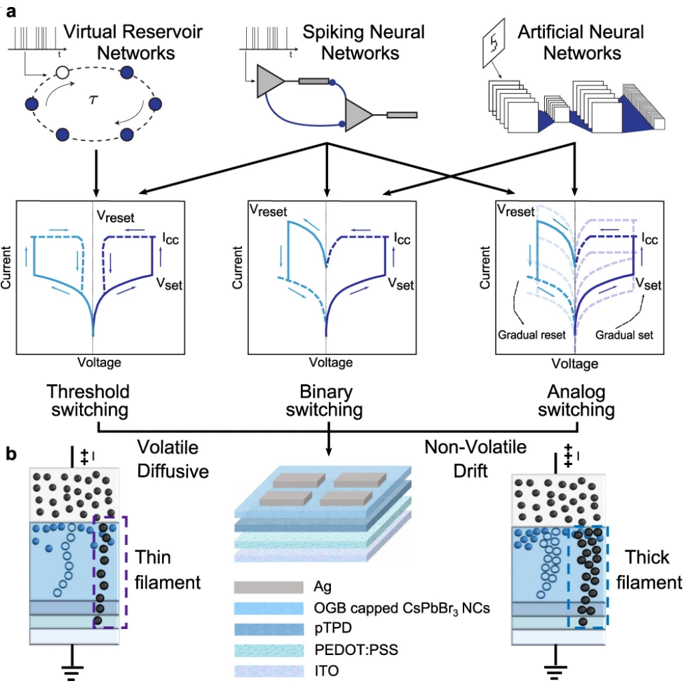
1. **Section a**: Compares three neural network architectures (Virtual Reservoir, Spiking, Artificial) with their operational mechanisms (switching types).
2. **Section b**: Illustrates two filament structures (Thin and Thick) with layered material compositions and properties.
---
### Components/Axes
#### Section a: Neural Network Architectures
- **Virtual Reservoir Networks**:
- Circular node arrangement labeled `τ` (time constant).
- Box diagram with:
- **Current** (dashed line), **Voltage** (solid line), **Vreset**, **Icc**, **Vset**.
- **Threshold switching** (blue legend).
- **Spiking Neural Networks**:
- Similar box diagram with:
- **Current**, **Voltage**, **Vreset**, **Icc**, **Vset**.
- **Binary switching** (green legend).
- **Artificial Neural Networks**:
- Box diagram with:
- **Current**, **Voltage**, **Vreset**, **Icc**, **Vset**, **Gradient reset**, **Gradient set**.
- **Analog switching** (red legend).
#### Section b: Filament Structures
- **Thin Filament**:
- Dotted porous structure with layers:
- **Ag** (silver), **OGB capped CsPbBr₃**, **pTPD**, **PEDOT:PSS**, **ITO** (indium tin oxide).
- **Volatile Diffusive** (blue legend).
- **Thick Filament**:
- Denser structure with similar layers but thicker **OGB capped CsPbBr₃**.
- **Non-Volatile Drift** (green legend).
---
### Detailed Analysis
#### Section a: Switching Mechanisms
1. **Virtual Reservoir Networks**:
- **Threshold switching** (blue) involves voltage-dependent activation (`Vset`, `Icc`).
- Circular node arrangement suggests dynamic reservoir states.
2. **Spiking Neural Networks**:
- **Binary switching** (green) uses discrete voltage thresholds (`Vreset`, `Vset`).
- Simplified node connections compared to Virtual Reservoir.
3. **Artificial Neural Networks**:
- **Analog switching** (red) incorporates gradient-based updates (`Gradient reset`, `Gradient set`).
- Complex parameter interactions for continuous adjustments.
#### Section b: Filament Properties
- **Thin Filament**:
- Porous structure with **OGB capped CsPbBr₃** (blue) and **pTPD** (dark blue) layers.
- **Volatile Diffusive** behavior implies rapid charge/discharge cycles.
- **Thick Filament**:
- Enhanced **OGB capped CsPbBr₃** layer for stability.
- **Non-Volatile Drift** (green) suggests slower, persistent charge retention.
---
### Key Observations
1. **Switching Mechanisms**:
- Threshold switching (Virtual Reservoir) and Binary switching (Spiking) are discrete, while Analog switching (Artificial) enables continuous adjustments.
2. **Filament Design**:
- Thin filaments prioritize volatility (rapid response), while thick filaments emphasize non-volatility (long-term stability).
- Material layering (e.g., **pTPD**, **PEDOT:PSS**) likely modulates conductivity and drift characteristics.
---
### Interpretation
- **Neural Network Architectures**:
- The choice of switching mechanism (Threshold, Binary, Analog) directly impacts computational efficiency and adaptability. Virtual Reservoir Networks may excel in dynamic environments, while Artificial Networks prioritize precision via gradient-based updates.
- **Filament Structures**:
- Material composition and thickness trade off volatility for stability. Thin filaments with **OGB capped CsPbBr₃** and **pTPD** are suited for high-speed applications, whereas thick filaments with reinforced layers are ideal for memory retention.
- **Cross-Sectional Insights**:
- The diagrams emphasize material engineering (e.g., **ITO** electrodes, **Ag** contacts) to optimize neural network performance.
---
### Uncertainties
- No numerical values or quantitative data are provided; trends are inferred from structural and categorical labels.
- Material layer thicknesses (e.g., "thin" vs. "thick") are qualitative, not metric-based.