\n
## Bar Chart: Comparison with Different Settings and GKG-LLM
### Overview
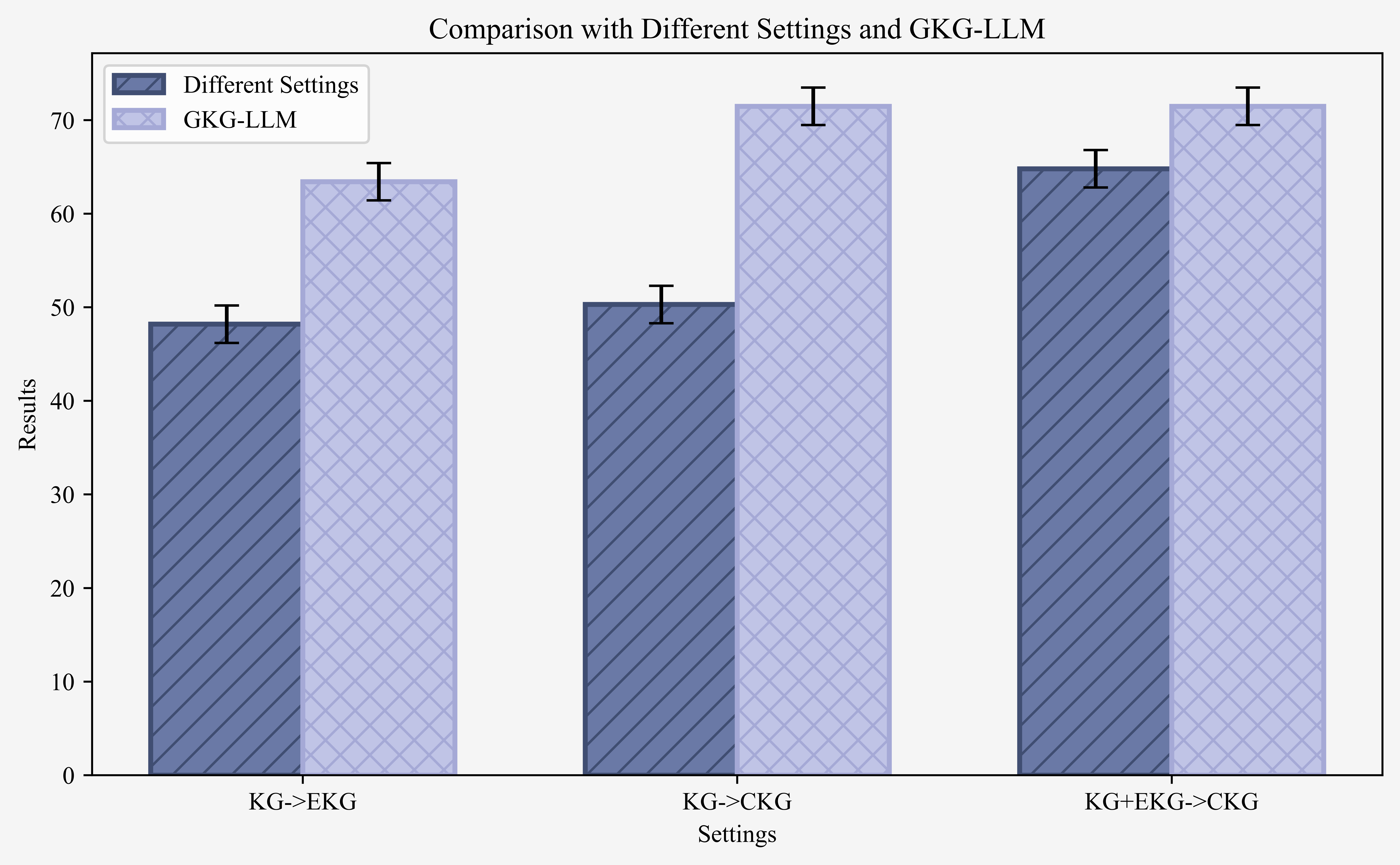
The image is a grouped bar chart comparing the performance (labeled "Results") of two approaches across three different experimental settings. The chart includes error bars for each data point, indicating variability or confidence intervals. The overall title is "Comparison with Different Settings and GKG-LLM".
### Components/Axes
* **Chart Title:** "Comparison with Different Settings and GKG-LLM" (centered at the top).
* **Y-Axis:** Labeled "Results". The scale runs from 0 to 70, with major tick marks at intervals of 10 (0, 10, 20, 30, 40, 50, 60, 70).
* **X-Axis:** Labeled "Settings". It contains three categorical groups:
1. `KG->EKG`
2. `KG->CKG`
3. `KG+EKG->CKG`
* **Legend:** Located in the top-left corner of the plot area.
* **Dark blue bar with diagonal stripes (\\):** Labeled "Different Settings".
* **Light blue bar with cross-hatching (X):** Labeled "GKG-LLM".
* **Data Series:** Each of the three x-axis categories contains two adjacent bars, one for each series defined in the legend. Each bar is topped with a black error bar (I-beam style).
### Detailed Analysis
**Data Point Extraction (Approximate Values):**
The values below are estimated from the y-axis scale. The error bars appear to represent a range of approximately ±2 to ±3 units.
| Setting | Series (Legend) | Approximate Result Value | Error Bar Range (Approx.) |
| :--- | :--- | :--- | :--- |
| **KG->EKG** | Different Settings | 48 | 46 to 50 |
| **KG->EKG** | GKG-LLM | 63 | 61 to 65 |
| **KG->CKG** | Different Settings | 50 | 48 to 52 |
| **KG->CKG** | GKG-LLM | 71 | 69 to 73 |
| **KG+EKG->CKG** | Different Settings | 65 | 63 to 67 |
| **KG+EKG->CKG** | GKG-LLM | 71 | 69 to 73 |
**Trend Verification:**
* **"Different Settings" Series (Dark Blue, Striped):** This series shows a clear upward trend from left to right. The bar for `KG->EKG` is the shortest (~48), the bar for `KG->CKG` is slightly taller (~50), and the bar for `KG+EKG->CKG` is the tallest (~65).
* **"GKG-LLM" Series (Light Blue, Cross-hatched):** This series also shows an upward trend, but it is less steep. The bar for `KG->EKG` is the shortest (~63), while the bars for `KG->CKG` and `KG+EKG->CKG` are of equal, maximum height (~71).
### Key Observations
1. **Consistent Superiority:** The "GKG-LLM" bar is taller than the "Different Settings" bar in all three categories, indicating higher "Results" scores.
2. **Performance Gap:** The performance gap between the two series is largest in the `KG->EKG` setting (a difference of ~15 points) and narrows in the other two settings (a difference of ~21 points for `KG->CKG` and ~6 points for `KG+EKG->CKG`).
3. **Plateau Effect:** The performance of "GKG-LLM" appears to plateau at approximately 71 for the last two settings (`KG->CKG` and `KG+EKG->CKG`), suggesting a potential performance ceiling under those conditions.
4. **Error Bars:** The error bars are relatively small and consistent across all data points, suggesting the reported results have low variance or high confidence.
### Interpretation
This chart demonstrates the comparative effectiveness of the "GKG-LLM" method against a baseline referred to as "Different Settings" across three distinct configurations, likely related to knowledge graph (KG) processing tasks (inferred from labels like EKG, CKG).
* **What the data suggests:** GKG-LLM consistently yields higher results. The most significant advantage is seen in the `KG->EKG` transformation task. The method's performance improves as the setting changes from `KG->EKG` to `KG->CKG`, but shows no further improvement when combining inputs (`KG+EKG->CKG`), hinting that the `CKG` output may be the primary driver of performance in the latter two cases.
* **Relationship between elements:** The x-axis represents increasing complexity or a change in the transformation task (from KG to an "EKG", then to a "CKG", then using both KG and EKG to produce a CKG). The y-axis measures a success metric for these tasks. The chart effectively isolates the impact of the core method ("GKG-LLM" vs. "Different Settings") on this metric.
* **Notable patterns:** The convergence of the "GKG-LLM" scores for the last two settings is the most notable pattern. It implies that for the task of producing a CKG, using additional input (EKG) alongside the base KG does not improve the outcome for GKG-LLM, whereas the baseline "Different Settings" method does see a substantial benefit from the combined input. This could indicate that GKG-LLM is more efficient at leveraging the core KG information or that the EKG input provides redundant information for this particular model.