## Bar Chart: Comparison with Different Settings and GKG-LLM
### Overview
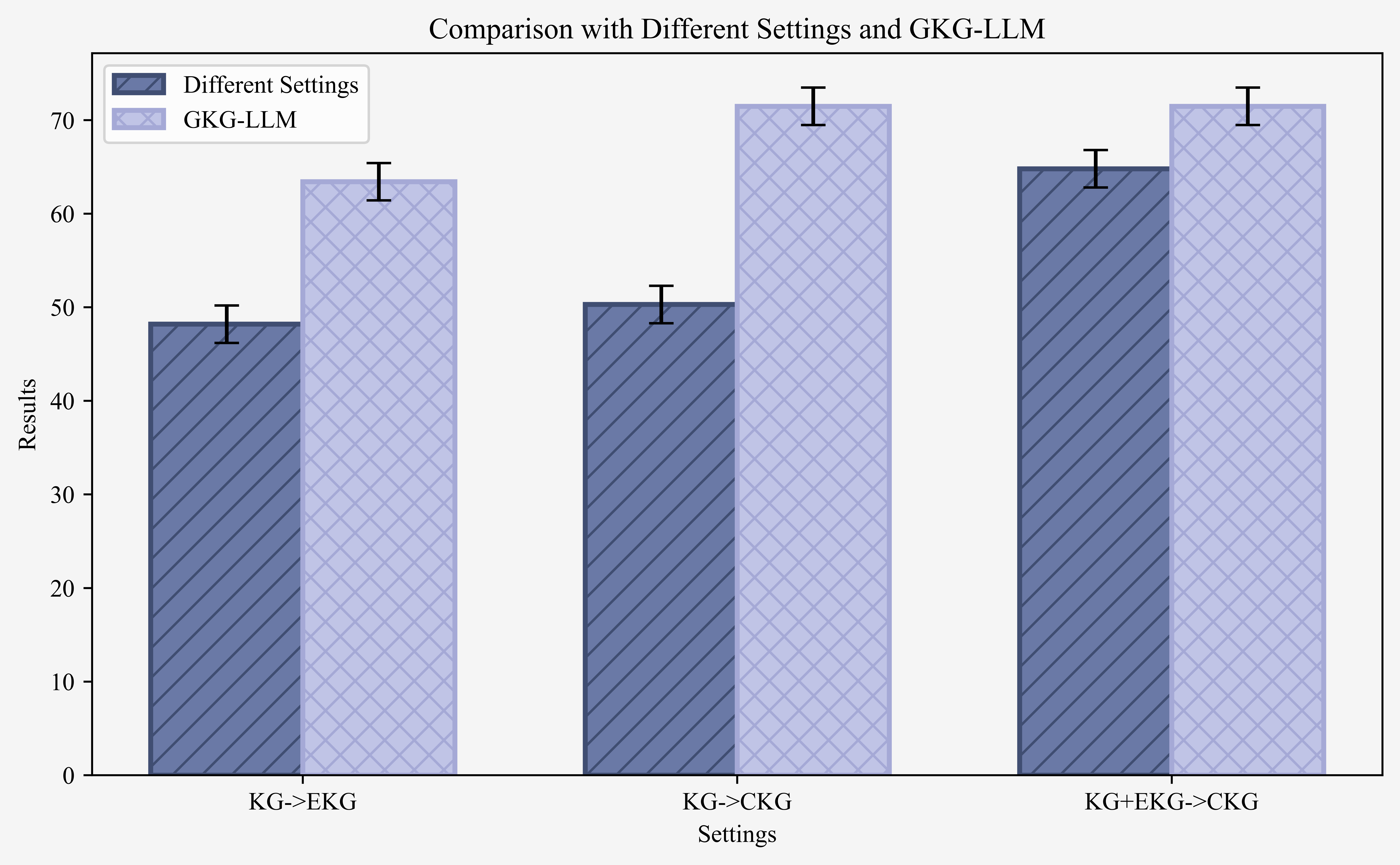
The chart compares performance results between two categories: "Different Settings" (striped pattern) and "GKG-LLM" (crosshatched pattern) across three configurations: KG->EKG, KG->CKG, and KG+EKG->CKG. Results are measured on a scale from 0 to 70, with error bars indicating uncertainty.
### Components/Axes
- **X-axis (Settings)**:
- KG->EKG
- KG->CKG
- KG+EKG->CKG
- **Y-axis (Results)**:
- Scale: 0–70 (linear)
- Units: Unspecified (generic "Results")
- **Legend**:
- Top-left corner
- "Different Settings" (striped pattern)
- "GKG-LLM" (crosshatched pattern)
### Detailed Analysis
1. **KG->EKG**:
- Different Settings: ~48 (±2)
- GKG-LLM: ~63 (±3)
2. **KG->CKG**:
- Different Settings: ~50 (±2)
- GKG-LLM: ~71 (±4)
3. **KG+EKG->CKG**:
- Different Settings: ~64 (±3)
- GKG-LLM: ~71 (±4)
### Key Observations
- GKG-LLM consistently outperforms "Different Settings" in all configurations.
- The largest performance gap occurs in KG->CKG (21-point difference).
- Error bars for GKG-LLM are larger in KG->CKG and KG+EKG->CKG, suggesting higher variability in those settings.
- "Different Settings" show minimal improvement from KG->EKG to KG+EKG->CKG (~16-point increase).
### Interpretation
The data demonstrates that GKG-LLM significantly outperforms baseline configurations across all tested settings. The performance advantage is most pronounced in KG->CKG, where GKG-LLM achieves ~71 results versus ~50 for "Different Settings." The minimal improvement in "Different Settings" from KG->EKG to KG+EKG->CKG suggests that incremental configuration changes have limited impact without the GKG-LLM framework. The error bars indicate that while GKG-LLM's performance is stable in KG->EKG, its results become more variable in complex configurations (KG->CKG and KG+EKG->CKG), potentially reflecting increased computational complexity or sensitivity to input parameters.