## Diagram: Causal Model of Education, Gender, Score, and Test
### Overview
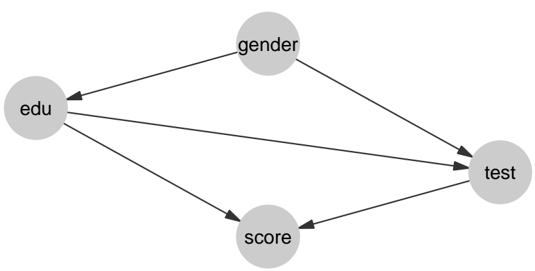
The image displays a directed acyclic graph (DAG), commonly known as a causal diagram or path diagram. It illustrates hypothesized relationships and directional influences between four distinct variables: "edu", "gender", "score", and "test". The variables are represented as light grey circular nodes, and the relationships are depicted by black directed arrows indicating the flow of influence.
### Components/Axes
The diagram consists solely of nodes and directed edges. There are no axes, legends, or explicit titles within the image itself.
**Nodes (Variables):**
* **edu**: A light grey circular node, centrally positioned on the left side of the diagram. The text "edu" is centered within it.
* **gender**: A light grey circular node, positioned in the top-center region of the diagram. The text "gender" is centered within it.
* **score**: A light grey circular node, positioned in the bottom-center region of the diagram. The text "score" is centered within it.
* **test**: A light grey circular node, positioned on the right side of the diagram, slightly below the vertical center. The text "test" is centered within it.
**Edges (Directed Relationships):**
All edges are black arrows indicating a unidirectional influence from the source node to the destination node.
* An arrow originates from the "gender" node (top-center) and points towards the "edu" node (left-center).
* An arrow originates from the "gender" node (top-center) and points towards the "test" node (right-center).
* An arrow originates from the "edu" node (left-center) and points towards the "test" node (right-center).
* An arrow originates from the "edu" node (left-center) and points towards the "score" node (bottom-center).
* An arrow originates from the "score" node (bottom-center) and points towards the "test" node (right-center).
### Detailed Analysis
The diagram visually represents a network of dependencies among the four variables. Each arrow signifies a direct causal effect or influence.
**Node Positions and Connections:**
* **gender** (top-center): Acts as a source node for two outgoing arrows, indicating it influences "edu" and "test". It has no incoming arrows, suggesting it is an exogenous variable in this model.
* `gender` → `edu`
* `gender` → `test`
* **edu** (left-center): Receives one incoming arrow from "gender" and has two outgoing arrows, indicating it influences "test" and "score".
* `gender` → `edu`
* `edu` → `test`
* `edu` → `score`
* **score** (bottom-center): Receives one incoming arrow from "edu" and has one outgoing arrow, indicating it influences "test".
* `edu` → `score`
* `score` → `test`
* **test** (right-center): Receives three incoming arrows from "edu", "gender", and "score". It has no outgoing arrows, indicating it is an ultimate outcome or dependent variable in this model.
* `gender` → `test`
* `edu` → `test`
* `score` → `test`
### Key Observations
* "gender" is an upstream variable, influencing "edu" and "test" directly.
* "edu" is an intermediate variable, influenced by "gender" and, in turn, influencing "score" and "test".
* "score" is also an intermediate variable, influenced by "edu" and influencing "test".
* "test" is the most downstream variable, directly influenced by all other variables ("gender", "edu", "score").
* There are no reciprocal relationships (e.g., an arrow from A to B and B to A) or cycles, confirming it is a directed acyclic graph.
* The diagram implies specific pathways of influence, for example, "gender" can influence "test" directly, or indirectly via "edu", and further indirectly via "edu" then "score".
### Interpretation
This diagram presents a hypothesized causal structure among "education" (edu), "gender", "score", and "test". It suggests that:
1. **Gender** directly influences both an individual's **education** level and their **test** performance. This could imply societal or biological factors related to gender that affect educational attainment and test outcomes.
2. **Education** is influenced by **gender**, and in turn, **education** directly influences both an individual's **score** (perhaps on a specific task or assessment) and their overall **test** performance. This highlights the role of education as a mediator or a direct causal factor.
3. The **score** variable is influenced by **education**, and this **score** then directly influences the final **test** outcome. This suggests that the "score" might represent an intermediate performance metric or a specific skill acquired through education that contributes to the broader "test" performance.
4. The **test** variable is the ultimate outcome, being directly affected by **gender**, **education**, and the specific **score**. This implies that to understand "test" outcomes, one must consider these three factors and their interrelationships.
The model allows for the investigation of direct and indirect effects. For instance, the effect of "gender" on "test" can be decomposed into a direct effect and indirect effects mediated through "edu" (gender -> edu -> test) and through "edu" and "score" (gender -> edu -> score -> test). This type of diagram is fundamental in fields like econometrics, social sciences, and epidemiology for designing studies, identifying confounding variables, and performing causal inference. The absence of an arrow between "gender" and "score" (direct) suggests that any influence of "gender" on "score" is entirely mediated through "edu". Similarly, there is no direct arrow from "score" to "edu" or "gender", reinforcing the directionality of influence.