\n
## Diagram: Network Topology
### Overview
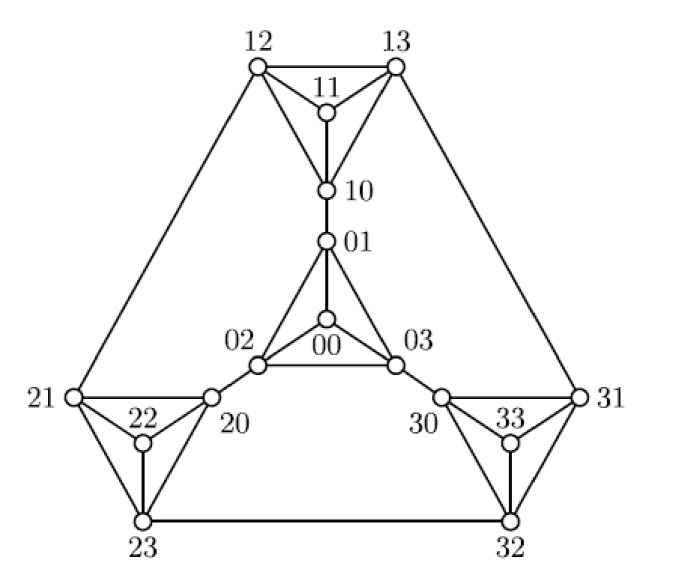
The image depicts a network topology represented as a graph. The graph consists of nodes (represented by circles) and edges (represented by lines connecting the nodes). Each node is labeled with a two-digit number. The diagram appears to illustrate connections between different states or configurations within a system.
### Components/Axes
The diagram does not have traditional axes or a legend. It consists solely of nodes and edges. The nodes are labeled as follows: 00, 01, 02, 03, 10, 11, 12, 13, 20, 21, 22, 23, 30, 31, 32, 33. The edges represent connections between these nodes.
### Detailed Analysis or Content Details
The diagram shows the following connections:
* **00** is connected to 01, 02, and 03.
* **01** is connected to 00, 10, 02, and 03.
* **02** is connected to 00, 01, 20, and 21.
* **03** is connected to 00, 01, 30, and 31.
* **10** is connected to 01, 11, 12, and 13.
* **11** is connected to 10, 12, and 13.
* **12** is connected to 10, 11, and 21.
* **13** is connected to 10, 11, and 31.
* **20** is connected to 02, 21, and 22.
* **21** is connected to 02, 12, 20, and 23.
* **22** is connected to 20, 21, and 23.
* **23** is connected to 21, 22, and 32.
* **30** is connected to 03, 31, and 33.
* **31** is connected to 03, 13, 30, and 32.
* **32** is connected to 23, 31, and 33.
* **33** is connected to 30, 31, and 32.
The network appears to be structured around a central node **00**, with branching connections to nodes in the 10s, 20s, and 30s series.
### Key Observations
The diagram exhibits a symmetrical structure. The nodes 10, 20, and 30 appear to be "corner" nodes, each connected to three other nodes. The nodes 11, 22, and 33 are also central to their respective sections of the network. The connections are bidirectional, meaning the edges represent two-way communication or relationships.
### Interpretation
This diagram likely represents a state transition diagram or a network topology. The nodes could represent different states in a system, and the edges represent possible transitions between those states. The symmetrical structure suggests a balanced or regular system. The numbering scheme (00, 01, etc.) might indicate a binary representation or a systematic ordering of states.
The diagram could also represent a communication network, where nodes are devices and edges are communication links. The central node 00 could be a central server or hub. The connections suggest a fully connected or highly interconnected network.
Without further context, it's difficult to determine the exact meaning of the diagram. However, the structure and labeling suggest a well-defined and organized system.