## Diagram: Comparison of Problem-Solving Methods
### Overview
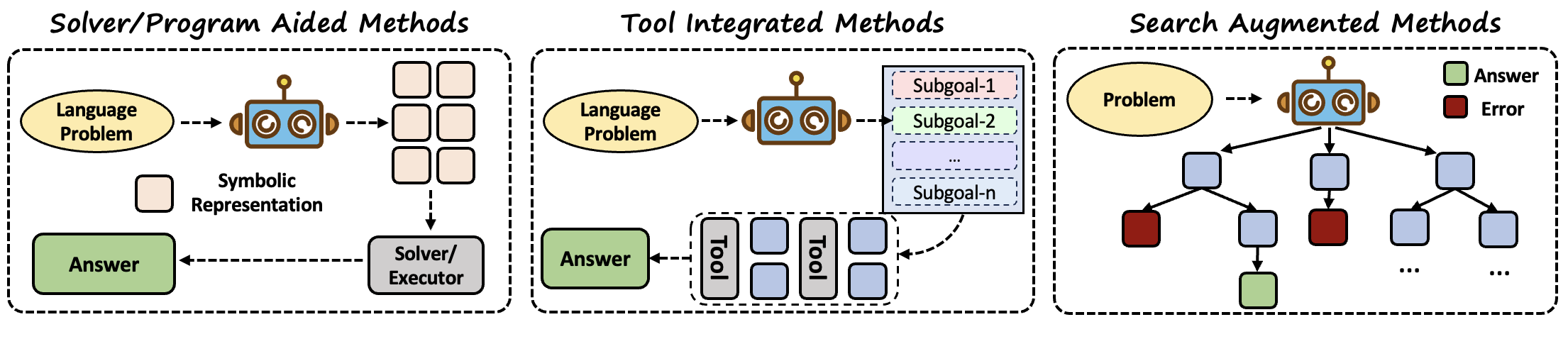
The image presents a comparative diagram illustrating three distinct methods for problem-solving: Solver/Program Aided Methods, Tool Integrated Methods, and Search Augmented Methods. Each method is depicted with a flowchart-like representation, showing the flow of information and processes involved. The diagrams use a consistent visual language, including a robot icon, ovals for problems, rectangles for representations or subgoals, and arrows to indicate the flow of information.
### Components/Axes
* **Titles:**
* Solver/Program Aided Methods (top-left)
* Tool Integrated Methods (top-center)
* Search Augmented Methods (top-right)
* **Elements:**
* **Language Problem:** Represented as a yellow oval.
* **Problem:** Represented as a yellow oval.
* **Robot Icon:** A blue robot with brown accents, representing the problem-solving agent.
* **Symbolic Representation:** Represented as a light peach square.
* **Solver/Executor:** Represented as a gray rounded rectangle.
* **Tool:** Represented as a gray rounded rectangle.
* **Subgoal-1, Subgoal-2, Subgoal-n:** Represented as light red, light green, and light blue rounded rectangles, respectively.
* **Answer:** Represented as a green rounded rectangle.
* **Error:** Represented as a red square.
* **Legend (top-right):**
* Green square: Answer
* Red square: Error
### Detailed Analysis
**1. Solver/Program Aided Methods (Left)**
* **Flow:** Language Problem (yellow oval) -> Robot -> Symbolic Representation (9 light peach squares arranged in a 3x3 grid) -> Solver/Executor (gray rounded rectangle) -> Answer (green rounded rectangle).
* **Description:** A language problem is processed by a robot, converted into a symbolic representation, and then solved by a solver/executor, resulting in an answer.
**2. Tool Integrated Methods (Center)**
* **Flow:** Language Problem (yellow oval) -> Robot -> Subgoals (Subgoal-1 (light red), Subgoal-2 (light green), ..., Subgoal-n (light blue)) -> Tool (3 gray rounded rectangles) -> Answer (green rounded rectangle). A dashed arrow goes from the last tool back to the subgoals.
* **Description:** A language problem is processed by a robot and broken down into subgoals. These subgoals are then addressed using a tool, and the tool's output leads to an answer. The dashed arrow indicates a feedback loop from the tool back to the subgoals.
**3. Search Augmented Methods (Right)**
* **Flow:** Problem (yellow oval) -> Robot -> Tree Structure of blue squares, red squares, and a green square.
* **Description:** A problem is processed by a robot, which initiates a search process represented by a tree structure. The nodes in the tree represent states or steps in the search. Blue squares represent intermediate states, a red square represents an error state, and a green square represents a successful answer.
### Key Observations
* The diagrams illustrate different approaches to problem-solving, each with its own unique flow and components.
* The Solver/Program Aided method relies on a symbolic representation and a solver/executor.
* The Tool Integrated method uses subgoals and external tools to arrive at an answer.
* The Search Augmented method employs a search process, exploring different paths to find a solution.
* The use of color-coded squares in the Search Augmented method indicates the outcome of each search path (blue = intermediate, red = error, green = answer).
### Interpretation
The diagrams provide a high-level overview of three distinct problem-solving paradigms. The Solver/Program Aided method is suitable for problems that can be easily formalized and solved algorithmically. The Tool Integrated method is useful when external tools can assist in solving sub-problems. The Search Augmented method is appropriate for complex problems where the solution is not immediately obvious and requires exploration of different possibilities. The choice of method depends on the nature of the problem and the available resources. The diagrams highlight the importance of representation, tools, and search in the problem-solving process.