TECHNICAL ASSET FINGERPRINT
89cc902df9bafcecff824894
Click to view fullscreen
Press ESC or click to close
FOUND IN PAPERS
EXPERT: healer-alpha-free VERSION 1
RUNTIME: free/openrouter/healer-alpha
INTEL_VERIFIED
## Diagram: Three Approaches to AI Problem-Solving
### Overview
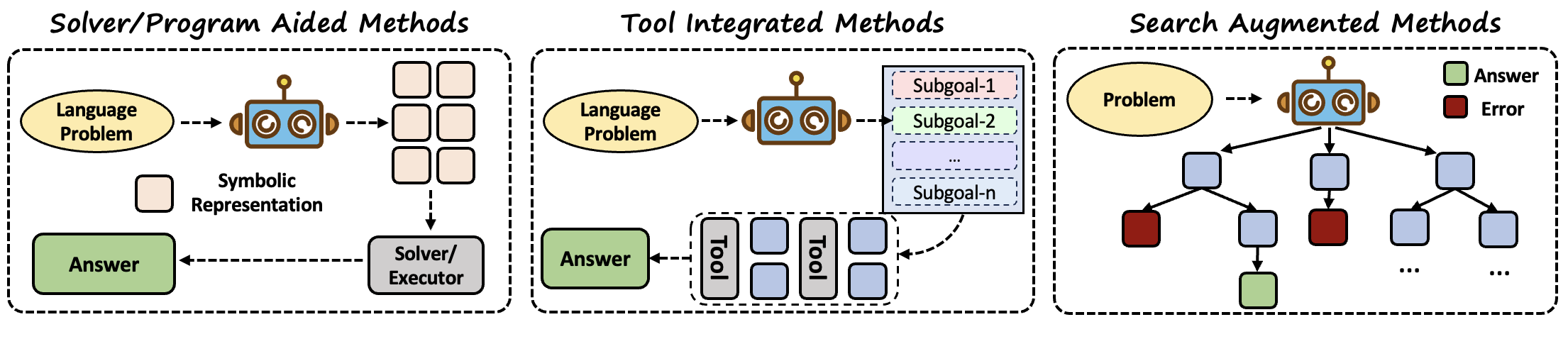
The image is a technical diagram illustrating three distinct methodological frameworks for using AI (represented by a robot icon) to solve language-based problems. The diagram is divided into three horizontally arranged panels, each enclosed in a dashed-line box and titled at the top. The overall flow in each panel moves from left to right, starting with a problem and ending with an answer, but the intermediate processes differ significantly.
### Components/Axes
The diagram contains no numerical axes or data charts. It is a conceptual flow diagram with the following consistent visual components across all three panels:
* **Problem Input:** Represented by a yellow oval labeled "Language Problem" (Panels 1 & 2) or "Problem" (Panel 3).
* **AI Agent:** Represented by a blue robot icon with two circular "eyes" and an antenna.
* **Process Blocks:** Various shapes (rectangles, squares) representing intermediate steps, tools, or representations.
* **Answer Output:** Represented by a green rectangle labeled "Answer".
* **Legend (Panel 3 only):** Located in the top-right corner of the third panel. It defines two color codes: a light green square for "Answer" and a dark red square for "Error".
### Detailed Analysis
The diagram is segmented into three independent regions (panels), processed below:
**Panel 1: Solver/Program Aided Methods (Left)**
* **Flow:** `Language Problem` (yellow oval) → `AI Robot` → A grid of six light beige squares labeled "Symbolic Representation" → `Solver/Executor` (grey rectangle) → `Answer` (green rectangle).
* **Spatial Grounding:** The "Symbolic Representation" grid is positioned to the right of the robot. The "Solver/Executor" is below this grid. The final "Answer" is to the left of the "Solver/Executor", connected by a dashed arrow pointing left.
* **Component Isolation:** This panel depicts a linear pipeline where the AI first translates the problem into a formal, symbolic format, which is then processed by a separate, dedicated solver module to produce the answer.
**Panel 2: Tool Integrated Methods (Center)**
* **Flow:** `Language Problem` (yellow oval) → `AI Robot` → A dashed-line box containing a vertical list: `Subgoal-1` (pink), `Subgoal-2` (light green), `...`, `Subgoal-n` (light blue) → A second dashed-line box containing two grey "Tool" rectangles and four light blue squares → `Answer` (green rectangle).
* **Spatial Grounding:** The "Subgoal" list is directly right of the robot. The "Tool" box is below the subgoal list. The final "Answer" is to the left of the tool box.
* **Component Isolation:** This panel shows a decomposition approach. The AI breaks the main problem into a sequence of subgoals. It then invokes specific tools (and possibly intermediate data, represented by blue squares) to address these subgoals, culminating in the final answer.
**Panel 3: Search Augmented Methods (Right)**
* **Flow:** `Problem` (yellow oval) → `AI Robot` → A tree/search graph structure.
* **Tree Structure:** The robot is the root node. It branches to three light blue square nodes. The leftmost blue node branches further to a dark red "Error" node and another blue node. The center blue node branches to a dark red "Error" node. The rightmost blue node branches to two blue nodes. One of the lower-level blue nodes (from the left branch) leads to a green "Answer" node. Ellipses (`...`) indicate the tree continues.
* **Legend & Color Key:** The legend in the top-right explicitly maps light green to "Answer" and dark red to "Error". All other intermediate nodes are light blue.
* **Spatial Grounding:** The search tree expands downwards and outwards from the robot. The legend is positioned in the upper right quadrant of this panel, separate from the tree.
* **Component Isolation:** This panel illustrates an exploratory, tree-based search process. The AI generates multiple potential solution paths (blue nodes). Some paths lead to dead ends or errors (red nodes), while others eventually converge on a correct answer (green node). The process involves backtracking and exploration.
### Key Observations
1. **Progressive Complexity:** The methods show increasing complexity in the AI's role: from a translator (Panel 1), to a planner and tool-user (Panel 2), to an explorer navigating a solution space (Panel 3).
2. **Error Handling:** Only the "Search Augmented Methods" (Panel 3) explicitly models and visualizes "Error" states as part of the process. The other two panels imply a more deterministic, error-free pipeline.
3. **Modularity vs. Integration:** Panel 1 relies on a separate, external "Solver/Executor". Panel 2 integrates "Tools" directly into the workflow. Panel 3 uses an internal search mechanism.
4. **Visual Consistency:** The AI agent (robot), problem input (yellow oval), and answer output (green rectangle) are visually consistent across all three panels, emphasizing that the core objective is the same, but the methodology differs.
### Interpretation
This diagram provides a Peircean investigative framework for categorizing how large language models (LLMs) or AI agents can be augmented to solve complex reasoning tasks. It moves beyond seeing the AI as a monolithic black box.
* **What it demonstrates:** It classifies augmentation strategies based on the *nature of the external or internal process* coupled with the language model.
* **Solver/Program Aided:** Leverages formal, symbolic systems (like code interpreters or mathematical solvers) for reliable computation. The AI's job is precise translation.
* **Tool Integrated:** Treats the AI as a central controller that can decompose tasks and dynamically call upon specialized APIs or functions (tools). This is akin to a "function calling" or agentic workflow.
* **Search Augmented:** Emphasizes exploration and verification. The AI generates and evaluates multiple hypotheses, learning from errors. This mirrors techniques like chain-of-thought with self-consistency, tree-of-thought, or reinforcement learning from human feedback (RLHF) where paths are scored.
* **Why it matters:** The choice of method involves trade-offs. Solver-aided methods are precise but require a perfect symbolic translation. Tool-integrated methods are flexible but depend on tool availability and robust planning. Search-augmented methods are powerful for open-ended problems but are computationally expensive and less deterministic. The diagram helps researchers and engineers select an architectural pattern based on the problem's nature—whether it requires precise calculation (Panel 1), modular skill application (Panel 2), or creative exploration (Panel 3).
* **Notable Anomaly:** The "Language Problem" label in Panels 1 and 2 becomes simply "Problem" in Panel 3. This subtle shift may imply that search-augmented methods are more general-purpose and not strictly limited to linguistically framed inputs, potentially encompassing broader reasoning tasks.
DECODING INTELLIGENCE...