## Diagram: Three Methods of Problem-Solving with AI Assistance
### Overview
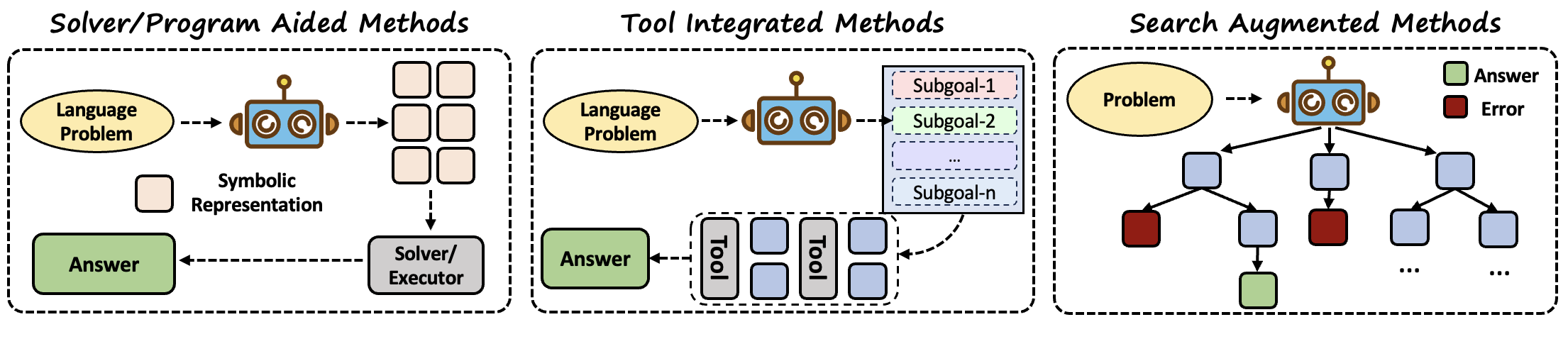
The diagram illustrates three distinct approaches to solving language problems using AI assistance:
1. **Solver/Program Aided Methods**
2. **Tool Integrated Methods**
3. **Search Augmented Methods**
Each method is represented as a flowchart with a central "robot" icon symbolizing AI integration. Arrows indicate information flow, and colored boxes represent data states (green = Answer, red = Error).
---
### Components/Axes
#### Solver/Program Aided Methods (Left Section)
- **Input**: Language Problem (oval, yellow)
- **Process**:
- Symbolic Representation (pink square)
- Solver/Executor (gray rectangle)
- **Output**: Answer (green rectangle)
- **Robot**: Blue robot with antenna (central connector)
#### Tool Integrated Methods (Center Section)
- **Input**: Language Problem (oval, yellow)
- **Process**:
- Subgoals (pink, green, purple rectangles labeled "Subgoal-1" to "Subgoal-n")
- Tools (gray rectangles labeled "Tool")
- **Output**: Answer (green rectangle)
- **Robot**: Blue robot with antenna (central connector)
#### Search Augmented Methods (Right Section)
- **Input**: Problem (oval, yellow)
- **Process**:
- Branching paths with:
- Answer (green square)
- Error (red square)
- **Output**: Robot processes paths (blue robot with antenna)
- **Legend**:
- Green = Answer
- Red = Error
---
### Detailed Analysis
#### Solver/Program Aided Methods
- **Flow**: Language Problem → Symbolic Representation → Solver/Executor → Answer
- **Key Feature**: Linear, deterministic process with no branching.
#### Tool Integrated Methods
- **Flow**: Language Problem → Subgoals/Tools → Answer
- **Key Feature**: Hierarchical decomposition into subgoals and tool usage.
#### Search Augmented Methods
- **Flow**: Problem → Branching paths (Answer/Error) → Robot processing
- **Key Feature**: Exploratory search with error handling.
---
### Key Observations
1. **Robot Consistency**: The blue robot icon appears in all three methods, acting as a unifying symbol for AI assistance.
2. **Color Coding**:
- Green (Answer) and red (Error) are used exclusively in the Search Augmented Methods section.
- Subgoals in Tool Integrated Methods use multiple colors (pink, green, purple) for differentiation.
3. **Branching vs. Linear**:
- Solver/Program Aided and Tool Integrated Methods follow linear flows.
- Search Augmented Methods emphasize non-linear exploration with error states.
---
### Interpretation
This diagram contrasts three AI-assisted problem-solving paradigms:
1. **Deterministic Execution**: Solver/Program Aided Methods rely on structured symbolic processing.
2. **Modular Tool Use**: Tool Integrated Methods break problems into subgoals and leverage external tools.
3. **Exploratory Search**: Search Augmented Methods prioritize adaptive pathfinding, explicitly accounting for errors.
The robot’s central role across all methods suggests AI acts as a mediator, translating problems into actionable steps (symbolic representation), coordinating tools, or evaluating search outcomes. The absence of numerical data implies this is a conceptual framework rather than an empirical study.
**Notable Design Choice**: The use of distinct colors for subgoals (pink/green/purple) vs. binary answer/error states (green/red) visually reinforces the complexity of intermediate steps versus final outcomes.