## Line Graph: Accuracy vs. Number of Samples n
### Overview
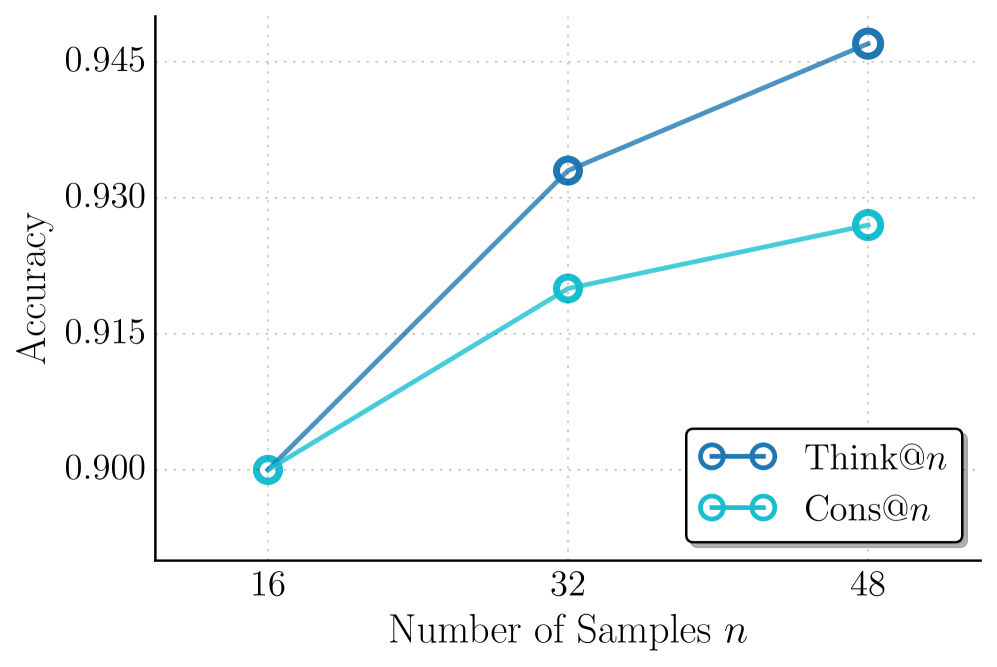
The image is a line graph comparing the accuracy of two methods, "Think@n" and "Cons@n," across different numbers of samples (n). The x-axis represents the number of samples (16, 32, 48), and the y-axis represents accuracy (0.900 to 0.945). Two lines are plotted: a blue line for "Think@n" and a teal line for "Cons@n."
### Components/Axes
- **X-axis**: "Number of Samples n" with discrete values at 16, 32, and 48.
- **Y-axis**: "Accuracy" with a scale from 0.900 to 0.945.
- **Legend**: Located in the bottom-right corner, with:
- **Blue circles**: "Think@n"
- **Teal circles**: "Cons@n"
### Detailed Analysis
- **Think@n (Blue Line)**:
- At **n = 16**: Accuracy ≈ 0.900
- At **n = 32**: Accuracy ≈ 0.930
- At **n = 48**: Accuracy ≈ 0.945
- **Trend**: Steep upward slope, indicating a significant increase in accuracy with more samples.
- **Cons@n (Teal Line)**:
- At **n = 16**: Accuracy ≈ 0.900
- At **n = 32**: Accuracy ≈ 0.915
- At **n = 48**: Accuracy ≈ 0.928
- **Trend**: Gradual upward slope, with a slower rate of improvement compared to "Think@n."
### Key Observations
1. Both methods start with the same accuracy (0.900) at n = 16.
2. "Think@n" consistently outperforms "Cons@n" across all sample sizes.
3. The gap between the two lines widens as n increases, suggesting "Think@n" scales more effectively with larger datasets.
4. "Cons@n" shows a plateau in accuracy gains after n = 32, while "Think@n" continues to improve.
### Interpretation
The data demonstrates that "Think@n" achieves higher accuracy than "Cons@n" as the number of samples increases. This suggests that "Think@n" may be more robust or efficient in handling larger datasets. The widening gap between the two lines implies that "Think@n" could be preferable for applications requiring high accuracy with substantial data. However, the slower improvement of "Cons@n" might indicate limitations in its methodology or design for scaling. The graph highlights the importance of method selection based on dataset size and accuracy requirements.