## Heatmap: Baseline - Short-to-Long - Qwen-2.5 7B
### Overview
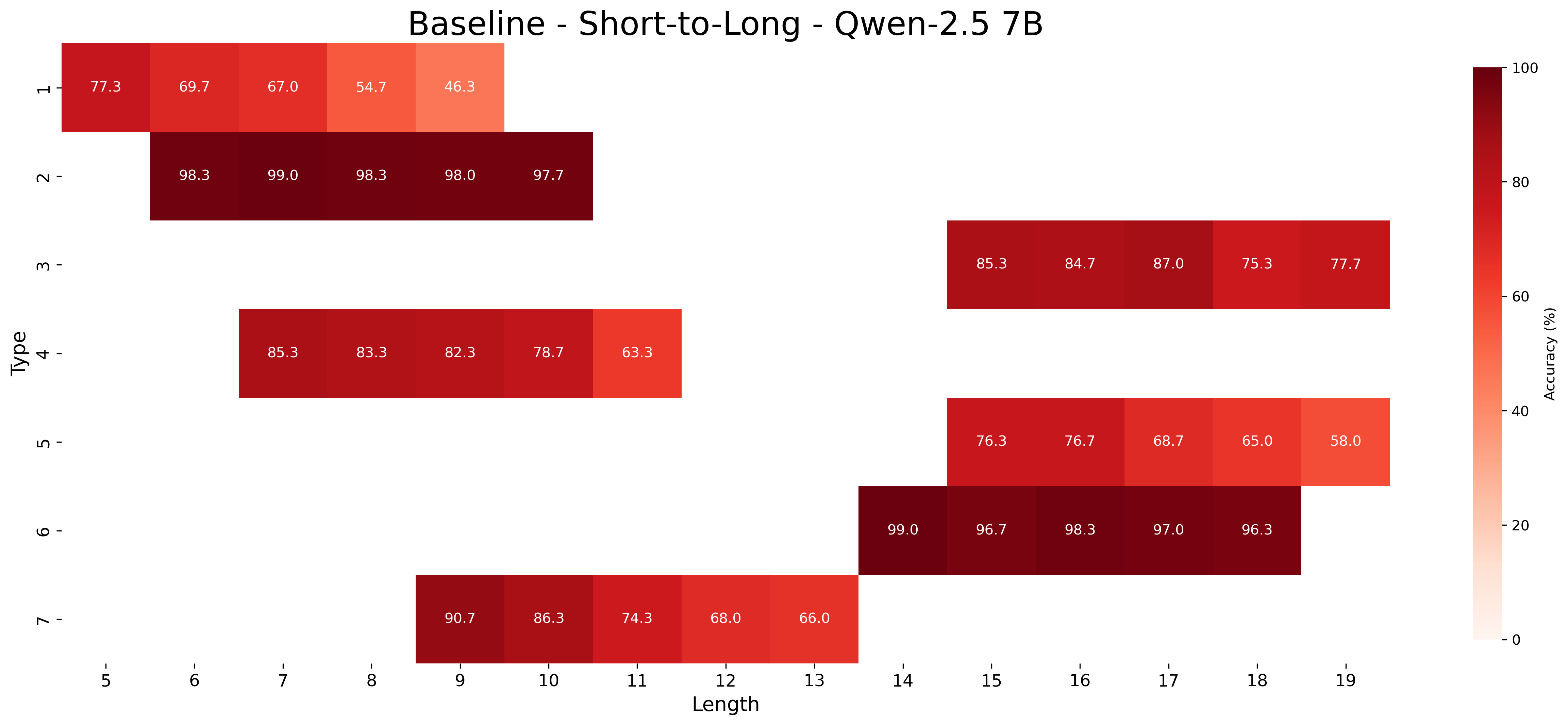
This image is a heatmap visualizing the accuracy (in percentage) of a model named "Qwen-2.5 7B" across different "Types" and "Lengths." The title "Baseline - Short-to-Long" suggests this data represents a baseline performance evaluation, likely measuring how well the model generalizes from shorter to longer sequences or inputs. The chart uses a color gradient from light orange (low accuracy) to dark red (high accuracy) to represent the accuracy values.
### Components/Axes
* **Title:** "Baseline - Short-to-Long - Qwen-2.5 7B" (centered at the top).
* **Y-Axis (Vertical):** Labeled "Type." It lists seven discrete categories, numbered 1 through 7 from top to bottom.
* **X-Axis (Horizontal):** Labeled "Length." It displays a numerical scale from 5 to 19, with tick marks at each integer.
* **Color Bar/Legend:** Located on the right side of the chart. It is a vertical gradient bar labeled "Accuracy (%)" with a scale from 0 (lightest) to 100 (darkest). The color mapping is:
* ~0-20%: Light peach/orange
* ~40-60%: Medium orange/red
* ~80-100%: Dark red to maroon
* **Data Cells:** The main chart area contains rectangular cells positioned at the intersection of a specific Type and Length. Each cell contains a numerical value representing the accuracy percentage and is colored according to the legend.
### Detailed Analysis
The heatmap does not contain data for every Type-Length combination. Data is present in distinct horizontal bands for each Type, covering specific Length ranges. Below is the extracted data, organized by Type (row) and Length (column).
**Type 1 (Top Row):**
* Length 5: 77.3%
* Length 6: 69.7%
* Length 7: 67.0%
* Length 8: 54.7%
* Length 9: 46.3%
* *Trend:* Accuracy shows a clear and steady downward trend as Length increases from 5 to 9.
**Type 2:**
* Length 6: 98.3%
* Length 7: 99.0%
* Length 8: 98.3%
* Length 9: 98.0%
* Length 10: 97.7%
* *Trend:* Accuracy is consistently very high (above 97%) across all measured lengths, with minimal variation.
**Type 3:**
* Length 14: 85.3%
* Length 15: 84.7%
* Length 16: 87.0%
* Length 17: 75.3%
* Length 18: 77.7%
* *Trend:* Accuracy is relatively stable in the mid-80s for lengths 14-16, then drops notably at length 17 before a slight recovery at length 18.
**Type 4:**
* Length 7: 85.3%
* Length 8: 83.3%
* Length 9: 82.3%
* Length 10: 78.7%
* Length 11: 63.3%
* *Trend:* Accuracy declines gradually from length 7 to 10, followed by a sharp drop of over 15 percentage points at length 11.
**Type 5:**
* Length 14: 76.3%
* Length 15: 76.7%
* Length 16: 68.7%
* Length 17: 65.0%
* Length 18: 58.0%
* *Trend:* Accuracy is stable for lengths 14-15, then begins a consistent downward trend through length 18.
**Type 6:**
* Length 13: 99.0%
* Length 14: 96.7%
* Length 15: 98.3%
* Length 16: 97.0%
* Length 17: 96.3%
* *Trend:* Accuracy remains exceptionally high (above 96%) across all measured lengths, showing robustness.
**Type 7 (Bottom Row):**
* Length 9: 90.7%
* Length 10: 86.3%
* Length 11: 74.3%
* Length 12: 68.0%
* Length 13: 66.0%
* *Trend:* Accuracy shows a strong downward trend as length increases, with the most significant drop occurring between lengths 10 and 11.
### Key Observations
1. **Performance Clusters:** The data reveals two distinct performance clusters. **High-Performance Types** (2 and 6) maintain accuracy above ~96% across their measured length ranges. **Declining-Performance Types** (1, 4, 5, 7) show a clear negative correlation between length and accuracy. Type 3 is intermediate, with a mid-range performance that dips at longer lengths.
2. **Critical Length Thresholds:** Several types exhibit a sharp performance drop at a specific length:
* Type 1: Drop begins at Length 8 (54.7%).
* Type 4: Sharp drop at Length 11 (63.3%).
* Type 7: Sharp drop at Length 11 (74.3%).
* Type 3: Drop at Length 17 (75.3%).
3. **Length Coverage:** The "Length" axis is not uniformly covered. Different types are evaluated on different, often non-overlapping, length intervals (e.g., Type 1 covers 5-9, Type 6 covers 13-17). This suggests the "Types" may represent different tasks, datasets, or evaluation conditions with inherent length constraints.
4. **Color Correlation:** The visual color intensity perfectly matches the numerical values. The highest values (99.0% in Types 2 & 6) are the darkest maroon, while the lowest value (46.3% in Type 1) is a light orange, confirming the legend's accuracy.
### Interpretation
This heatmap provides a diagnostic view of the Qwen-2.5 7B model's generalization capability in a "Short-to-Long" scenario. The core insight is that **model performance is highly type-dependent and often degrades with increased sequence length.**
* **Robustness vs. Fragility:** Types 2 and 6 represent tasks or conditions where the model's performance is robust and does not suffer from increased length. This could indicate tasks with simpler patterns, better representation in the training data, or where the model's architecture is particularly well-suited.
* **Length Generalization Failure:** The declining trends in Types 1, 4, 5, and 7 demonstrate a failure to generalize to longer sequences. The sharp drops at specific lengths (e.g., Type 4 at Length 11) may point to a "breaking point" where the model's attention mechanism or context window becomes insufficient, or where the task complexity exceeds the model's capacity for longer inputs.
* **Task-Specific Evaluation:** The non-overlapping length ranges for different types strongly imply that "Type" corresponds to distinct evaluation benchmarks or task categories, each with its own characteristic input length distribution. The model's struggle with longer inputs in certain types highlights a potential limitation in its training or architecture for handling long-context dependencies across diverse tasks.
In summary, the data suggests that while the Qwen-2.5 7B model can achieve near-perfect accuracy on some tasks regardless of length, its performance on others is significantly compromised as input length increases, revealing a key area for potential improvement in long-context modeling.