\n
## Diagram: Two-layer Denoising Autoencoder (DAE) Architecture
### Overview
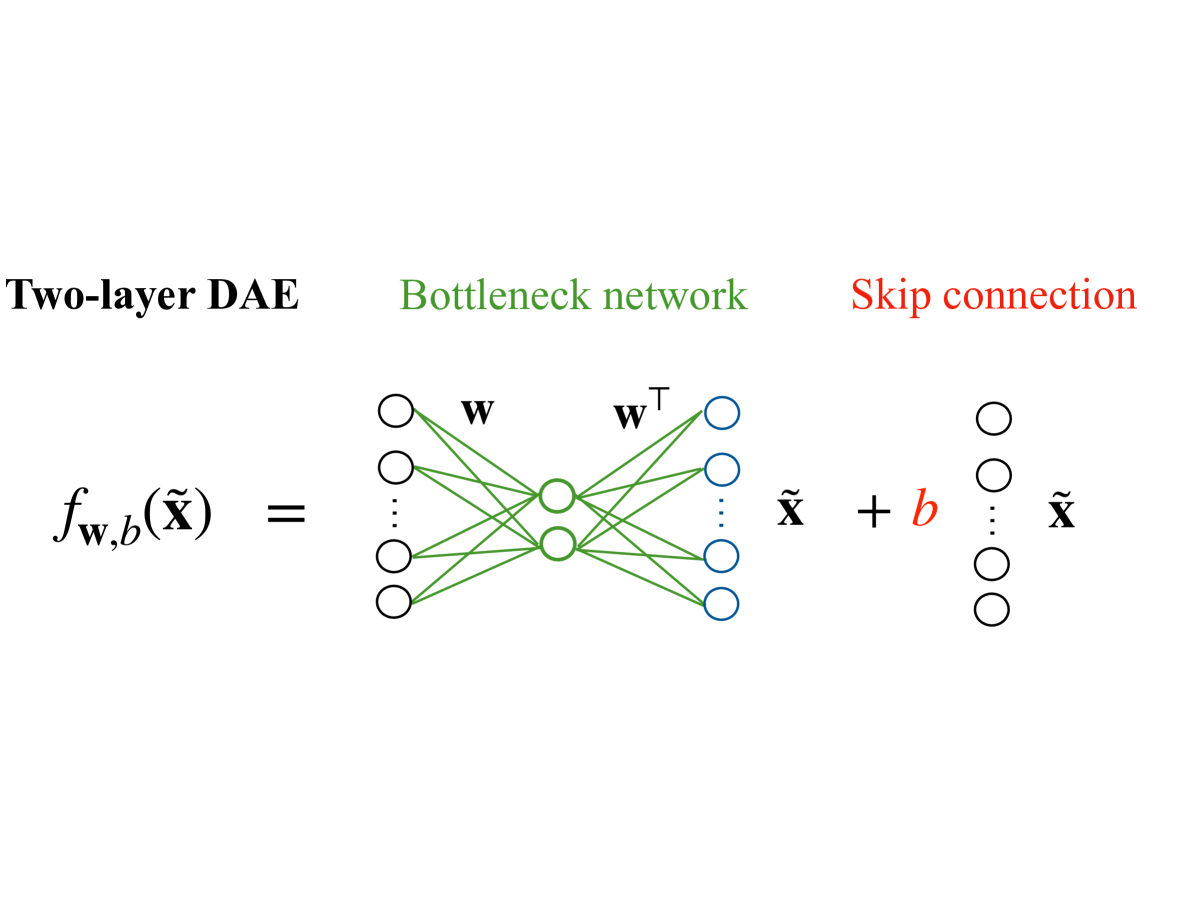
The image depicts the architecture of a two-layer Denoising Autoencoder (DAE). It illustrates the flow of data through a bottleneck network with a skip connection. The diagram is primarily a visual representation of the mathematical function `f_{w,b}(X)`.
### Components/Axes
The diagram consists of three main sections:
1. **Left Side:** The mathematical function `f_{w,b}(X)` is displayed.
2. **Center:** A bottleneck network is shown with connections labeled 'w' and 'wᵀ'.
3. **Right Side:** A skip connection is illustrated, adding a bias 'b' to the reconstructed output.
Labels:
* "Two-layer DAE" (top-left, green text)
* "Bottleneck network" (center-top, green text)
* "Skip connection" (top-right, red text)
* `f_{w,b}(X)` (left side, black text)
* 'w' (connections between input and bottleneck layers, black text)
* 'wᵀ' (connections between bottleneck and output layers, black text)
* 'X̃' (output of the bottleneck layer, black text)
* 'b' (bias added in the skip connection, black text)
* 'X̃' (final reconstructed output, black text)
### Detailed Analysis or Content Details
The diagram shows a neural network with the following structure:
* **Input Layer:** Represented by a series of circles on the left. The number of nodes is not explicitly specified, but is indicated by the "..." symbol.
* **Bottleneck Layer:** A smaller set of circles in the center, representing a lower-dimensional representation of the input. The number of nodes is also not explicitly specified.
* **Output Layer:** A series of circles on the right, representing the reconstructed output. The number of nodes appears to match the input layer.
* **Connections:**
* Connections from the input layer to the bottleneck layer are labeled 'w'.
* Connections from the bottleneck layer to the output layer are labeled 'wᵀ' (w transpose).
* A skip connection adds a bias 'b' to the output of the bottleneck layer.
* **Mathematical Function:** The entire process is represented by the function `f_{w,b}(X)`, where:
* `w` represents the weights of the connections.
* `b` represents the bias.
* `X` represents the input.
* `X̃` represents the reconstructed output.
### Key Observations
The diagram highlights the key components of a DAE: the bottleneck layer for dimensionality reduction and the skip connection for preserving information. The use of 'wᵀ' suggests a symmetric weight structure, potentially related to autoencoder properties. The diagram does not provide any numerical values or specific details about the network's size or activation functions.
### Interpretation
The diagram illustrates a two-layer Denoising Autoencoder, a type of neural network used for unsupervised learning and dimensionality reduction. The DAE aims to learn a compressed representation of the input data (through the bottleneck layer) while also being robust to noise. The skip connection helps to preserve information during the reconstruction process. The function `f_{w,b}(X)` mathematically describes the transformation of the input `X` into the reconstructed output `X̃` using weights `w` and bias `b`. The diagram is a conceptual representation and does not provide specific implementation details. The absence of numerical values suggests that the diagram is intended to convey the general architecture rather than specific performance characteristics.