## Diagram: Privacy-Preserving Federated Learning Architecture
### Overview
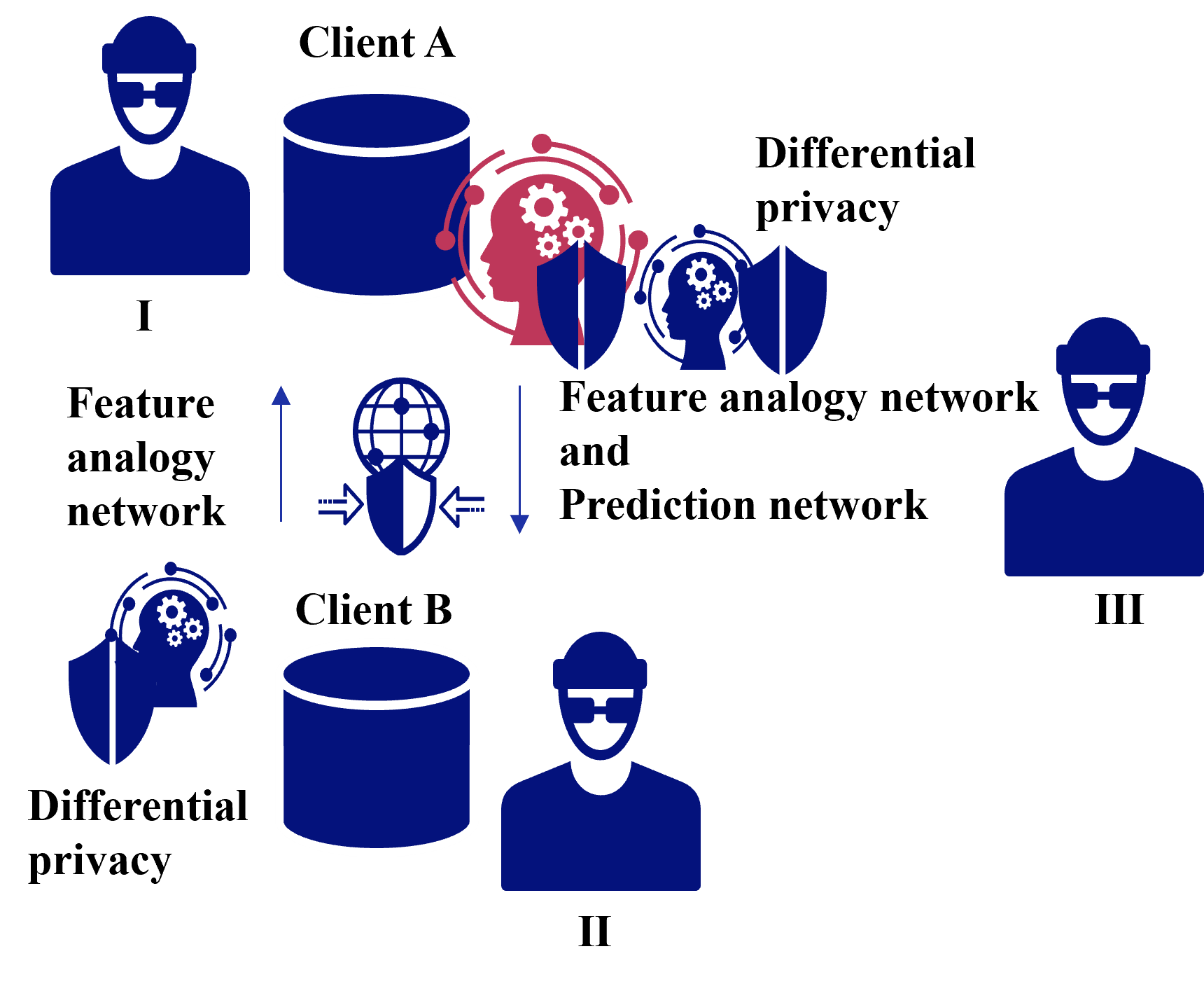
The image is a conceptual technical diagram illustrating a distributed machine learning system, likely a federated learning architecture. It depicts the interaction between multiple data sources (Clients), privacy-preserving mechanisms (Differential Privacy), and a central processing framework (Feature Analogy and Prediction Networks). The diagram uses icons to represent human participants, databases, and AI/security processes.
### Components/Axes
**Entities & Icons:**
* **Figures (I, II, III):** Represent human participants or distinct entities in the system.
* **Figure I:** Positioned at the top-left.
* **Figure II:** Positioned at the bottom-center.
* **Figure III:** Positioned at the right.
* **Database Icons:**
* **Client A:** Located at the top-left, associated with Figure I.
* **Client B:** Located at the bottom-left, associated with Figure II.
* **AI/Security Icons:**
* **Red Head with Gears:** Located between Client A and the center. Represents an AI/ML model or feature extraction process.
* **Blue Head with Gears (with Shield):** Located to the left of Client B. Represents a secured AI/ML model.
* **Globe with Shield:** Located in the center. Represents a global or network-level security/privacy layer.
* **Blue Shields:** Used throughout to denote security/privacy protection.
**Textual Labels:**
* **"Client A"**: Label for the top database.
* **"Client B"**: Label for the bottom database.
* **"Differential privacy"**: Appears twice (once near the top-left, once near the bottom-left).
* **"Feature analogy network"**: Appears on the left side, associated with the vertical flow.
* **"Feature analogy network and Prediction network"**: Appears on the right side, associated with Figure III.
### Detailed Analysis
**Spatial Layout & Flow:**
* **Left Region (Input/Processing):**
* **Top-Left:** Figure I is linked to "Client A". A red icon (head with gears) is positioned next to a blue shield. This suggests that data from Client A is processed through a feature extraction model (the red head) and protected by a shield.
* **Bottom-Left:** Figure II is linked to "Client B". A blue icon (head with gears) is protected by a shield. The text "Differential privacy" is placed below this, indicating that the data/model from Client B is subject to differential privacy constraints.
* **Center Region (Communication):**
* A central icon (globe with a shield) acts as a hub.
* Vertical blue arrows point up and down, indicating bidirectional communication or synchronization between the clients and the central network.
* The text "Feature analogy network" is placed to the left of the central arrows, suggesting this is the mechanism facilitating the connection between the clients.
* **Right Region (Output/Aggregation):**
* Figure III is positioned on the right.
* The text "Feature analogy network and Prediction network" is placed near Figure III, indicating that the final output or the aggregation of the system occurs here, combining the feature analogy and prediction capabilities.
### Key Observations
* **Color Coding:** The diagram predominantly uses blue for all elements, except for the "head with gears" icon associated with Client A, which is red. This may signify that Client A is the primary source, the active learner, or a specific type of node distinct from Client B.
* **Redundancy:** The term "Differential privacy" is explicitly labeled twice, emphasizing that it is a mandatory component for both Client A and Client B to ensure data security.
* **Symmetry:** The diagram is structured to show a balanced interaction between Client A and Client B, feeding into a central network, which then feeds into a final prediction network.
### Interpretation
This diagram illustrates a **Privacy-Preserving Federated Learning** workflow.
1. **Data Isolation:** By using "Client A" and "Client B" with "Differential privacy," the system ensures that raw data remains local to the clients and is not exposed during the training process.
2. **Feature Alignment:** The "Feature analogy network" suggests that the system is designed to align or map features between different clients (who may have heterogeneous data) so that a global model can be trained effectively without direct data sharing.
3. **Prediction:** The "Prediction network" on the right represents the final stage where the aggregated knowledge (derived from the feature analogy network) is used to perform inference or prediction tasks.
4. **Security:** The consistent use of shield icons and the explicit mention of "Differential privacy" indicates that security is a primary architectural constraint, likely designed to prevent model inversion attacks or data leakage from the participating clients.