\n
## Diagram: Federated Learning with Differential Privacy
### Overview
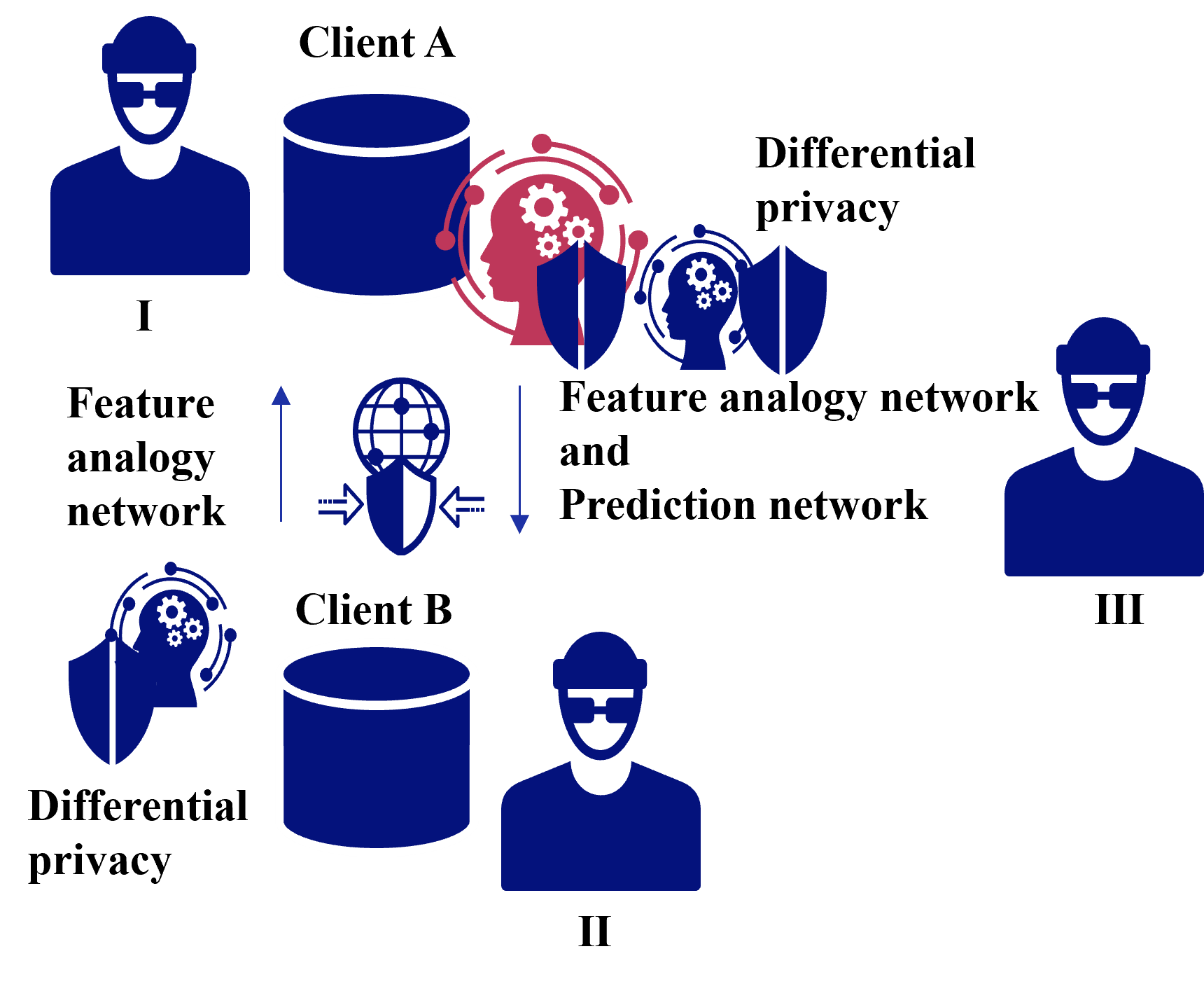
The image depicts a diagram illustrating a federated learning system incorporating differential privacy. It shows two clients (A and B) contributing to a central "Feature analogy network and Prediction network" while maintaining differential privacy. The diagram highlights the flow of information and the application of privacy mechanisms.
### Components/Axes
The diagram consists of the following components:
* **Client A:** Represented by a dark blue silhouette wearing a hard hat, a cylindrical database, and a "Differential privacy" shield. Labeled "I".
* **Client B:** Similar to Client A, represented by a dark blue silhouette wearing a hard hat, a cylindrical database, and a "Differential privacy" shield. Labeled "II".
* **Feature analogy network and Prediction network:** A central component depicted as a globe with gears overlaid, and a "Differential privacy" shield.
* **Differential privacy shields:** Blue shields with white gears, indicating the application of differential privacy.
* **Arrows:** Red arrows indicate the flow of information between clients and the central network. Double-sided arrows indicate bidirectional flow.
* **Text Labels:** "Client A", "Client B", "Feature analogy network", "Differential privacy", "Feature analogy network and Prediction network".
* **Roman Numerals:** I, II, and III are used to label the clients and the central network.
* **Client III:** A dark blue silhouette wearing a hard hat, labeled "III".
### Detailed Analysis or Content Details
The diagram illustrates the following process:
1. **Client A (I)** sends data to the "Feature analogy network and Prediction network". This is indicated by a red arrow originating from the database associated with Client A.
2. **Client B (II)** sends data to the "Feature analogy network and Prediction network". This is indicated by a red arrow originating from the database associated with Client B.
3. The "Feature analogy network and Prediction network" processes the data from both clients. The globe with gears suggests a complex processing mechanism.
4. The "Feature analogy network and Prediction network" sends information back to both Client A and Client B. This is indicated by double-sided red arrows.
5. Both Client A and Client B utilize "Differential privacy" shields, suggesting that privacy-preserving mechanisms are applied to the data before or after transmission.
6. Client III is present but does not appear to be directly involved in the data flow.
There are no numerical values or specific data points presented in the diagram. It is a conceptual illustration of a system architecture.
### Key Observations
* The diagram emphasizes the decentralized nature of federated learning, with data residing on the clients.
* Differential privacy is a key component of the system, indicated by the shields on both clients and the central network.
* The bidirectional arrows suggest an iterative process of model training and refinement.
* The presence of Client III without direct connection suggests a potential role as an observer or a future participant.
### Interpretation
The diagram illustrates a federated learning system designed to protect user privacy. Federated learning allows a model to be trained on decentralized data sources (Client A and Client B) without directly exchanging the data itself. Instead, the clients send model updates or gradients to a central server (Feature analogy network and Prediction network), which aggregates them to improve the global model.
The inclusion of "Differential privacy" shields indicates that noise or other privacy-preserving techniques are applied to the data or model updates to prevent the identification of individual users. This is crucial for protecting sensitive information while still enabling collaborative learning.
The diagram suggests a closed-loop system where the central network learns from the clients and provides feedback, iteratively improving the model's performance. The role of Client III is unclear, but it could represent a separate entity that benefits from the trained model or a potential future participant in the federated learning process.
The diagram is a high-level conceptual representation and does not provide details about the specific algorithms or techniques used for federated learning or differential privacy. It serves as a visual aid for understanding the overall architecture and key principles of the system.