## Diagram: Thought Process Flow
### Overview
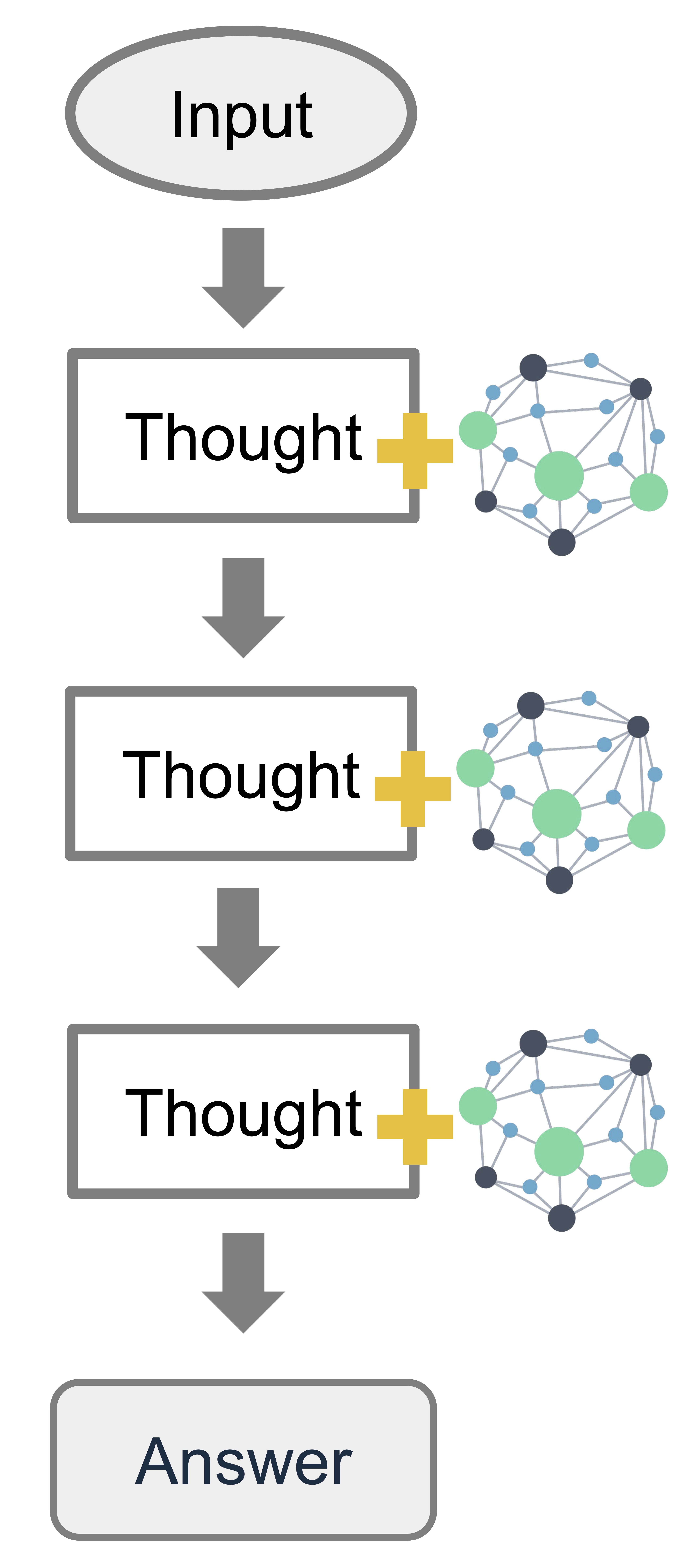
The image is a flowchart illustrating a multi-stage thought process. It starts with an "Input," proceeds through iterative "Thought" stages, each associated with a network diagram, and culminates in an "Answer." The flow is sequential, indicated by downward-pointing arrows.
### Components/Axes
* **Nodes:**
* **Input:** An oval shape at the top, labeled "Input."
* **Thought:** Three rectangular boxes, each labeled "Thought."
* **Answer:** A rounded rectangle at the bottom, labeled "Answer."
* **Connectors:** Downward-pointing arrows connecting the nodes.
* **Network Diagrams:** Three network diagrams, each connected to a "Thought" box via a yellow plus sign. Each network diagram consists of nodes (large green, small blue, small dark blue) connected by lines.
### Detailed Analysis
1. **Input:** The process begins with an "Input" node, represented by a gray-bordered oval.
2. **Thought 1:** A gray arrow leads from "Input" to the first "Thought" box. A yellow plus sign connects the "Thought" box to a network diagram. This network diagram contains approximately 3 large green nodes, 6 small blue nodes, and 2 small dark blue nodes.
3. **Thought 2:** A gray arrow leads from the first "Thought" box to the second "Thought" box. A yellow plus sign connects the second "Thought" box to a network diagram. This network diagram contains approximately 3 large green nodes, 6 small blue nodes, and 2 small dark blue nodes.
4. **Thought 3:** A gray arrow leads from the second "Thought" box to the third "Thought" box. A yellow plus sign connects the third "Thought" box to a network diagram. This network diagram contains approximately 3 large green nodes, 6 small blue nodes, and 2 small dark blue nodes.
5. **Answer:** A gray arrow leads from the third "Thought" box to the "Answer" node, represented by a gray-bordered rounded rectangle.
The network diagrams attached to each "Thought" box appear visually similar, each containing a mix of large green, small blue, and small dark blue nodes connected by lines.
### Key Observations
* The diagram illustrates a sequential process.
* The "Thought" stage is repeated three times.
* Each "Thought" stage is associated with a network diagram.
* The network diagrams appear to be consistent across the three "Thought" stages.
### Interpretation
The diagram likely represents a simplified model of a cognitive process. The "Input" could be a stimulus or initial information. The iterative "Thought" stages suggest repeated processing or analysis of the input. The network diagrams might represent the interconnectedness of ideas or concepts within each stage of thought. The "Answer" represents the final outcome of the thought process. The consistency of the network diagrams across the "Thought" stages could indicate a stable underlying cognitive structure or a consistent approach to processing information. The plus sign may indicate an additive process, where each thought stage builds upon the previous one.