\n
## Diagram: Conceptual Flow of Thought Process
### Overview
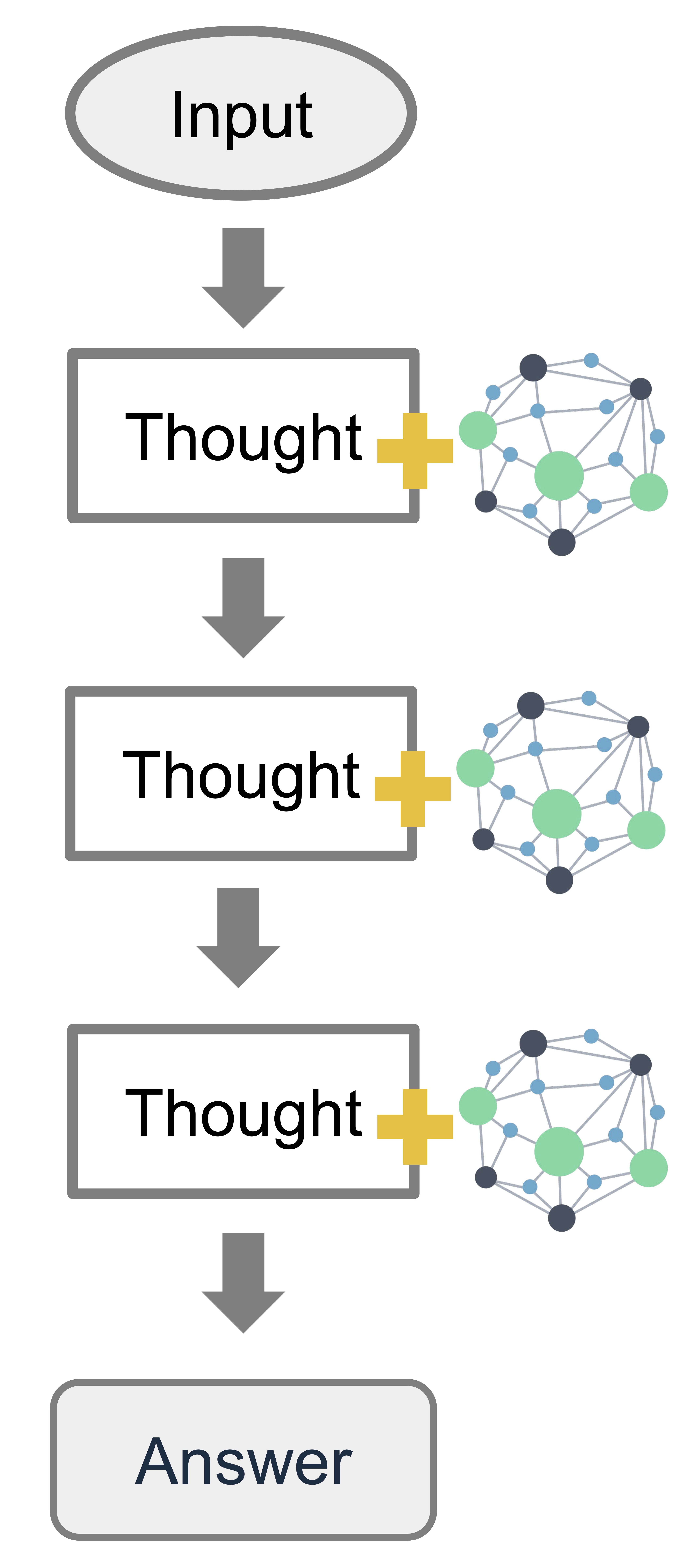
The image depicts a simplified diagram illustrating a conceptual flow of a thought process. It shows a sequence of stages: Input, three stages labeled "Thought" each accompanied by a network-like graphic, and finally, "Answer". The diagram uses arrows to indicate the direction of flow from one stage to the next.
### Components/Axes
The diagram consists of the following components:
* **Input:** An oval shape at the top.
* **Thought (x3):** Three rectangular shapes, each labeled "Thought" and containing a network graphic.
* **Answer:** A rectangular shape at the bottom.
* **Arrows:** Downward-pointing arrows connecting each stage in sequence.
* **Network Graphic:** Each "Thought" stage contains a network of nodes (circles) connected by lines. The nodes are colored in three colors: green, blue, and yellow. The yellow nodes are highlighted with a small square around them.
### Detailed Analysis or Content Details
The diagram shows a linear progression of thought. Each "Thought" stage appears to represent a level of processing or refinement of the initial "Input". The network graphic within each "Thought" stage seems to represent connections and relationships between ideas or concepts.
* **Input:** No specific data or details are provided within the "Input" stage.
* **Thought 1:** The network graphic contains approximately 15-20 nodes. The distribution of colors is roughly equal between green, blue, and yellow.
* **Thought 2:** The network graphic appears similar to "Thought 1" in terms of node count and color distribution.
* **Thought 3:** The network graphic is also similar to the previous two "Thought" stages.
* **Answer:** No specific data or details are provided within the "Answer" stage.
### Key Observations
The diagram emphasizes a sequential process. The repeated "Thought" stages suggest iterative refinement or processing of information. The network graphics within each "Thought" stage imply complex relationships and connections between ideas. The highlighting of yellow nodes within the network graphics could indicate a focus on specific concepts or ideas during each stage of thought.
### Interpretation
This diagram likely represents a simplified model of cognitive processing. The "Input" represents initial information received, and the "Thought" stages represent the internal processing and manipulation of that information. The network graphics symbolize the interconnectedness of ideas and concepts within the mind. The "Answer" represents the final output or conclusion reached after processing.
The iterative nature of the "Thought" stages suggests that the thought process is not always linear but may involve revisiting and refining ideas multiple times. The highlighting of yellow nodes could indicate that certain concepts are more salient or important during the thought process.
The diagram is conceptual and does not provide specific data or quantitative information. It serves as a visual metaphor for the complexity and dynamism of human thought. It could be used to illustrate concepts in psychology, artificial intelligence, or cognitive science. The diagram is a high-level representation and lacks specific details about the nature of the input, the processing steps within each "Thought" stage, or the criteria for arriving at the "Answer".