## Horizontal Bar Chart: Public Perception of Party Competence on Key Issues
### Overview
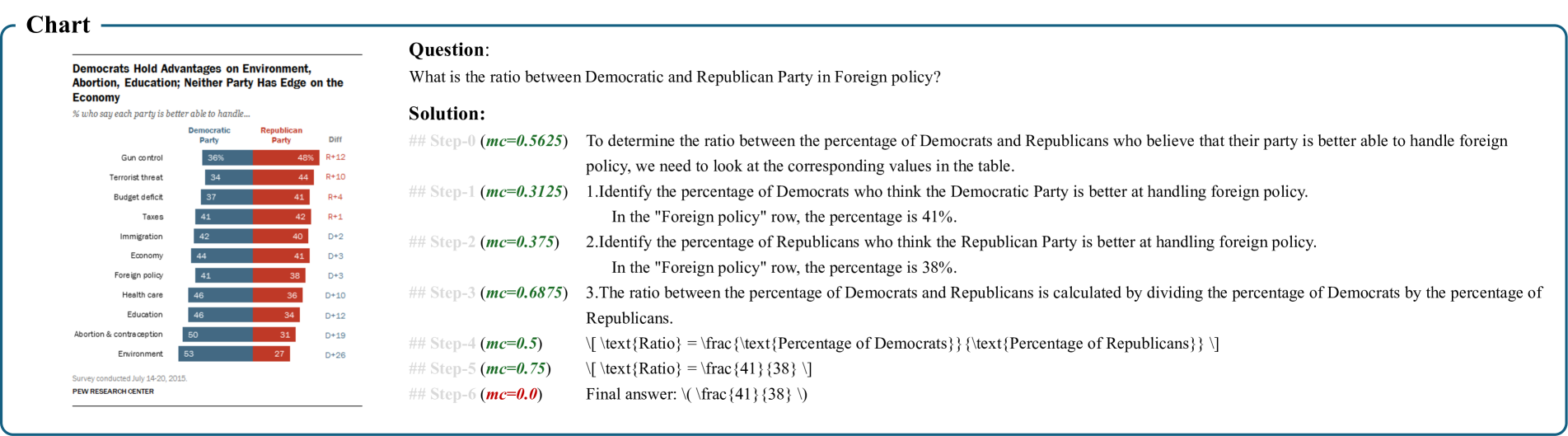
The image displays a horizontal bar chart titled "Democrats Hold Advantages on Environment, Abortion, Education; Neither Party Has Edge on the Economy." It presents survey data on the percentage of respondents who believe the Democratic or Republican Party is better able to handle a series of specific issues. To the right of the chart, a question and a step-by-step solution are provided, calculating a ratio based on one of the data points.
### Components/Axes
* **Chart Title:** "Democrats Hold Advantages on Environment, Abortion, Education; Neither Party Has Edge on the Economy"
* **Subtitle:** "% who say each party is better able to handle..."
* **Columns (Left to Right):**
1. **Issue Category:** A list of 11 policy issues.
2. **Democratic Party:** A blue bar and percentage value.
3. **Republican Party:** A red bar and percentage value.
4. **Diff:** The difference between the two percentages, labeled with "D+" (Democratic advantage) or "R+" (Republican advantage).
* **Legend:** Implicitly defined by column headers and bar colors: Blue = Democratic Party, Red = Republican Party.
* **Footer Text:** "Survey conducted July 14-20, 2015. PEW RESEARCH CENTER"
### Detailed Analysis
**Chart Data (Issue, Democratic %, Republican %, Difference):**
1. **Gun control:** 36% (D), 48% (R), R+12
2. **Terrorist threat:** 34% (D), 44% (R), R+10
3. **Budget deficit:** 37% (D), 41% (R), R+4
4. **Taxes:** 41% (D), 42% (R), R+1
5. **Immigration:** 42% (D), 40% (R), D+2
6. **Economy:** 44% (D), 41% (R), D+3
7. **Foreign policy:** 41% (D), 38% (R), D+3
8. **Health care:** 46% (D), 36% (R), D+10
9. **Education:** 46% (D), 34% (R), D+12
10. **Abortion & contraception:** 50% (D), 31% (R), D+19
11. **Environment:** 53% (D), 27% (R), D+26
**Question & Solution Text (Right Side):**
* **Question:** "What is the ratio between Democratic and Republican Party in Foreign policy?"
* **Solution Steps (Transcribed from visible text):**
* **Step-0 (mc=0.5625):** "To determine the ratio between the percentage of Democrats and Republicans who believe that their party is better able to handle foreign policy, we need to look at the corresponding values in the table."
* **Step-1 (mc=0.3125):** "1. Identify the percentage of Democrats who think the Democratic Party is better at handling foreign policy. In the "Foreign policy" row, the percentage is 41%."
* **Step-2 (mc=0.375):** "2. Identify the percentage of Republicans who think the Republican Party is better at handling foreign policy. In the "Foreign policy" row, the percentage is 38%."
* **Step-3 (mc=0.6875):** "3. The ratio between the percentage of Democrats and Republicans is calculated by dividing the percentage of Democrats by the percentage of Republicans."
* **Step-4 (mc=0.5):** "\[ \text{Ratio} = \frac{\text{Percentage of Democrats}}{\text{Percentage of Republicans}} \]"
* **Step-5 (mc=0.75):** "\[ \text{Ratio} = \frac{41}{38} \]"
* **Step-6 (mc=0.0):** "Final answer: \( \frac{41}{38} \)" (Note: The final answer text is partially faded/obscured but the fraction is legible).
### Key Observations
1. **Clear Issue-Based Divide:** The chart shows a stark partisan divide on issues. Democrats hold significant advantages on social and domestic policy issues (Environment +26, Abortion +19, Education +12, Health care +10). Republicans hold advantages on security and fiscal issues (Gun control +12, Terrorist threat +10, Budget deficit +4).
2. **Economy as a Toss-Up:** The "Economy" issue shows the smallest Democratic advantage (D+3), aligning with the chart's title stating neither party has a clear edge.
3. **Data Consistency:** The solution on the right correctly extracts the values for "Foreign policy" (D:41%, R:38%) from the chart and performs the stated calculation.
4. **Visual Layout:** The chart is positioned on the left third of the image. The question and solution occupy the right two-thirds. The legend (column headers) is at the top of the chart area.
### Interpretation
This data, from a 2015 Pew Research Center survey, illustrates the perceived comparative advantages of the two major U.S. political parties on key national issues. The pattern suggests that voter trust is highly segmented by policy domain.
* **Democratic Strengths:** The Democratic Party's largest leads are on issues often framed around social welfare, individual rights, and regulation (environment, healthcare, education, reproductive rights). This reflects a brand associated with government-led solutions in these areas.
* **Republican Strengths:** The Republican Party's largest leads are on issues framed around security, defense, and fiscal restraint (terrorism, gun rights, deficits). This aligns with a brand emphasizing national security and limited government spending.
* **The "Foreign Policy" Ratio:** The specific calculation requested (41/38 ≈ 1.08) shows a very slight Democratic advantage in perceived competence on foreign policy at the time of the survey. This is a relatively small margin (D+3), placing it closer to the "Economy" as a competitive issue rather than a clear partisan strength.
* **Strategic Implications:** For political strategists, this map highlights which issues each party can use to mobilize its base and which issues are potential battlegrounds for persuading swing voters. The large gaps on issues like the environment and gun control suggest these are powerful tools for partisan differentiation and turnout.