## Bar Chart: Democrats Hold Advantages on Environment, Abortion, Education; Neither Party Has Edge on the Economy
### Overview
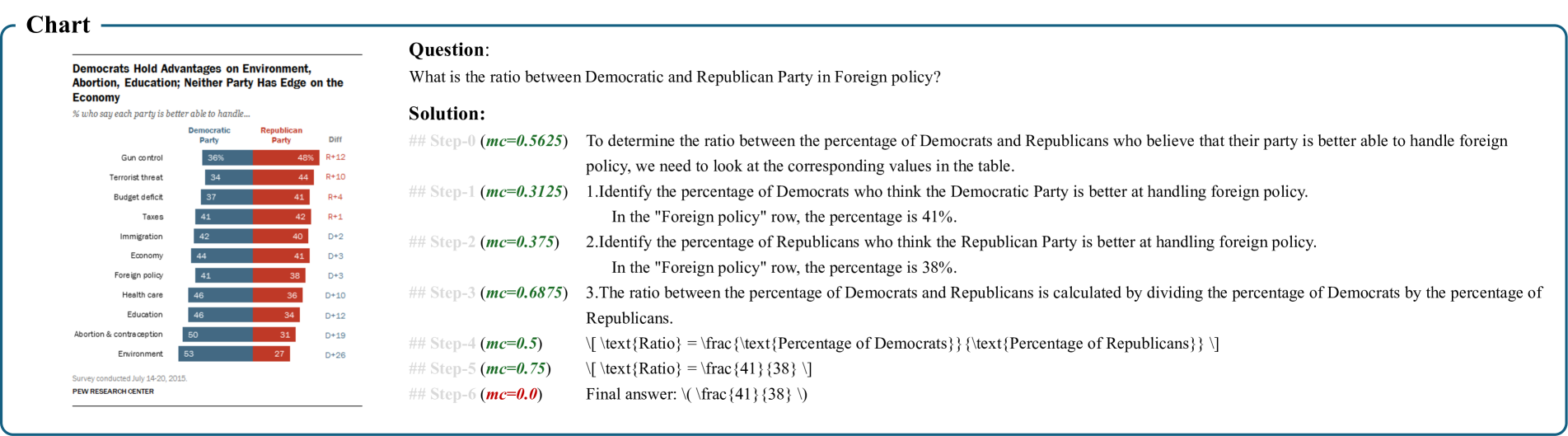
The image presents a comparative analysis of public perception regarding which political party (Democratic or Republican) is better equipped to handle various societal issues. The chart includes a table of percentages, a question about foreign policy ratios, and a step-by-step solution. Key themes include partisan advantages in social issues, neutrality in economic matters, and a slight Democratic edge in foreign policy.
### Components/Axes
- **Title**: "Democrats Hold Advantages on Environment, Abortion, Education; Neither Party Has Edge on the Economy"
- **Table Headers**:
- Issue categories (e.g., Gun control, Terrorist threat, Budget deficit)
- Columns:
- Democratic Party (%)
- Republican Party (%)
- Diff (percentage point difference)
- **Question**: "What is the ratio between Democratic and Republican Party in Foreign policy?"
- **Solution Steps**:
- Step 0: Identify foreign policy percentages (Democrats: 41%, Republicans: 38%)
- Step 1: Calculate ratio (41:38)
- Final Answer: 41:38
### Detailed Analysis
#### Table Data
| Issue | Democratic Party (%) | Republican Party (%) | Diff |
|------------------------|----------------------|----------------------|------|
| Gun control | 36 | 48 | R+12 |
| Terrorist threat | 34 | 44 | R+10 |
| Budget deficit | 37 | 41 | R+4 |
| Taxes | 41 | 42 | R+1 |
| Immigration | 42 | 40 | D+2 |
| Economy | 44 | 41 | D+3 |
| Foreign policy | 41 | 38 | D+3 |
| Health care | 46 | 36 | D+10 |
| Education | 46 | 34 | D+12 |
| Abortion & contraception | 50 | 31 | D+19 |
| Environment | 53 | 27 | D+26 |
#### Key Observations
1. **Democratic Advantages**:
- Environment (53% vs. 27%)
- Abortion & contraception (50% vs. 31%)
- Education (46% vs. 34%)
- Health care (46% vs. 36%)
2. **Republican Advantages**:
- Gun control (48% vs. 36%)
- Terrorist threat (44% vs. 34%)
- Budget deficit (41% vs. 37%)
3. **Economic Neutrality**:
- Economy (44% vs. 41%) and taxes (41% vs. 42%) show minimal partisan divides.
4. **Foreign Policy**:
- Democrats lead slightly (41% vs. 38%), with a calculated ratio of 41:38.
### Interpretation
The data suggests Democrats are perceived as more competent in social and environmental issues, while Republicans hold an edge in security-related domains. The economy is viewed as a nonpartisan concern. The foreign policy ratio (41:38) indicates a marginal Democratic advantage, though the difference is statistically small. This analysis could inform strategic messaging or policy prioritization for both parties. The stark contrast in abortion/environmental perceptions highlights cultural divides, while the economic neutrality underscores shared voter priorities.