## Diagram: Large Language Model Reasoning Process
### Overview
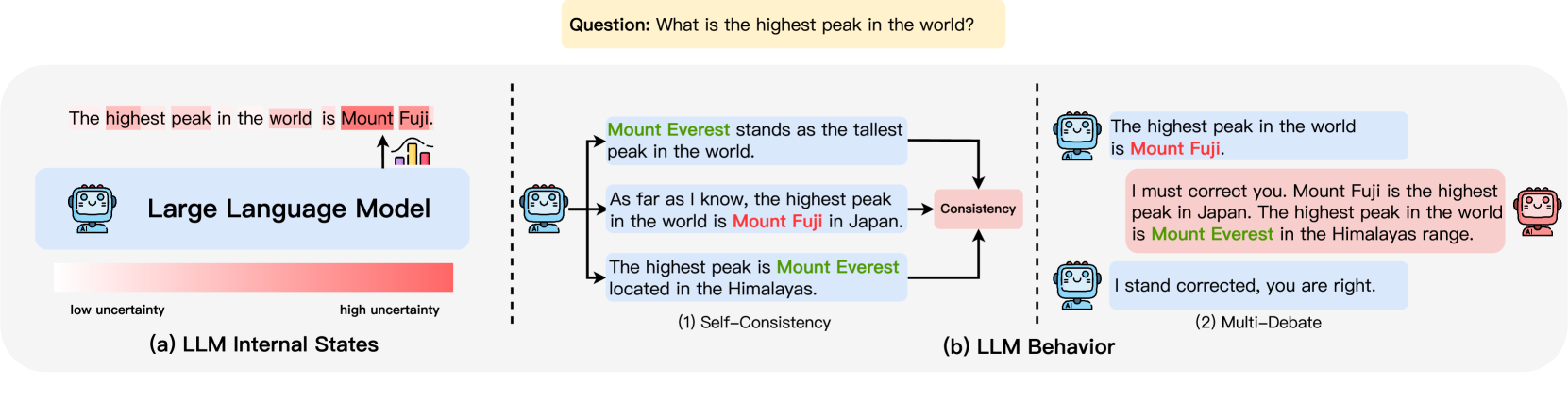
The diagram illustrates the internal reasoning process of a Large Language Model (LLM) when answering the question "What is the highest peak in the world?" It contrasts two reasoning strategies: **Self-Consistency** and **Multi-Debate**, while visualizing uncertainty levels through a bar chart.
---
### Components/Axes
#### (a) LLM Internal States
- **Bar Chart**:
- **X-axis**: Uncertainty levels (labeled "low uncertainty" and "high uncertainty").
- **Y-axis**: "Large Language Model" (title).
- **Legend**: Implied by bar color (red = high uncertainty).
- **Text**: "The highest peak in the world is Mount Fuji" (highlighted in red, indicating high uncertainty).
#### (b) LLM Behavior
- **Self-Consistency (1)**:
- **Components**:
- **Input**: Question: "What is the highest peak in the world?"
- **Internal Debate**:
- "Mount Everest stands as the tallest peak in the world."
- "As far as I know, the highest peak in the world is Mount Fuji in Japan."
- "The highest peak is Mount Everest located in the Himalayas."
- **Output**: Resolves to "Mount Everest" (correct answer).
- **Flow**: Arrows indicate iterative refinement toward consistency.
- **Multi-Debate (2)**:
- **Components**:
- **Input**: Question: "What is the highest peak in the world?"
- **Internal Debate**:
- "The highest peak in the world is Mount Fuji."
- "I must correct you. Mount Fuji is the highest peak in Japan. The highest peak in the world is Mount Everest in the Himalayas range."
- "I stand corrected, you are right."
- **Output**: Final answer: "Mount Everest."
- **Flow**: Arrows show back-and-forth correction.
---
### Detailed Analysis
#### (a) LLM Internal States
- The bar chart shows **high uncertainty** (red bar) associated with the model's initial assertion that "Mount Fuji" is the highest peak. This suggests the model's confidence is low for this claim.
#### (b) LLM Behavior
1. **Self-Consistency**:
- The model generates multiple candidate answers (Everest vs. Fuji) but resolves to **Mount Everest** as the consistent answer.
- Uncertainty is reduced through internal validation.
2. **Multi-Debate**:
- The model engages in a self-correcting dialogue, initially asserting "Mount Fuji" but later acknowledging "Mount Everest" as the correct answer.
- Demonstrates iterative refinement and error correction.
---
### Key Observations
1. **Uncertainty Correlation**: The red bar in (a) directly correlates with the model's initial incorrect assertion about Mount Fuji, indicating high uncertainty.
2. **Resolution Strategies**:
- **Self-Consistency** resolves ambiguity by favoring the most widely accepted fact (Everest).
- **Multi-Debate** explicitly models uncertainty through adversarial reasoning and correction.
3. **Final Answer Alignment**: Both strategies converge on **Mount Everest**, but Multi-Debate provides a more transparent path to the correct answer.
---
### Interpretation
The diagram highlights how LLMs manage uncertainty and reasoning errors:
- **High Uncertainty States**: Initial claims (e.g., "Mount Fuji") are flagged as low-confidence, reflecting the model's awareness of potential inaccuracies.
- **Self-Consistency**: Acts as a "sanity check" to prioritize widely accepted facts (Everest).
- **Multi-Debate**: Mimics human-like reasoning by simulating counterarguments and corrections, leading to more robust conclusions.
- **Practical Implication**: Structured reasoning frameworks (like Multi-Debate) may outperform simpler methods in complex, factually ambiguous tasks by explicitly modeling and resolving contradictions.
The model's ability to self-correct underscores the importance of iterative reasoning in reducing uncertainty and improving factual accuracy.