TECHNICAL ASSET FINGERPRINT
8a9008097ec23ce360028f0b
Click to view fullscreen
Press ESC or click to close
FOUND IN PAPERS
EXPERT: gemini-2.5-flash-lite-free VERSION 1
RUNTIME: google-free/gemini-2.5-flash-lite
INTEL_VERIFIED
## Diagram: Itemized Evaluation of a Story Outline
### Overview
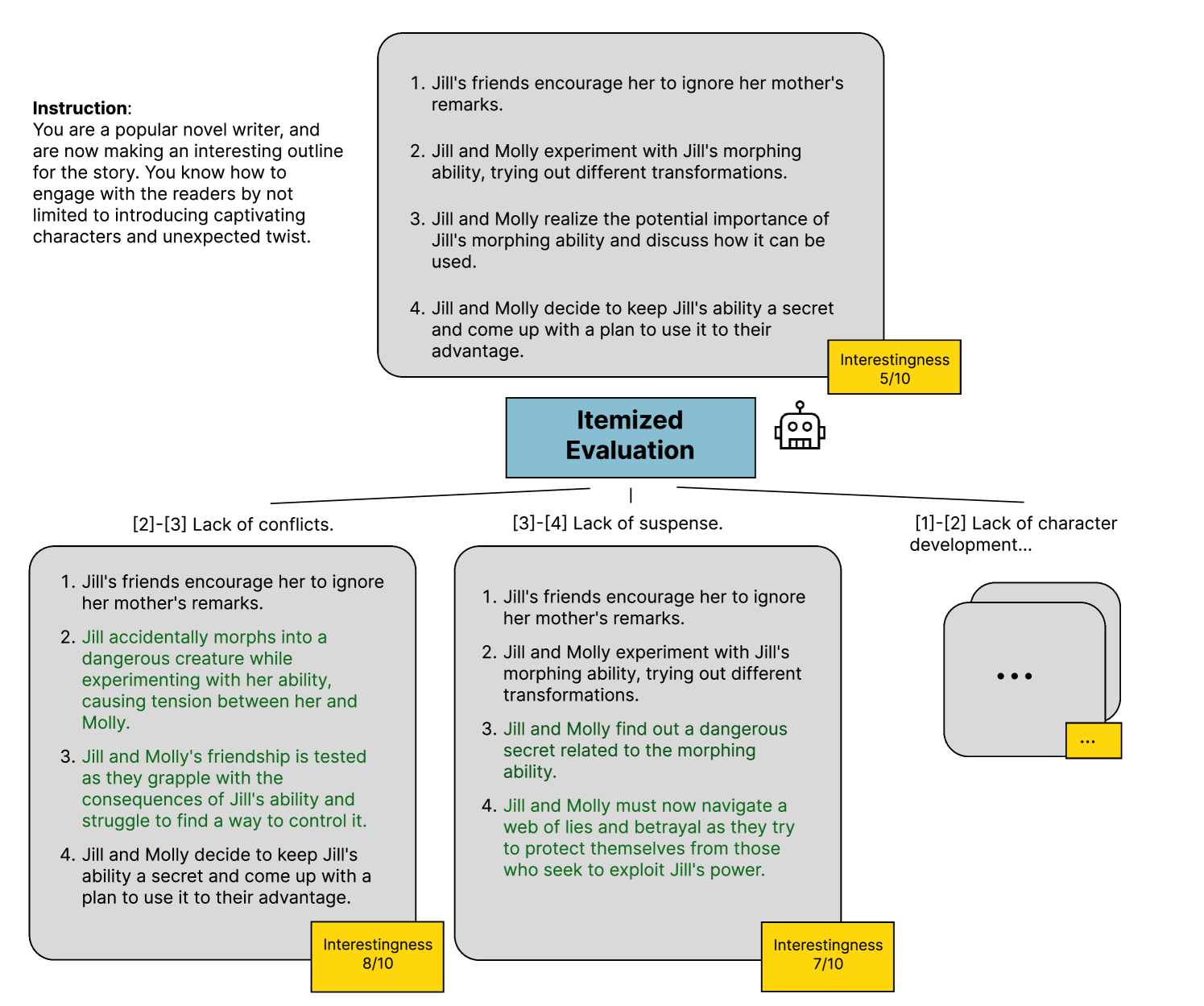
This diagram presents an "Itemized Evaluation" of a story outline, likely for a novel. It breaks down the evaluation into different aspects, such as conflicts, suspense, and character development, and assigns an "Interestingness" score to each. The diagram starts with an instruction for a popular novel writer to create a captivating outline. It then shows an initial evaluation of a story segment with an "Interestingness" score of 5/10. This is followed by a more detailed breakdown into three categories: "Lack of conflicts," "Lack of suspense," and "Lack of character development," each associated with a revised story segment and a new "Interestingness" score.
### Components/Axes
The diagram is structured as a flowchart or mind map, with a central "Itemized Evaluation" node.
* **Instruction Box (Top-Left):**
* **Title:** "Instruction:"
* **Content:** "You are a popular novel writer, and are now making an interesting outline for the story. You know how to engage the readers by not limited to introducing captivating characters and unexpected twist."
* **Initial Story Segment Evaluation (Top-Right):**
* **Content:** A numbered list of four plot points:
1. "Jill's friends encourage her to ignore her mother's remarks."
2. "Jill and Molly experiment with Jill's morphing ability, trying out different transformations."
3. "Jill and Molly realize the potential importance of Jill's morphing ability and discuss how it can be used."
4. "Jill and Molly decide to keep Jill's ability a secret and come up with a plan to use it to their advantage."
* **Associated Label:** "Interestingness 5/10" (in a yellow rectangle).
* **Central Node:**
* **Text:** "Itemized Evaluation" (in a light blue rectangle).
* **Icon:** A stylized robot figure to the right of the text.
* **Branching Categories (Below Central Node):**
* **Branch 1 Label:** "[2]-[3] Lack of conflicts."
* **Branch 2 Label:** "[3]-[4] Lack of suspense."
* **Branch 3 Label:** "[1]-[2] Lack of character development..."
* **Detailed Story Segment Evaluations (Below Branches):**
* **Evaluation 1 (Under "[2]-[3] Lack of conflicts."):**
* **Content:** A numbered list of four revised plot points:
1. "Jill's friends encourage her to ignore her mother's remarks."
2. "Jill accidentally morphs into a dangerous creature while experimenting with her ability, causing tension between her and Molly."
3. "Jill and Molly's friendship is tested as they grapple with the consequences of Jill's ability and struggle to find a way to control it."
4. "Jill and Molly decide to keep Jill's ability a secret and come up with a plan to use it to their advantage."
* **Associated Label:** "Interestingness 8/10" (in a yellow rectangle).
* **Evaluation 2 (Under "[3]-[4] Lack of suspense."):**
* **Content:** A numbered list of four revised plot points:
1. "Jill's friends encourage her to ignore her mother's remarks."
2. "Jill and Molly experiment with Jill's morphing ability, trying out different transformations."
3. "Jill and Molly find out a dangerous secret related to the morphing ability."
4. "Jill and Molly must now navigate a web of lies and betrayal as they try to protect themselves from those who seek to exploit Jill's power."
* **Associated Label:** "Interestingness 7/10" (in a yellow rectangle).
* **Evaluation 3 (Under "[1]-[2] Lack of character development...")**:
* **Content:** A visual representation of stacked, rounded squares with three dots (...) inside the topmost square, and a smaller yellow rectangle with three dots (...) below it. This likely represents a placeholder or a concept related to character development that is not explicitly detailed in text.
* **Associated Label:** No explicit "Interestingness" score is provided for this branch, but it is visually linked to the "[1]-[2] Lack of character development..." label.
### Detailed Analysis or Content Details
The diagram illustrates an iterative process of story evaluation and revision.
* **Initial Outline:** The first set of plot points (Interestingness 5/10) is evaluated.
* **Categorized Weaknesses:** The evaluation identifies specific areas for improvement:
* Lack of conflicts (between points [2] and [3]).
* Lack of suspense (between points [3] and [4]).
* Lack of character development (between points [1] and [2]).
* **Revised Outlines:**
* **Conflict Revision:** The plot points are revised to introduce a dangerous morphing incident and test the friendship, leading to an "Interestingness" score of 8/10. This revision specifically targets the conflict between points 2 and 3.
* **Suspense Revision:** The plot points are revised to include a dangerous secret and a web of lies and betrayal, resulting in an "Interestingness" score of 7/10. This revision targets the suspense between points 3 and 4.
* **Character Development:** This aspect is represented visually, suggesting that the specific plot points [1]-[2] were identified as lacking character development, but the revised content is not explicitly transcribed.
### Key Observations
* The "Itemized Evaluation" process aims to improve the story's "Interestingness."
* The initial evaluation of 5/10 is significantly improved in the revised versions, reaching 8/10 for conflict and 7/10 for suspense.
* The diagram suggests that addressing specific weaknesses (conflicts, suspense, character development) leads to higher "Interestingness" scores.
* The visual representation for character development implies that this aspect might be more abstract or require a different form of representation than a simple list of plot points.
### Interpretation
This diagram demonstrates a structured approach to story development and critique, likely employed by a writer or editor. The "Itemized Evaluation" serves as a framework to dissect a narrative's strengths and weaknesses. The "Instruction" sets the context, emphasizing the goal of creating an engaging story with captivating elements.
The initial evaluation (5/10) suggests that the original outline, while containing some basic plot points, lacked the necessary depth in conflict and suspense to be highly engaging. The subsequent revisions directly address these identified shortcomings. The significant increase in "Interestingness" for the conflict-revised section (8/10) indicates that introducing a tangible, high-stakes event (morphing into a dangerous creature, testing friendship) is a highly effective strategy for improving reader engagement. The suspense-revised section (7/10) also shows improvement, with the introduction of secrets and betrayal adding layers of intrigue.
The visual representation for "Lack of character development" is particularly interesting. It suggests that this aspect might be harder to quantify or express through simple plot points alone. The stacked squares and dots could symbolize the unfolding or deepening of a character's personality, motivations, or internal struggles, which might require more nuanced narrative techniques than simply listing events.
Overall, the diagram illustrates a practical application of narrative theory, where identifying and resolving specific structural or thematic weaknesses directly correlates with an increase in the story's perceived quality or "Interestingness." It highlights the importance of conflict and suspense in driving reader engagement and suggests that character development, while crucial, might be addressed through different narrative means. The Peircean investigative approach here would be to consider what "signs" (plot points, character actions) are being interpreted by the evaluator, and how the revised "signs" are intended to signify a more compelling narrative to the reader (the interpretant). The underlying assumption is that a well-structured narrative with clear stakes and character arcs will be more "interesting."
DECODING INTELLIGENCE...