## Diagram: Story Outline Evaluation
### Overview
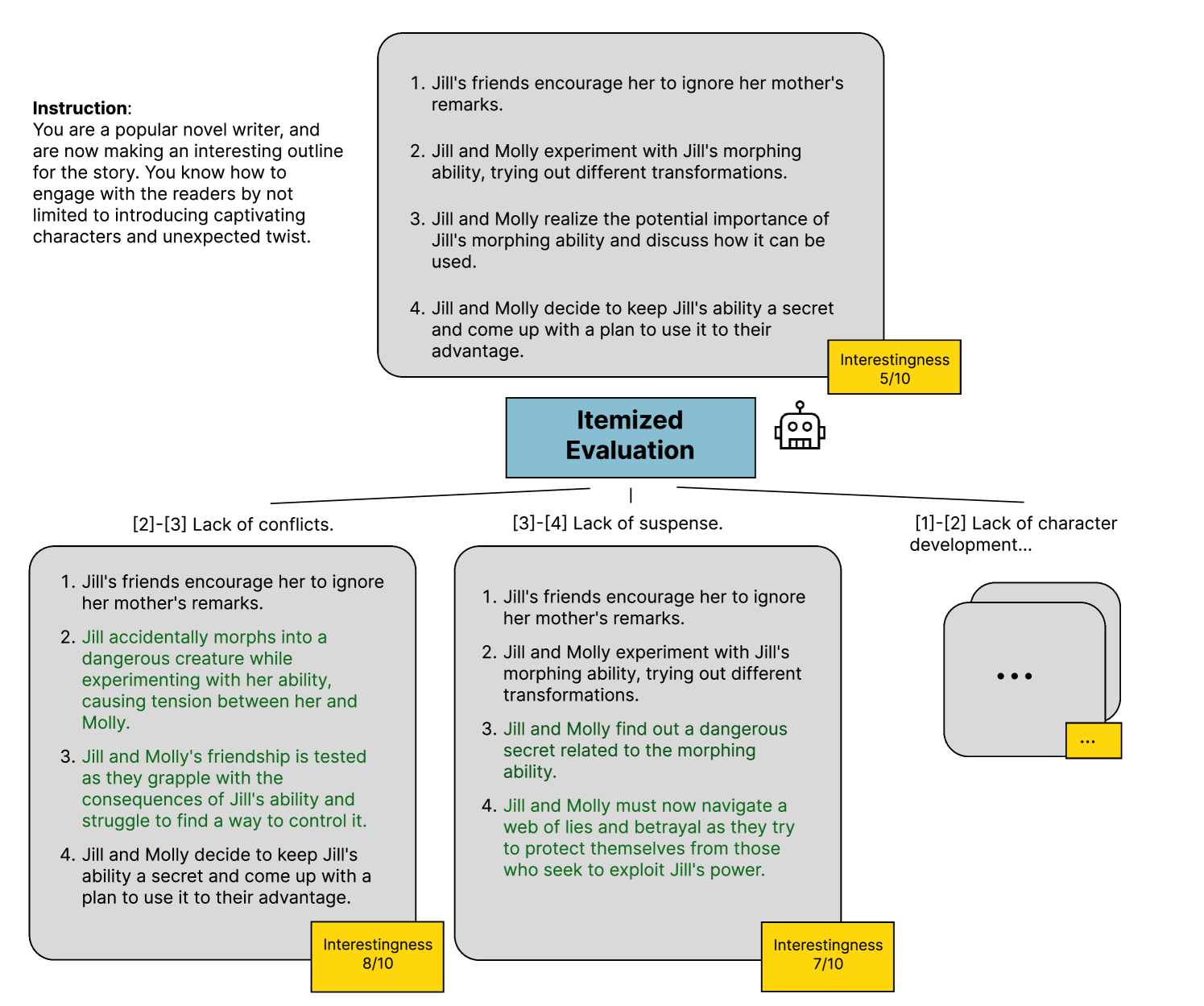
The image presents a diagram evaluating different story outlines for a novel, focusing on the "interestingness" of each outline and identifying areas for improvement. It compares three versions of a story outline, each with four plot points, and assesses them based on criteria like "lack of conflicts," "lack of suspense," and "lack of character development." Each outline is assigned an "interestingness" score.
### Components/Axes
The diagram is structured into three main columns, each representing a different story outline. Each column contains four numbered plot points. A central section labeled "Itemized Evaluation" lists evaluation criteria. Each outline is accompanied by an "Interestingness" score presented as a fraction over 10 (e.g., 5/10, 8/10, 7/10). The evaluation criteria are presented in rectangular boxes with associated numerical ranges (e.g., "[2]- [3] Lack of conflicts.").
### Detailed Analysis or Content Details
**Outline 1 (Left Column):**
1. Jill’s friends encourage her to ignore her mother’s remarks.
2. Jill and Molly experiment with Jill’s morphing ability, trying out different transformations.
3. Jill and Molly realize the potential importance of Jill’s morphing ability and discuss how it can be used.
4. Jill and Molly decide to keep Jill’s ability a secret and come up with a plan to use it to their advantage.
* Interestingness: 5/10
**Outline 2 (Center Column):**
1. Jill’s friends encourage her to ignore her mother’s remarks.
2. Jill accidentally morphs into a dangerous creature while experimenting with her ability, causing tension between her and Molly.
3. Jill and Molly’s friendship is tested as they grapple with the consequences of Jill’s ability and struggle to find a way to control it.
4. Jill and Molly decide to keep Jill’s ability a secret and come up with a plan to use it to their advantage.
* Interestingness: 8/10
**Outline 3 (Right Column):**
1. Jill’s friends encourage her to ignore her mother’s remarks.
2. Jill and Molly experiment with Jill’s morphing ability, trying out different transformations.
3. Jill and Molly find out a dangerous secret related to the morphing ability.
4. Jill and Molly must now navigate a web of lies and betrayal as they try to protect themselves from those who seek to exploit Jill’s power.
* Interestingness: 7/10
**Itemized Evaluation:**
* "[2]- [3] Lack of conflicts."
* "[3]- [4] Lack of suspense."
* "[1]- [2] Lack of character development…" (The ellipsis indicates there is more text, but it is cut off.)
### Key Observations
* Outline 2 receives the highest "interestingness" score (8/10), suggesting it is the most compelling of the three. This is likely due to the introduction of conflict (Jill morphing into a dangerous creature) and tension in the friendship.
* Outline 1 receives the lowest "interestingness" score (5/10), indicating it is the least engaging.
* The evaluation criteria highlight areas where the outlines could be improved: conflicts, suspense, and character development.
* The diagram uses a consistent structure for each outline, making it easy to compare them.
### Interpretation
The diagram demonstrates a process of iterative story development. The initial outline (Outline 1) is considered relatively uninteresting, and subsequent revisions (Outlines 2 and 3) attempt to address this by introducing elements of conflict, suspense, and potentially deeper character exploration. The "Itemized Evaluation" provides specific feedback on areas for improvement. The increasing "interestingness" scores suggest that the revisions are moving in a positive direction. The diagram is a visual representation of a writer's thought process, weighing different plot points and assessing their potential impact on the overall story. The cut-off text in the last evaluation point ("Lack of character development…") suggests that this is a key area for further refinement. The diagram suggests that a compelling story requires more than just a sequence of events; it needs conflict, suspense, and well-developed characters.