TECHNICAL ASSET FINGERPRINT
8a9008097ec23ce360028f0b
Click to view fullscreen
Press ESC or click to close
FOUND IN PAPERS
EXPERT: healer-alpha-free VERSION 1
RUNTIME: free/openrouter/healer-alpha
INTEL_VERIFIED
## Flowchart: Story Outline Evaluation and Revision
### Overview
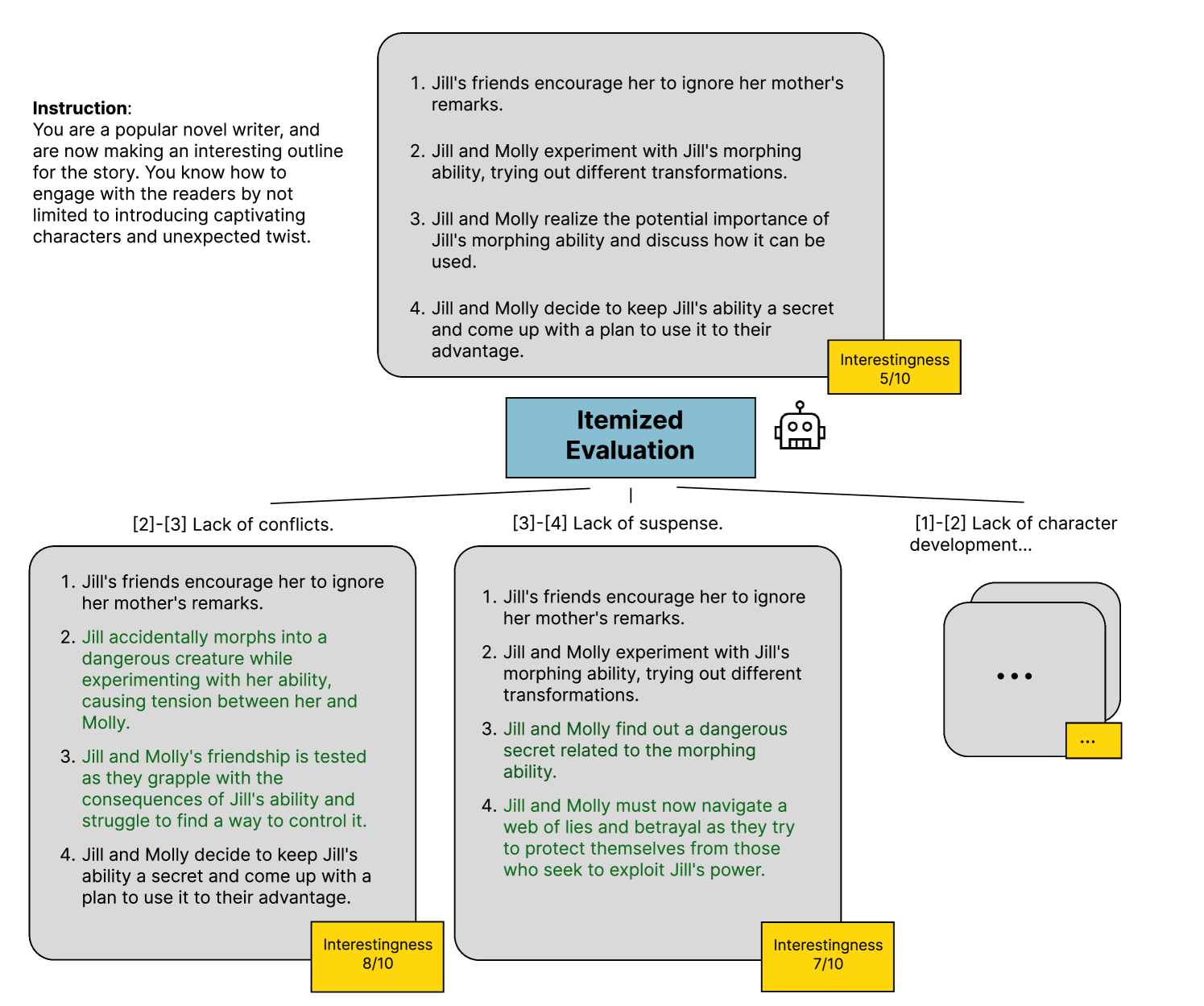
The image is a flowchart diagram illustrating a process for evaluating and revising a story outline to increase its "interestingness." It begins with an initial outline, which is then analyzed by an "Itemized Evaluation" system (represented by a robot icon). This evaluation identifies specific weaknesses, leading to three distinct revised outlines, each addressing a different critique and achieving a higher interestingness score.
### Components/Axes
The diagram is structured hierarchically with connecting lines indicating flow.
1. **Instruction Box (Top-Left):**
* **Text:** "Instruction: You are a popular novel writer, and are now making an interesting outline for the story. You know how to engage with the readers by not limited to introducing captivating characters and unexpected twist."
2. **Initial Outline Box (Top-Center):**
* A large, light-gray rounded rectangle containing a numbered list.
* **Content:**
1. Jill's friends encourage her to ignore her mother's remarks.
2. Jill and Molly experiment with Jill's morphing ability, trying out different transformations.
3. Jill and Molly realize the potential importance of Jill's morphing ability and discuss how it can be used.
4. Jill and Molly decide to keep Jill's ability a secret and come up with a plan to use it to their advantage.
* **Attached Label (Bottom-Right of box):** A yellow rectangle with the text "Interestingness 5/10".
3. **Central Evaluation Node (Center):**
* A blue rectangle with the text "Itemized Evaluation".
* A small robot icon is positioned to its right.
4. **Critique Labels (Below Central Node):**
* Three text labels branch down from the central node, each identifying a specific flaw in the initial outline.
* **Left:** "[2]-[3] Lack of conflicts."
* **Center:** "[3]-[4] Lack of suspense."
* **Right:** "[1]-[2] Lack of character development..."
5. **Revised Outline Boxes (Bottom Row):**
* Three light-gray rounded rectangles, each corresponding to a critique above it. They contain revised numbered lists. Changes from the original are highlighted in **green text**.
* **Left Box (Addresses "Lack of conflicts"):**
* **Content:**
1. Jill's friends encourage her to ignore her mother's remarks.
2. **Jill accidentally morphs into a dangerous creature while experimenting with her ability, causing tension between her and Molly.**
3. **Jill and Molly's friendship is tested as they grapple with the consequences of Jill's ability and struggle to find a way to control it.**
4. Jill and Molly decide to keep Jill's ability a secret and come up with a plan to use it to their advantage.
* **Attached Label (Bottom-Right):** Yellow rectangle with "Interestingness 8/10".
* **Center Box (Addresses "Lack of suspense"):**
* **Content:**
1. Jill's friends encourage her to ignore her mother's remarks.
2. Jill and Molly experiment with Jill's morphing ability, trying out different transformations.
3. **Jill and Molly find out a dangerous secret related to the morphing ability.**
4. **Jill and Molly must now navigate a web of lies and betrayal as they try to protect themselves from those who seek to exploit Jill's power.**
* **Attached Label (Bottom-Right):** Yellow rectangle with "Interestingness 7/10".
* **Right Box (Addresses "Lack of character development..."):**
* **Content:** This box is mostly obscured by a stack of placeholder cards. The visible top card contains only an ellipsis ("..."). A small yellow rectangle with "..." is attached to its bottom-right corner, implying an interestingness score is present but not shown.
### Detailed Analysis
The diagram presents a clear before-and-after analysis of a narrative outline.
* **Initial State:** The starting outline (Interestingness: 5/10) is a straightforward, low-conflict sequence where two characters discover and plan to use a secret ability.
* **Evaluation Process:** The "Itemized Evaluation" system diagnoses three specific narrative weaknesses between numbered points in the initial outline:
* Between points 2 & 3: Lack of conflicts.
* Between points 3 & 4: Lack of suspense.
* Between points 1 & 2: Lack of character development.
* **Revised States:** Each revision directly targets one critique:
1. **Conflict Revision (Score: 8/10):** Introduces an accidental dangerous transformation (point 2) and tests the friendship (point 3), creating direct interpersonal and internal conflict.
2. **Suspense Revision (Score: 7/10):** Introduces a "dangerous secret" (point 3) and external antagonists seeking to exploit the power (point 4), raising stakes and creating narrative suspense.
3. **Character Development Revision (Score: Not shown):** The content is not visible, but the critique suggests the revisions would focus on deepening the characters' backgrounds, motivations, or relationships in the early points of the outline.
### Key Observations
* **Score Progression:** Addressing narrative flaws leads to higher interestingness scores. The "Lack of conflicts" revision yields the highest visible score (8/10), suggesting conflict is weighted heavily in this evaluation model.
* **Targeted Revisions:** Each revised outline only modifies the specific points implicated by the critique, leaving other points unchanged. This demonstrates a modular approach to story editing.
* **Visual Coding:** The use of **green text** in the revised outlines clearly highlights the exact lines that were altered to address the critique.
* **Spatial Layout:** The flow is top-down: Instruction -> Initial Outline -> Evaluation -> Critiques -> Revised Outlines. The legend (Interestingness scores) is consistently placed at the bottom-right of each outline box.
### Interpretation
This diagram models a structured, analytical approach to creative writing. It treats a story outline as a system that can be debugged and optimized by identifying and patching specific narrative deficiencies (conflict, suspense, character development). The "Itemized Evaluation" acts as an automated or systematic critic.
The underlying principle is that reader engagement ("interestingness") is not a vague quality but a direct result of employing specific narrative techniques. The process demonstrates that:
1. **Conflict is crucial:** Introducing accidental danger and interpersonal tension provided the greatest boost to the score.
2. **Stakes matter:** Adding external threats and secrets increases suspense and engagement.
3. **Modular improvement is possible:** A weak outline can be strengthened by surgically enhancing its components rather than starting from scratch.
The obscured third branch implies the process is repeatable for various narrative elements. The diagram serves as both a flowchart for a specific revision task and a general metaphor for using systematic critique to enhance creative work.
DECODING INTELLIGENCE...