## Flowchart Diagram: Story Development Evaluation
### Overview
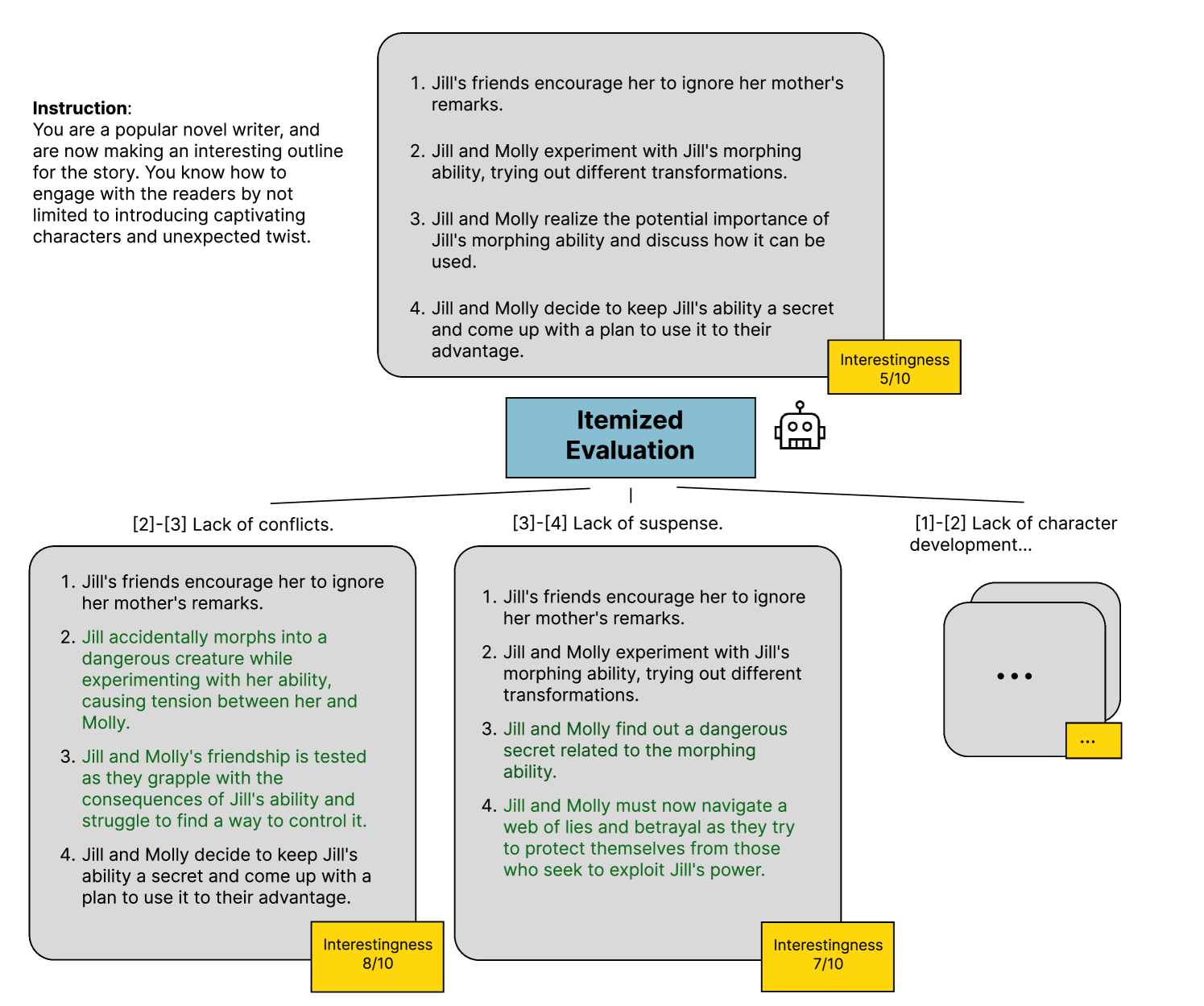
The image depicts a flowchart evaluating story development elements for a novel outline. It includes an initial outline, an itemized evaluation, and three alternative story development paths with ratings. The diagram uses gray boxes for content, yellow boxes for ratings, and arrows to indicate progression.
### Components/Axes
- **Main Sections**:
- **Instruction Box** (top-left): Defines the task for a novel writer to create an engaging outline.
- **Initial Outline Box** (center-top): Contains four story points about Jill and Molly's abilities and decisions.
- **Itemized Evaluation Box** (center): Lists "Lack of suspense" as the primary critique.
- **Robot Icon** (center-right): Visual element near the evaluation box.
- **Three Alternative Paths** (bottom): Labeled [2]-[3], [3]-[4], and [1]-[2], each with story developments and ratings.
- **Arrows**: Connect boxes to show narrative flow (e.g., from outline to evaluation to alternative paths).
- **Ratings**:
- Yellow boxes with "Interestingness" scores (5/10, 8/10, 7/10).
### Detailed Analysis
1. **Instruction Box**:
- Text: "You are a popular novel writer... characters and unexpected twist."
2. **Initial Outline Box**:
- Four story points:
1. Friends encourage ignoring mother's remarks.
2. Experimentation with morphing ability.
3. Realization of ability's importance.
4. Decision to keep ability secret for advantage.
3. **Itemized Evaluation Box**:
- Critique: "Lack of suspense."
- Robot icon adjacent to the box.
4. **Alternative Paths**:
- **[2]-[3] (8/10)**:
- Story points include accidental transformation into a dangerous creature, friendship tension, and secret-keeping.
- **[3]-[4] (7/10)**:
- Focus on discovering a dangerous secret and navigating lies/betrayal.
- **[1]-[2] (...)**:
- Incomplete (ellipsis), implying unresolved character development.
### Key Observations
- **Ratings Correlation**:
- The [2]-[3] path (8/10) introduces higher stakes (dangerous transformations, friendship conflict) compared to [3]-[4] (7/10), which emphasizes secrecy and betrayal.
- The [1]-[2] path lacks a rating, suggesting unresolved development.
- **Narrative Progression**:
- Arrows indicate a linear flow from the initial outline to evaluation, then branching into alternative paths.
- The robot icon may symbolize analytical evaluation or AI-assisted critique.
### Interpretation
- **Story Development Impact**:
- The highest-rated path ([2]-[3]) introduces external conflict (dangerous transformations) and interpersonal tension, aligning with the instruction to "engage readers with captivating characters and unexpected twists."
- The [3]-[4] path focuses on internal conflict (secrets, betrayal), which is rated slightly lower, possibly due to reduced action-driven engagement.
- The missing rating for [1]-[2] highlights a gap in character development, as noted in the initial evaluation ("Lack of character development").
- **Design Intent**:
- The flowchart visually emphasizes the importance of conflict and suspense in storytelling, as reflected in the evaluation and ratings.
- The use of color (yellow for ratings, green for story text) distinguishes evaluative elements from narrative content.
- **Anomalies**:
- The [1]-[2] path's incomplete rating suggests an unresolved critique, potentially indicating a need for further development in character arcs.
This diagram underscores how narrative choices (e.g., introducing danger vs. secrecy) directly influence perceived engagement, with higher ratings tied to dynamic character interactions and external stakes.