\n
## Diagram: Reasoning Chain Analysis
### Overview
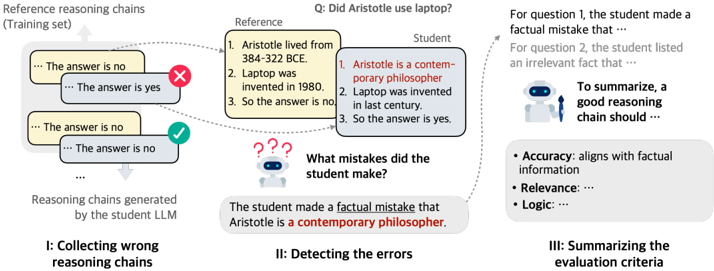
The image is a diagram illustrating a process for analyzing reasoning chains generated by a student Large Language Model (LLM) against a reference source. It outlines three stages: collecting wrong reasoning chains, detecting errors, and summarizing evaluation criteria. The diagram uses flowcharts, text boxes, and robot icons to represent the process and findings.
### Components/Axes
The diagram is divided into three main sections labeled I, II, and III, corresponding to the three stages of analysis.
* **Section I (Collecting wrong reasoning chains):** Depicts a flowchart with rounded rectangles representing reasoning steps. Arrows indicate the flow of reasoning. Labels include "...The answer is no" and "...The answer is yes".
* **Section II (Detecting the errors):** Presents a comparison between "Reference" and "Student" reasoning. Includes a robot icon with a question mark bubble.
* **Section III (Summarizing the evaluation criteria):** Lists evaluation criteria with bullet points: "Accuracy", "Relevance", and "Logic". Includes a robot icon.
* **Reference Reasoning Chains (Training set):** Located at the top-left, this section serves as the baseline for comparison.
* **Question:** "Did Aristotle use laptop?" is positioned above the "Reference" and "Student" comparison.
### Detailed Analysis or Content Details
**Section I: Collecting Wrong Reasoning Chains**
* The flowchart shows a series of reasoning steps, with some paths marked with a red "X" (indicating incorrect reasoning) and others with a green checkmark (indicating correct reasoning).
* The flow starts with "...The answer is no" and "...The answer is yes" branching out.
* The flow continues with "...The answer is no" repeated multiple times.
**Section II: Detecting the Errors**
* **Reference:**
1. "Aristotle lived from 384-322 BCE."
2. "Laptop was invented in 1980."
3. "So the answer is no."
* **Student:**
1. "Aristotle is a contemporary philosopher."
2. "Laptop was invented in last century."
3. "So the answer is yes."
* The robot icon has a speech bubble stating: "What mistakes did the student make?"
* Below the robot, a text box states: "The student made a factual mistake that Aristotle is a contemporary philosopher."
**Section III: Summarizing the Evaluation Criteria**
* **Accuracy:** aligns with factual information
* **Relevance:** ...
* **Logic:** ...
* A robot icon is present, with a speech bubble stating: "To summarize, a good reasoning chain should..."
**Additional Text:**
* "For question 1, the student made a factual mistake that..."
* "For question 2, the student listed an irrelevant fact that..."
### Key Observations
* The diagram highlights the importance of factual accuracy in reasoning. The student's error stems from a misunderstanding of Aristotle's historical period.
* The diagram demonstrates a clear comparison between the reference reasoning and the student's reasoning, pinpointing the specific error.
* The evaluation criteria emphasize accuracy, relevance, and logic as key components of a good reasoning chain.
* The use of visual cues (red "X", green checkmark, robot icons) effectively conveys the analysis process.
### Interpretation
The diagram illustrates a methodology for evaluating the reasoning capabilities of an LLM. It demonstrates how to identify factual errors and irrelevant information in the LLM's reasoning process. The comparison between the reference reasoning and the student's reasoning is crucial for pinpointing the specific mistakes. The evaluation criteria (accuracy, relevance, and logic) provide a framework for assessing the quality of the reasoning chain. The diagram suggests that a good reasoning chain should be grounded in factual information, relevant to the question, and logically sound. The use of a question about Aristotle and laptops serves as a concrete example to illustrate the process. The diagram is a valuable tool for understanding and improving the reasoning abilities of LLMs. The incomplete "Relevance" and "Logic" criteria suggest that these aspects are either being left for further elaboration or are not the primary focus of this particular analysis.