## Flowchart: Process for Evaluating Reasoning Chains in Student Responses
### Overview
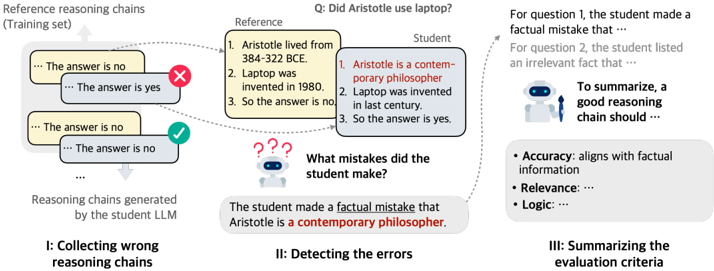
The image depicts a three-stage flowchart illustrating a process for analyzing and improving reasoning chains generated by students using large language models (LLMs). The flowchart emphasizes error detection, correction, and evaluation criteria for logical reasoning.
### Components/Axes
1. **Sections**:
- **I: Collecting wrong reasoning chains** (left)
- **II: Detecting the errors** (center)
- **III: Summarizing the evaluation criteria** (right)
2. **Visual Elements**:
- Text boxes with labels like "Reference reasoning chains (Training set)", "Reference", "Student", and "What mistakes did the student make?"
- Arrows indicating flow direction (left → center → right)
- Icons:
- Green checkmark (correct answer)
- Red X (incorrect answer)
- Robot with question marks (error detection)
- Robot holding a paintbrush (summarization)
3. **Text Content**:
- **Question**: "Did Aristotle use laptop?"
- **Reference Answer**:
1. Aristotle lived from 384-322 BCE.
2. Laptop was invented in 1980.
3. So the answer is no.
- **Student's Incorrect Reasoning**:
1. Aristotle is a contemporary philosopher.
2. Laptop was invented in the last century.
3. So the answer is yes.
- **Error Identification**: "The student made a factual mistake that Aristotle is a contemporary philosopher."
- **Evaluation Criteria**:
- Accuracy: aligns with factual information
- Relevance: ...
- Logic: ...
### Detailed Analysis
1. **Section I: Collecting wrong reasoning chains**
- Shows reference reasoning chains with training set examples.
- Displays conflicting student-generated chains (e.g., "The answer is yes" vs. "The answer is no").
- Highlights incorrect chains with red X marks.
2. **Section II: Detecting the errors**
- Focuses on identifying factual inaccuracies in student reasoning.
- Explicitly calls out the error: "Aristotle is a contemporary philosopher" (contradicts reference answer).
3. **Section III: Summarizing the evaluation criteria**
- Lists three criteria for valid reasoning chains:
- Accuracy (factual alignment)
- Relevance (contextual appropriateness)
- Logic (coherent structure)
### Key Observations
- The flowchart emphasizes **factual accuracy** as the primary evaluation metric, with explicit callouts to errors in historical knowledge.
- The student's reasoning chain contains a **temporal inconsistency** (Aristotle as contemporary) and a **misattributed invention timeline** (laptop in "last century" vs. 1980).
- The evaluation criteria prioritize **accuracy over relevance/logic**, suggesting factual correctness is foundational.
### Interpretation
This flowchart outlines a pedagogical framework for training LLMs to generate factually grounded reasoning chains. By:
1. Collecting diverse (correct/incorrect) examples,
2. Identifying specific factual errors,
3. Defining evaluation criteria,
The process aims to improve LLM outputs through structured error analysis. The example demonstrates how **temporal reasoning errors** (e.g., misdating inventions) can cascade into incorrect conclusions, underscoring the need for rigorous fact-checking in automated reasoning systems. The emphasis on accuracy aligns with Peircean principles of scientific inquiry, where factual verification precedes logical deduction.