## Heatmap: Room Occupancy
### Overview
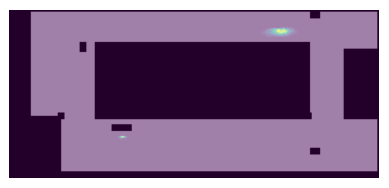
The image is a heatmap representing occupancy within a room. The room layout is depicted with walls and open spaces. The heatmap uses color intensity to indicate the level of occupancy, with brighter colors (yellow/green) indicating higher occupancy and darker colors (purple/black) indicating lower or no occupancy.
### Components/Axes
* **Room Layout:** The image shows the floor plan of a room, including walls and openings. The central area is a large, open space.
* **Heatmap Overlay:** A color gradient is overlaid on the room layout to represent occupancy levels.
* **Color Gradient:** The color gradient ranges from dark purple/black (low occupancy) to green/yellow (high occupancy). There is no explicit legend provided, so the exact occupancy values associated with each color are unknown.
### Detailed Analysis
* **High Occupancy Area:** There is a distinct area of high occupancy in the top-right corner of the room. This area is represented by a bright yellow/green color, indicating a concentration of people or activity.
* **Low Occupancy Areas:** The central area of the room and most of the surrounding space show low occupancy, indicated by the dark purple/black color.
* **Other Occupancy Points:** There is a small area of slightly elevated occupancy near the bottom-left of the room.
### Key Observations
* The heatmap suggests that the top-right corner of the room is the most frequently used or occupied area.
* The central area of the room is largely unoccupied.
* There is a minor occupancy point in the bottom-left.
### Interpretation
The heatmap provides a visual representation of how space is utilized within the room. The concentration of occupancy in the top-right corner could be due to the placement of furniture, equipment, or a specific activity that attracts people to that area. The low occupancy in the central area suggests that it may be used for circulation or is simply not a desirable location for people to congregate. The small occupancy point in the bottom-left could be due to a doorway or another point of interest. Without additional context, it is difficult to determine the exact reasons for the observed occupancy patterns.