## Code Snippet: Theorem Definitions
### Overview
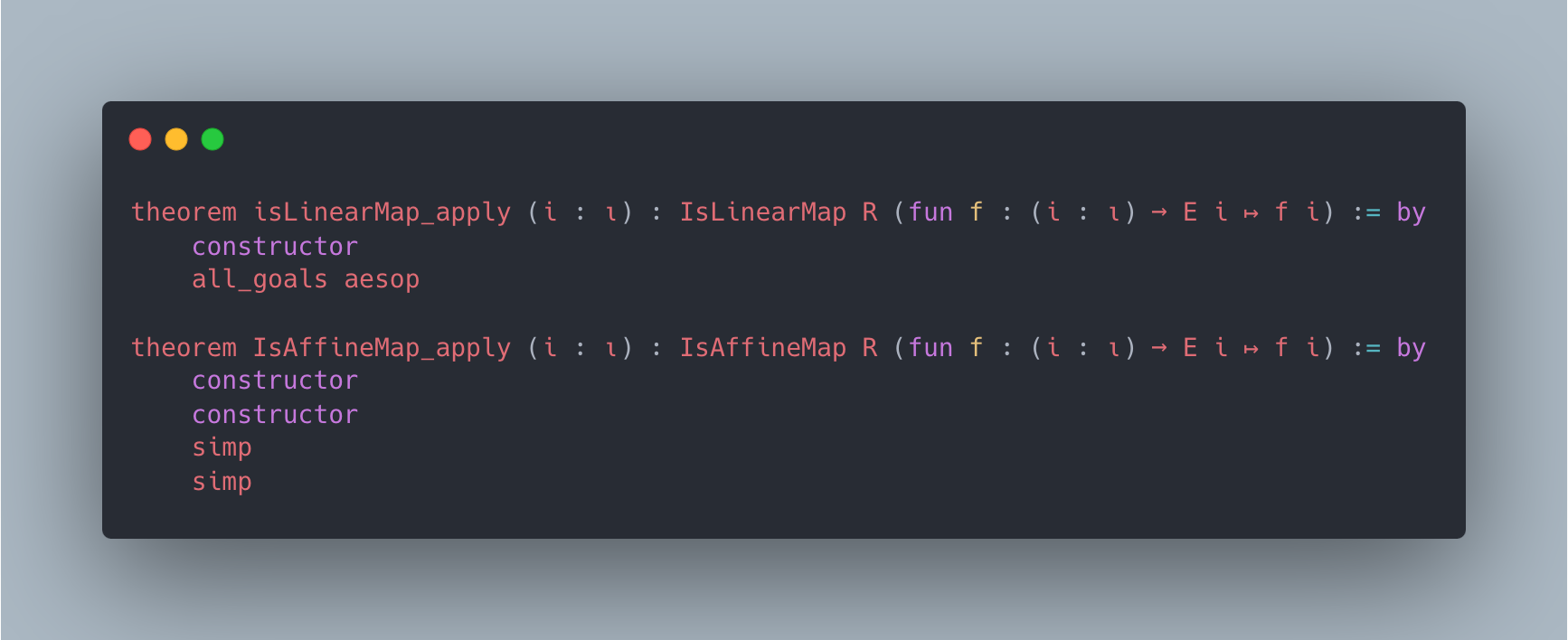
The image shows a code snippet defining two theorems: `isLinearMap_apply` and `IsAffineMap_apply`. The code appears to be written in a formal verification language, likely Coq or a similar system. The snippet defines the theorems and provides tactics for proving them.
### Components/Axes
* **Theorem Definitions:** Two theorems are defined: `isLinearMap_apply` and `IsAffineMap_apply`.
* **Input Parameters:** Both theorems take an input parameter `(i : ι)`.
* **Return Type:** Both theorems return a type indicating whether a function `f` is a linear map or an affine map, respectively. The function `f` takes an input `(ι : ι)` and returns a value of type `E i ↔ f i`.
* **Proof Tactics:** The `by` keyword indicates the start of the proof tactics used to prove the theorems.
### Detailed Analysis or ### Content Details
* **Theorem 1: `isLinearMap_apply`**
* Definition: `theorem isLinearMap_apply (i : ι) : IsLinearMap R (fun f : (ι : ι) → E i ↔ f i) := by`
* Proof Tactics:
* `constructor`
* `all_goals aesop`
* **Theorem 2: `IsAffineMap_apply`**
* Definition: `theorem IsAffineMap_apply (i : ι) : IsAffineMap R (fun f : (i : ι) → E i ↔ f i) := by`
* Proof Tactics:
* `constructor`
* `constructor`
* `simp`
* `simp`
### Key Observations
* Both theorems define properties related to linear and affine maps.
* The proof tactics used for the two theorems differ. `isLinearMap_apply` uses `all_goals aesop`, while `IsAffineMap_apply` uses `constructor` and `simp` tactics.
* The input parameter `(i : ι)` and the function `f` are similar in both theorem definitions.
### Interpretation
The code snippet demonstrates the formal definition and proof of two mathematical theorems related to linear and affine maps. The use of specific proof tactics suggests different approaches are needed to prove each theorem. The `aesop` tactic used in the first theorem is likely a more general-purpose tactic, while `constructor` and `simp` are more specific tactics used in the second theorem. The code is likely part of a larger formal verification project, where mathematical properties are rigorously defined and proven using automated or semi-automated tools. The `E i ↔ f i` likely represents a mapping or relationship between `E i` and `f i`. The `R` likely represents a ring or field over which the linear and affine maps are defined.