## Screenshot: Code Editor with Formal Proof Scripts
### Overview
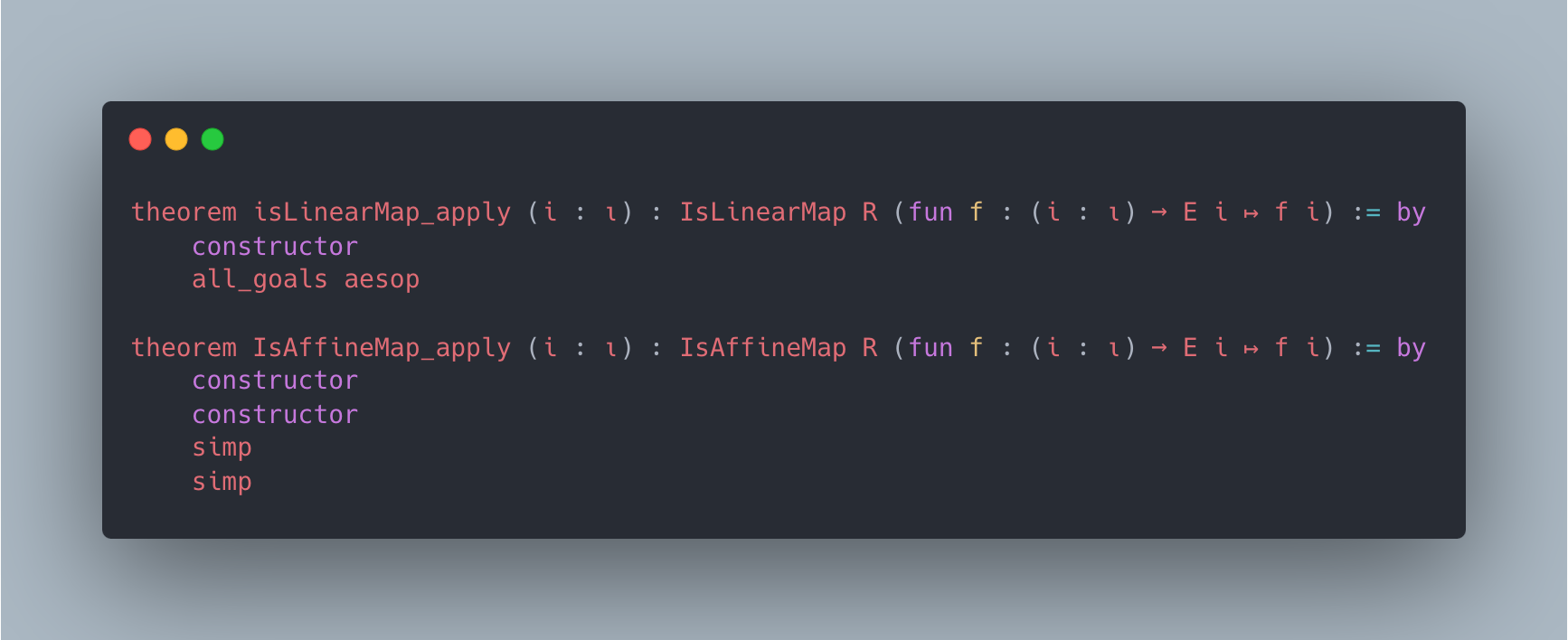
The image is a screenshot of a dark-themed code editor window (resembling a macOS interface with red, yellow, and green window control dots in the top-left corner) displaying two formal mathematical theorem proofs. The text is written in a formal proof language, likely Lean 4 or a similar dependent type theory system, given the syntax and tactic names. The code is presented with syntax highlighting.
### Components/Axes
* **Window Frame:** A dark gray (#2d2d30 approx.) rectangular window with rounded corners, centered on a light gray background.
* **Window Controls:** Three colored circles (red, yellow, green) positioned horizontally in the top-left corner of the window.
* **Code Area:** The main content area of the window, containing two distinct theorem statements and their proofs.
* **Text & Syntax Highlighting:**
* Keywords (`theorem`, `by`, `constructor`, `simp`) are in a salmon/pink color.
* Identifiers and types (`isLinearMap_apply`, `IsLinearMap`, `R`, `fun`, `f`, `E`, `i`, `ι`) are in a light blue/cyan color.
* The proof tactic `aesop` is in a light orange color.
* The symbol `↦` (maps to) is used within the function definition.
* The symbol `→` (function type) is used in the type signature.
### Detailed Analysis
The image contains two complete theorem statements and their proofs.
**Theorem 1 (Top Block):**
* **Statement:** `theorem isLinearMap_apply (i : ι) : IsLinearMap R (fun f : (i : ι) → E i ↦ f i) := by`
* **Proof Tactic:** `constructor`
* **Proof Tactic:** `all_goals aesop`
**Theorem 2 (Bottom Block):**
* **Statement:** `theorem IsAffineMap_apply (i : ι) : IsAffineMap R (fun f : (i : ι) → E i ↦ f i) := by`
* **Proof Tactic:** `constructor`
* **Proof Tactic:** `constructor`
* **Proof Tactic:** `simp`
* **Proof Tactic:** `simp`
### Key Observations
1. **Structural Similarity:** Both theorems have an identical structure in their statement: they are parameterized by an index `i` of type `ι` (iota), and they assert a property (`IsLinearMap` or `IsAffineMap`) over a ring `R` for a specific function. The function in question is `fun f : (i : ι) → E i ↦ f i`, which appears to be the projection or evaluation map that takes a dependent function `f` (from an index `i` to a space `E i`) and returns its value `f i`.
2. **Proof Complexity:** The proof for `IsAffineMap_apply` is slightly more involved, requiring two `constructor` steps and two `simp` (simplification) steps, compared to the single `constructor` and a call to the automated tactic `aesop` for `isLinearMap_apply`.
3. **Language & Notation:** The language uses standard mathematical notation (`→`, `↦`, `ι`) embedded within a programming language syntax. The presence of tactics like `aesop` and `simp` is characteristic of modern interactive theorem provers.
### Interpretation
This screenshot captures a snippet from a formal mathematics library, likely dealing with functional analysis or linear algebra in a dependent type theory setting.
* **What the data demonstrates:** The theorems establish that the evaluation map (which extracts the `i`-th component from a dependent function space `Π i, E i`) is both a linear map and an affine map over a ring `R`. This is a fundamental, expected property in these mathematical structures.
* **How elements relate:** The two proofs are presented together, suggesting they are related lemmas, possibly part of a larger development on properties of dependent product spaces or map classifications. The simpler proof for the linear case might be a prerequisite or a more straightforward result.
* **Notable patterns/anomalies:** There are no anomalies; the proofs follow a logical and expected pattern. The use of `all_goals aesop` in the first proof indicates that after applying `constructor`, all remaining subgoals can be solved automatically by the `aesop` tactic, which is a powerful automated reasoning tool. The second proof requires more manual guidance with repeated `constructor` and `simp` tactics, indicating its goals are less immediately tractable for full automation in this context. The image provides pure factual code; its meaning is derived entirely from the semantics of the formal language it is written in.